
AI agent: architecture, technologies, tools


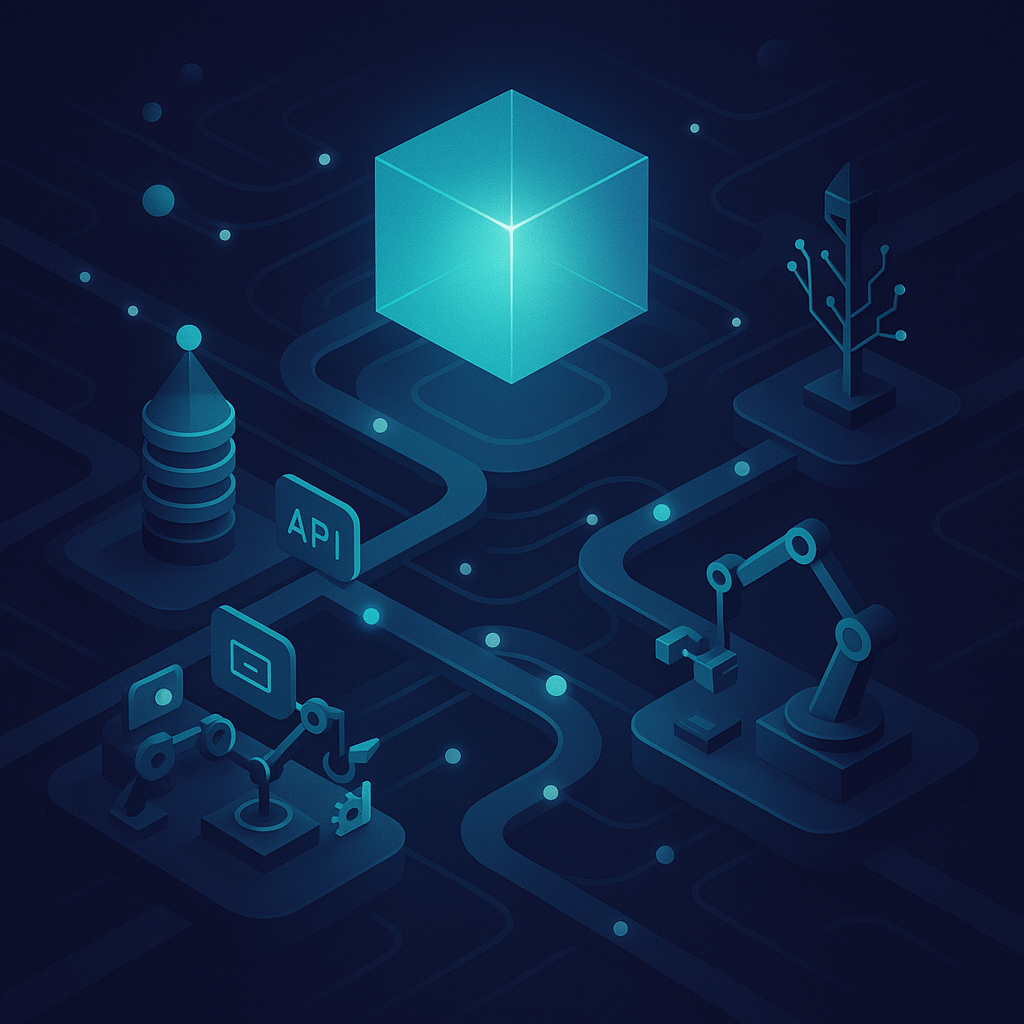
What's under the hood and what tools do developers use?
AI agents have become the central trend of 2024-2025. They are no longer perceived as "smart chatbots", but act as full-fledged performers of tasks: they collect data, process documents, manage APIs, run scripts, aggregate reports, communicate with customers, monitor order statuses.
In order for an agent to work as a live employee, a well—thought-out technical architecture is required. Let's look at what's under the hood and what tools developers use.
Architecture of a modern AI agent
An AI agent is not just one model. This is a bundle of modules, each of which performs its own role.
LLM core (model of thinking)
understanding queries and context,
The reasoning,
Decision-making,
adjusting the task execution strategy.
High—quality systems use not one LLM, but several: one for analysis, another for text generation, and the third for cheap auxiliary tasks.
Tools (tools, actions)
The agent must be able to act. To do this, he is given a set of tools.:
API calls,
database queries,
functions (in the spirit of OpenAI "function calling"),
running scripts,
performing CRUD operations,
browser management,
working with files.
The LLM "decides" which tool to use and forms the call structure.
Memory (Memory)
The agent must remember:
status of the current task,
communication history,
user data,
progress of the execution.
Technically, memory is implemented via:
vector databases (Weaviate, Qdrant, Pinecone),
Redis как short-term memory,
knowledge repository (PostgreSQL/MySQL).
Context (Context Orchestrator)
A module that collects everything the agent needs for reflection.:
recent history,
external documents,
instrument results,
user data.
At this stage, the RAG (Retrieval-Augmented Generation) mechanisms are working.
Planner (Planner / Reasoner)
The following are used here:
chain-of-thought,
tree-of-thought,
agentic workflow,
analytical models (division of roles into “think”/“act").
The Executor (Executor)
The one who really launches:
requests,
Python scripts,
integrations,
SQL,
automation of actions.
Executor provides security (sandboxing), timeouts, and error control.
What technologies do developers use?
The agent's core
DeepSeek R1 / DeepSeek V3
OpenAI GPT-4.1 / GPT-5.1
Anthropic Claude 3.5 Sonnet / Opus
YandexGPT 4 / YaLM 3
Mistral Large / Small
RAG and memory
Qdrant (open-source, actively used in Russia)
Weaviate
Pinecone
Redis Stack for in-memory search
Tool management
OpenAI Function Calling
Mistral Tools
YandexGPT Functions
LangChain Tools
LlamaIndex Agents (including AgentRunner)
Agent Orchestration
LangChain
LlamaIndex
OpenAI Assistants API
FastAPI + Python tools
N8N / Airflow
Browser management and actions
Playwright
Puppeteer
Selenium
With their help, an agent can visit the website, fill out a form, download documents, and check analytics.
Integrations and APIs
REST / GraphQL
gRPC
Webhooks
The company's internal API
How an AI agent is created technically
Step 1. Defining tasks
What actions should an agent be able to do: analyze documents? Process a request to CRM?
Step 2. Collecting tools
The developer creates functions:
getOrders(),
updateLead(),
runSQL(),
sendEmail(),
getAnalytics().
And describes their structure for LLM.
Step 3. Setting up the memory
Being created:
vector base,
database for long-term memory,
the context manager.
Step 4. Model Configuration
Specified:
the model of thinking,
generation model,
temperature conditions,
the size of the context.
Step 5. Create a Scheduler
This is where the agent learns to break down the task into steps.
Optionally, they are connected:
Traces of reflections (CoT),
The plan tree,
interim reports.
Step 6. Integration and Testing
The agent connects to real systems:
CRM,
ERP,
Telegram bots,
databases,
the internal API.
It is then tested on real-world scenarios.
Ready-made platforms for creating AI agents
If you don't want to write your own framework, there are ready-made solutions.
Platforms for business
OpenAI Assistants
Anthropic Workflows (2025)
YandexGPT Agents
Mistral Agents
DeepSeek Agents Framework (beta)
Tools for developers
LangChain
LlamaIndex
FastAPI / Django / Laravel + LLM SDK
Airflow / Temporal / N8N
Dify.ai (no-code + ability to write custom functions)
Flowise / LangFlow
The main technical principles by which the agent works
The LLM makes decisions.
The tools give the agent hands.
Memory provides a long-term context.
RAG provides access to knowledge outside of LLM.
The orchestrator manages the steps and coordinates the instruments.
The Executor does the real work.
Security is a mandatory layer (limits, sandbox, logging).
The Future of AI Agents: 2025-2026
We will see growth in the coming years.:
manage complex processes
multimodal agents (text + voice + video + actions);
corporate systems that take control of entire blocks of business operations: finance, sales, logistics;
self-improving-adents are systems that learn from their own mistakes and improve themselves without a developer.
Agents will no longer be a toy. They will become part of the company's IT infrastructure, such as APIs, servers, and ERP.
 Автор
Антон Амосов
Автор
Антон Амосов


