An AI that knows everything about your company: access to the knowledge base and practical application


Content:
- What is AI with access to the company's knowledge base?
- Why does a business need it?
- How does such a system work?
- Where it brings maximum benefit
- Benefits and risks of implementation
- How to prepare a corporate knowledge base
- The stages of implementation in the company
- Practice, metrics, and expected effect
- Conclusion
What is AI with access to the company's knowledge base?
AI with access to the company's knowledge base is an intelligent system that can find, interpret, and formulate answers based on the organization's internal documents. Unlike a regular chatbot, which responds according to pre-written scenarios, such an assistant works with real corporate materials: regulations, instructions, FAQ database, contracts, product descriptions, security policies, technical documentation and accumulated support cases.
It is access to an up-to-date knowledge base that transforms AI from an "interesting technology" into a working business tool.
It is especially important that this approach helps to reduce dependence on individual experts within the company. When knowledge is distributed across people, emails, and folders, business loses speed. When knowledge is collected, structured and accessible through an AI interface, the company receives a single digital layer of competencies that works around the clock and scales without proportional staff growth.
Previously, an employee had to search for an answer in five documents and two correspondence, but now he can receive it in one request — in an understandable and applicable form.
Why does a business need it?
The main reason for implementing such solutions is to increase the speed of decision—making and reduce the operational load. In most companies, a huge amount of knowledge already exists, but it is used in fragments. Employees spend time searching for information, ask repetitive questions to colleagues, and make mistakes due to outdated versions of documents. An AI assistant with access to the corporate knowledge base eliminates these losses and makes access to information almost instantaneous.
30–70%20–50%
There is also a less obvious but very important benefit — standardization of communications. When employees respond "from memory," clients and colleagues receive different interpretations of the same rule. AI, based on approved sources, helps to even out the quality of responses. This is especially valuable in areas where precision of wording and compliance with procedures are critical: finance, medicine, law, IT, logistics, manufacturing.
- For managers
- For employees
- For clients
How does such a system work?
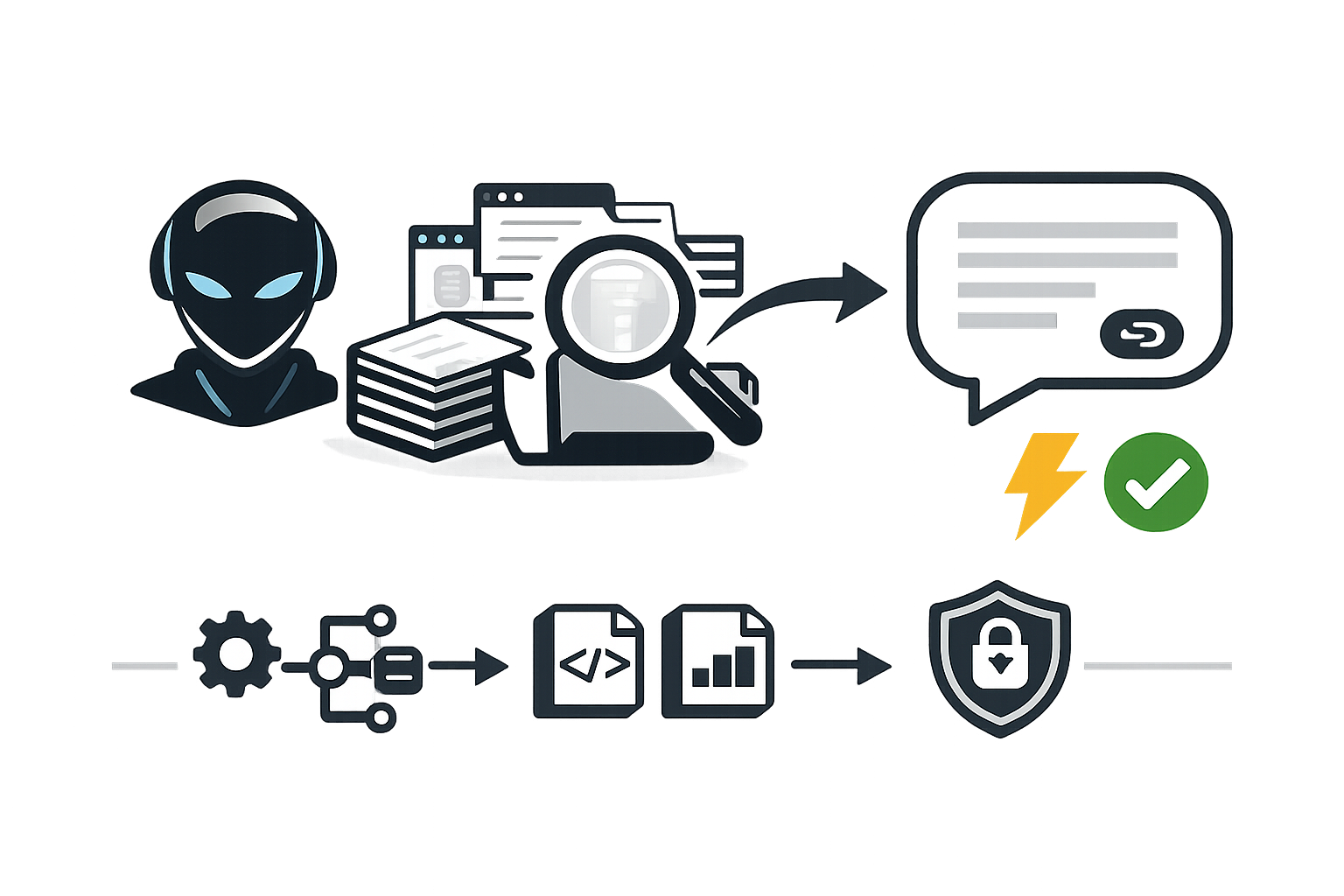
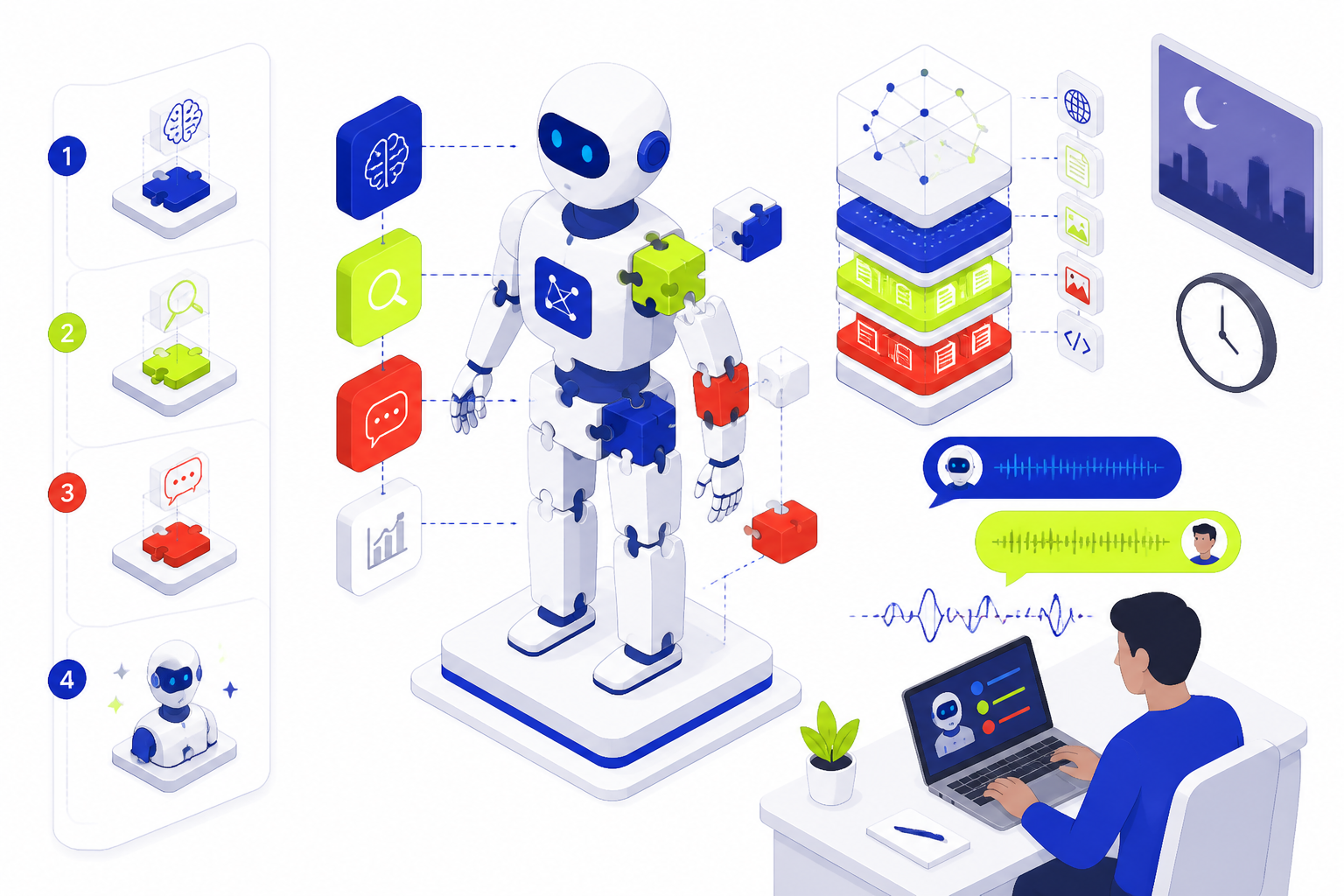
The solution is usually based on a bundle of several components. The first is a repository of knowledge: documents, databases, wiki, CRM, helpdesk, and file directories. The second is an indexing mechanism that prepares materials for quick search. The third is a language model that can understand the question and formulate an answer. The fourth is the access control level, so that each user sees only the information to which they have rights.
RAG
Additionally, dictionaries of terms, response templates, source priority, citation rules, and query logs can be used. Thanks to this, the AI system becomes not just a search engine, but a managed corporate knowledge environment. The better the sources, access roles, and content update logic are configured, the more reliable the solution works in everyday tasks.
The key principle is simple:
Where it brings maximum benefit
One of the most obvious applications is internal employee support. HR teams use AI to answer questions about vacation rules, adaptations, benefits, and internal procedures. IT services - for typical requests for access, system configuration, and service operation. Legal departments are used for initial navigation through document templates, policies, and approval requirements.
No less promising is the external application. If you connect AI to a proven customer knowledge base, it can help in sales and service: find answers to questions about the product, explain the terms, clarify the specifics of tariffs, collect requests, and provide instructions. With the right architecture, the client receives fast service, and employees connect only to complex or non-standard cases.
Sales and presale should be highlighted separately. When a manager negotiates, it is important for him to quickly find specifications, cases, answers to objections and acceptable commercial formulations. The AI assistant reduces the time needed to prepare for a meeting and improves the quality of argumentation. This affects not only the comfort of the team, but also the conversion into deals.
AI makes the most sense where there are many questions, information is complex, and the cost of error is higher than the cost of automation.
Benefits and risks of implementation
The benefits are usually visible quickly. The company gets an acceleration of internal processes, a reduction in the number of repetitive requests, an increase in the uniformity of responses and a reduction in dependence on specific specialists. In the medium term, an important effect is emerging: knowledge ceases to be a chaotic archive and turns into a manageable asset.
However, such projects have risks. The first is the quality of the sources. If the knowledge base is outdated, contradictory, or poorly structured, AI will broadcast the same problems. The second is security. The system must not be allowed to disclose confidential data to unauthorized users. The third is business expectations. Often, magic is expected from AI, although in fact the result depends on the architecture, data, and maintenance discipline.
There is also a risk of overestimating "autonomy". Even a very strong system must work within a given framework: know when to respond, when to request clarification, and when to escalate a question to a person. The best projects are based not on the idea of a complete replacement of employees, but on a competent redistribution of routine workload.
- The main benefit:
- The main risk:
- The main condition for success:
How to prepare a corporate knowledge base
Before implementing AI, it is important to review existing materials. At this stage, companies often find that documents are duplicated, instructions differ by version, and critical knowledge is generally stored in employees' personal chats. Therefore, the first step is not choosing a model, but putting the sources in order.
A good knowledge base must meet several requirements: be relevant, structured, logically broken down by topic, and provided with content owners. If there is no person responsible for the section, it quickly becomes obsolete. If there are no naming and updating rules, the search starts to produce contradictory results. This is especially sensitive for AI because it builds responses based on what it has been given.
It is practically useful to divide materials into several levels: regulatory documents, work instructions, reference articles, case studies, templates, and an archive. Then it's worth determining which sources have priority. For example, the approved regulations are higher than the old presentation, and the current contract is more important than the notes from the internal chat. This hierarchy increases the accuracy of responses and reduces the likelihood of controversial interpretations.
Preparing a knowledge base is not a boring preliminary job, but half of the success of the entire project.
The stages of implementation in the company
The rational path of implementation begins with the pilot. You should not try to connect all departments and all types of documents at once. It is better to choose one understandable scenario: for example, internal HR issues, technical support for employees, or a product database for the sales department. Such a pilot allows you to test a hypothesis on a limited amount of data, measure the effect and understand where the system is wrong.
The next step is to configure roles, sources, and response scripts. It is necessary to determine who has access to which documents, which formulations are acceptable, which answers should be accompanied by a link to the source, and which ones should be accompanied by a mandatory escalation to the employee. After that, it is important to organize testing on real queries.: not only "ideal" ones, but also ambiguous, incomplete, and colloquial ones.
After the pilot, scaling begins. Here it is useful for a company to move in stages: to connect new departments, expand the set of documents, set up analytics, and train employees to use the system. Without internal communication, even a good solution may remain undervalued. People need to understand why it was created, in which cases it can be trusted, and how to report errors.
4 to 12 weeks
Practice, metrics, and expected effect
It is necessary to evaluate such a project not by feeling "it has become more convenient", but by metrics. First of all, they look at the response rate, the proportion of requests resolved without human intervention, the accuracy of the information found, the frequency of escalations, and user satisfaction. The cost of processing the request is also important for the support service. For sales, it affects the speed of response preparation and the quality of communication. For HR, it reduces the number of recurring questions.
Suppose a company with 300 employees has about 2,000 typical internal requests per month. If the average time per request is 8 minutes, that's more than 260 hours of work per month. Even reducing this time by 40% frees up over 100 hours. In terms of the working time fund, this is already a noticeable organizational and financial effect, especially when it comes to qualified specialists.
From practice, a simple conclusion can be drawn: AI pays off especially well in an environment where knowledge is often reused. Where each response has to be collected manually, where there are many standard instructions and the high cost of error, technology provides not only savings, but also an increase in the quality of service. At the same time, companies that view AI not as a fashionable interface, but as part of a managed knowledge architecture, get the maximum result.
The most mature approach is to measure not "how well the system responds," but "how much faster and more accurately the business operates after its implementation."
Conclusion
AI with access to the company's knowledge base is not just a chat with a beautiful interface, but a new way to organize access to corporate expertise. It helps employees find answers faster, reduces the burden on support teams, standardizes communication, and makes knowledge a real asset rather than a dead archive of documents.
But technology benefits only when it relies on high-quality data, clear access rules, and a lively content update process. Where the knowledge base is chaotic, AI only accelerates chaos. Where knowledge is put in order, it becomes a quiet but powerful business efficiency booster.
For companies that are already facing employee overload, repetitive questions, and slow information retrieval, this solution has ceased to be an experiment. It becomes the logical next step in the development of a digital environment where knowledge is available not by acquaintance or memory, but on request — quickly, accurately and in the right context.


Related articles
Top 10 platforms for building AI agents: what's inside each service
A chatbot in simple words: what is it and what is it for?
Terms of reference for an AI agent: template, structure and examples of formulations
AI Agent Constructor: what is really possible to assemble without a programmer and where is the code needed?

GPT-6 Astra: a breakthrough to AGI or thoughtful marketing?