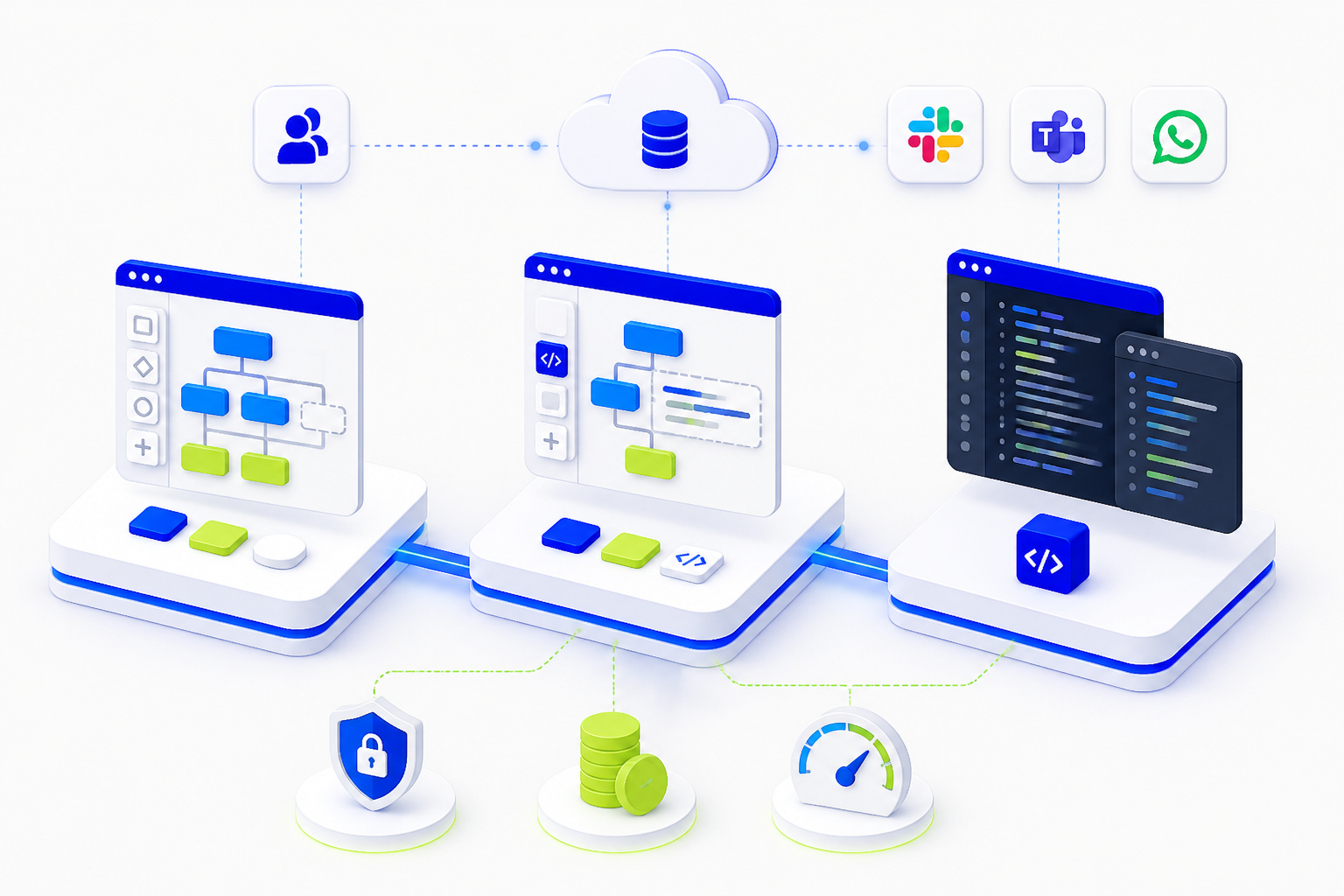
Automation using Telegram bots


Content
Introduction
Telegram has long ceased to be just a messenger for personal communication. For businesses, it has become a channel where the client and the company already "speak the same language": quickly, without unnecessary interface and logins, on familiar screens. Automation using Telegram bots turns such dialogues into manageable processes - from accepting applications and consultations to bookings, repeat sales and support. In a B2B environment, it is especially important that content and solutions are not "noise", but provide verifiable benefits: clear scenarios, confirmed figures, and transparent implementation steps. This kind of practicality is the core of an effective content approach in B2B: first the value and evidence, then the choice of a tool.
Dictionary of Terms
Telegram bot
Webhook
CAPEX / OPEX
CRM
KPI
AHT (Average Handle Time)
CSAT
NPS
GDPR / 152-FZ
Why automate processes in Telegram
When does it "hurt" most often? Slow responses from managers during peak hours, confusion in the same type of questions, loss of requests between channels, manual duplication of chat data in CRM/1C, lack of transparent analytics, call center costs for simple questions. The bot removes this layer of routine: it accepts a request, classifies, clarifies, verifies conditions, reserves a slot or product, transmits it to accounting systems, notifies the client and the team, and collects feedback. And all this is where your client is already located.
Typical automation scenarios
Operational processes.
Sales and marketing.
Support and service.
Internal processes.
Solution Architecture
It is based on the bot itself (dialog logic), an integration layer (REST/Webhook for CRM, 1C, billing, payment providers), a database (dialog status, directories, logs), and an admin panel for content, rights, and monitoring. Security — HTTPS, Webhook signature verification, secrets in storage, role-based access. Fault tolerance — task queues, delays, idempotence, event log. Horizontal scalability for handlers and queues; caching of dictionaries/directories; limitation of "noisy" integrations through buffers.
Data and analytics: what to collect and how to measure
It is useful to track the user's path: input source → dialog node → conversion action (request, payment, booking). System metrics: response time, the proportion of automatic request resolution, the proportion of escalations, integration errors. Business metrics: conversion to payment, average receipt/GMV, repeat purchases, conversion cost, operator time savings (AHT), CSAT/NPS. Raw logs (anonymized) help to find "bottlenecks" in scripts.
Project economics and payback calculation (ROI)
Formula:
ROI = (Effect – Cost) / Cost × 100%
KING ≈ (96 000 – 45 000)/45 000 ≈ 113%
Implementation methodology: from pilot to scale
diagnosticsKPI of the pilotMVP pilotaccounting integrationadmin paneliterating over the data
Risks, safety, and compliance
Keep exactly as much personal data as is necessary for the service; ask for explicit consent; provide a clear offer/policy. Divide accesses by roles and log actions. Encrypt sensitive fields "on disk", rotate the keys. Keep in mind the messenger's features: by default, bot messages are not encrypted as "secret chats", so it is better to transfer critical data via secure forms with one-time links. Plan for degradation: if integration with CRM is not available, the bot accepts the request in the queue and notifies the operator.
Common implementation errors and how to avoid them
Immediately "do everything".
The absence of an admin panel.
There is no analytics.
Compulsive selling.
Short case studies
Retail and shipping.
A service company (B2B).
Online education.
Project preparation checklist
Formulate the "pain" and the target metric (for example: reduce AHT by 30%, increase repeat purchases by 10%).
Choose 1-2 scenarios for the pilot, where it is easy to prove the effect.
Describe the integration: what we read/write in CRM, 1C, payment, mailing lists.
Resolve the issue with the data: policy, consents, retention periods, roles.
Schedule the admin panel and analytics events.
Set a rhythm for improvements: weekly metrics review → script edits.
Results
Automation in Telegram is not about "fashion", but about mature management of communication and operations where it is already convenient for the client. The secret of success lies in discipline: a well—chosen scenario, transparent metrics, careful integration and respect for the user. Then the bot ceases to be "another channel" and becomes part of a business process that is measurable, scaled, and predictably delivers results.


Related articles
The cost of developing Telegram bots in Russia in 2025

AI agent or chatbot: how to choose a business automation tool

Automation of accounting with AI: maintaining control over data
Automation of incoming calls: IVR, voice robots and AI agents for business

Support officer or AI: Who really solves customer requests?