What is the MCP protocol?


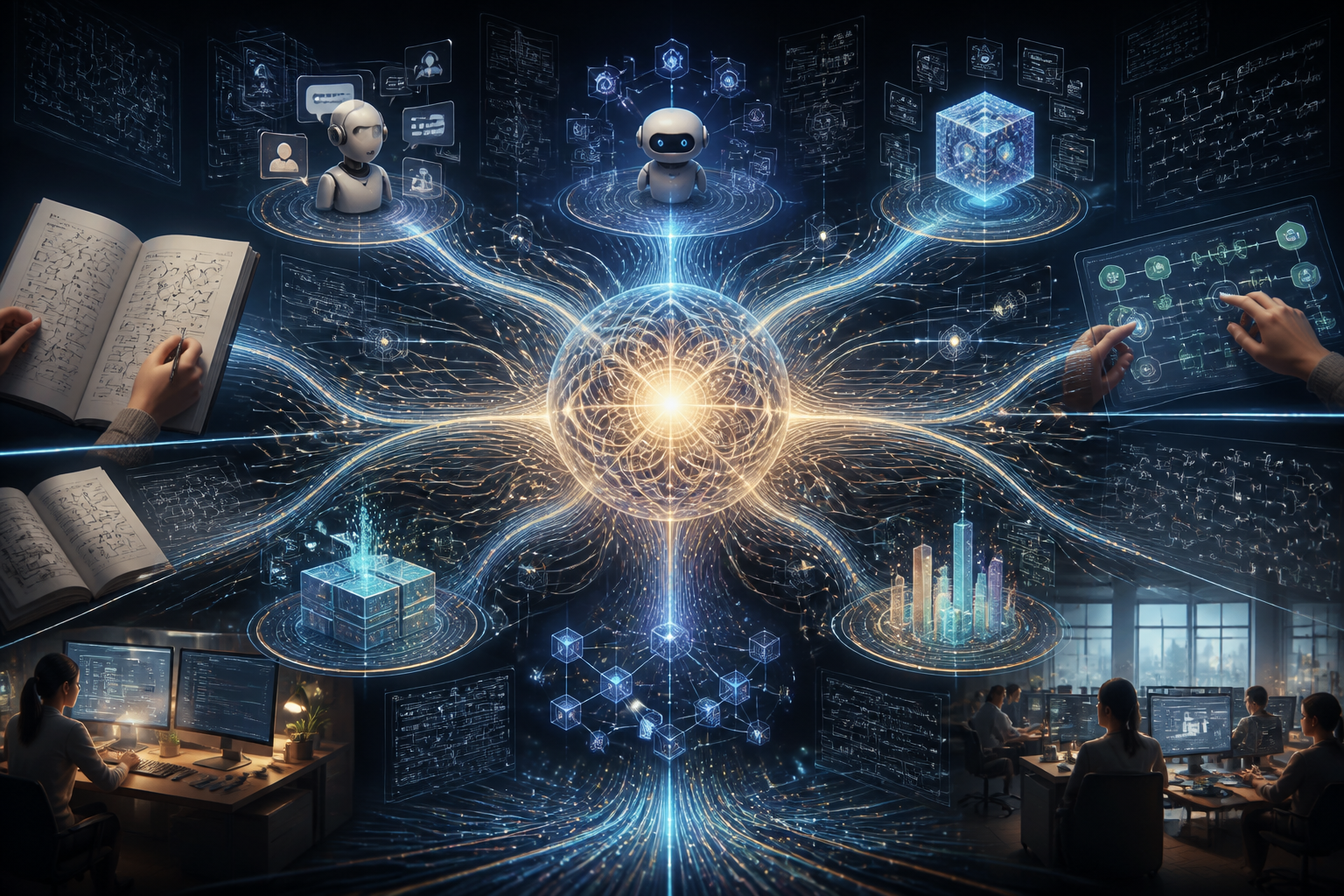
In recent years, large language models have stopped being just a tool for text generation. They are increasingly becoming the core of complex systems: corporate assistants, intelligent agent platforms, RAG solutions, and AI services embedded in business processes. And the wider the range of tasks becomes, the more clearly the fundamental problem becomes apparent — models live in isolation from the real world and each time require a unique "bridge" to data, tools and services.
It is at this point that the MCP — Model Context Protocol appears. It can be viewed not as another add-on to LLM, but as an attempt to rethink the very way models interact with the external context.
From integration chaos to protocol
Before the advent of MCP, connecting the model to the data looked chaotic. Each project created its own layer: somewhere it was a set of REST endpoints, somewhere it was a custom SDK, somewhere it was plug-ins or hardcoded functions. As a result, the model turned out to be tied to a specific implementation, and the architecture became fragile. Any API change, model change, or an increase in the number of tools led to avalanche-like code edits.
howwhathow
What is an MCP really like?
The Model Context Protocol is an open protocol that describes a single format for interaction between LLM and the outside world. It defines the language in which the model "talks" to systems: databases, file storages, business services, APIs, and internal company tools.
More broadly, MCP plays the same role that HTTP once played for the web. It does not dictate the implementation, does not impose a programming language, or restrict logic, but sets clear rules for sharing context and actions.
How the role of the model is changing
With the advent of MCP, the model ceases to be "hardwired" into the business logic code. It becomes a reasoning center that analyzes a task, selects available opportunities, and initiates actions without going into the details of their implementation. All application logic, data access, and restrictions are concentrated on the side of the MCP servers.
This is a fundamental shift: the model is no longer a place where integration lives. Integration becomes an infrastructure layer.
MCP server as a point of responsibility
The MCP server is a component that describes which tools and resources are available to the model. It formalizes the functions that can be called, the data that can be read, and the context within which the model should operate. At the same time, the server can be implemented in any language and run on top of any technology, from REST APIs to internal queues and legacy systems.
For businesses, this means the emergence of a single point of control. Instead of constraining the model at the level of promptes and heuristics, constraints are set at the protocol level. This simplifies security, auditing, scaling, and maintenance.
Why is MCP especially important for agent-based systems
AI agents, by their very nature, involve autonomy, planning, and interaction with a variety of tools. Without a standard, each new feature complicates the agent and increases the connectivity of the system. MCP solves this problem by turning the agent into a modular design where new abilities are connected as external components.
In such an architecture, an agent can evolve over the years without losing stability. Models are changing, new data sources are emerging, and business processes are being added, but the basic contract remains unchanged.
MCP and the future of RAG architectures
The RAG approach has been developing for a long time as a set of engineering techniques: embeddings, retrieval, chunking, prompt engineering. MCP allows you to bring these mechanisms to the infrastructure level. The knowledge repository becomes a resource, the search becomes a tool, and the strategy of working with the context becomes part of the agent's logic.
This opens the way to more complex scenarios.: multi-source search, iterative refinement, multi-agent research, and adaptive knowledge extraction strategies.
Why MCP is a step into the future, not a temporary solution
The main value of MCP is not in the specific capabilities, but in the approach itself. It forms an ecosystem where models, tools, and data evolve independently of each other. This reduces technical debt, speeds up development, and makes AI solutions predictable in the long run.
As AI becomes more deeply integrated into business and infrastructure, such protocols are becoming not a luxury, but a necessity. MCP is one of the first steps towards a mature, industrial architecture of AI systems.
Result
MCP is not just a protocol, but an architectural philosophy. It moves AI from the mode of experimental integrations to the mode of systemic, controlled development. For teams that are already building AI platforms, agent systems, or corporate assistants, understanding MCP is a foundation not for months, but for years ahead.
 Автор
Anton Amosov
Автор
Anton Amosov


Related articles
Fine-tuning LLM: how to turn a model into a business partner
MCP servers in the company: how to accelerate AI adoption, maintain security, and reduce costs
When AI makes code more expensive: Why generation makes maintenance more expensive
From Machine Optimization to Token Optimization: How AI Agents are Changing Development

AI Development: from fundamentals to business solutions and implementation