
ERP systems in Russia: what is it, how it works, how much it costs, and what trends are shaping the market in 2025-2026


Content
Introduction
Modern business is faced with the need to manage a growing volume of data: financial, logistical, production, personnel. This data becomes the basis for decision-making, but only if it is transparent, accurate, and accessible. ERP systems allow you to create such an environment, turning a company into a managed digital structure.
The essence and purpose of ERP systems
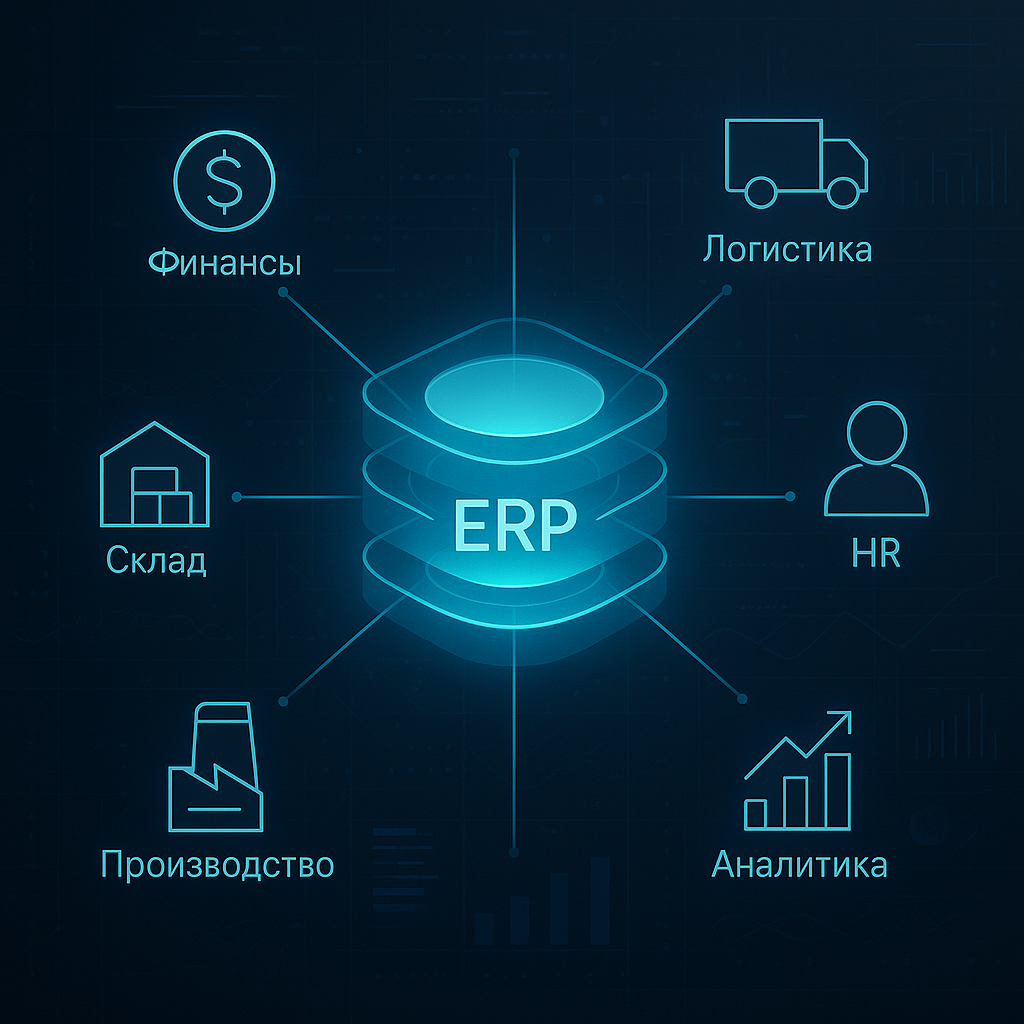
ERP (Enterprise Resource Planning) is an enterprise resource planning system. It integrates processes in a single digital space, allows data synchronization, eliminates fragmentation and creates the basis for management control.
The main goal of ERP is to ensure the integrity of processes by linking financial, production, logistics and personnel circuits.
Why do companies come to the need to implement
In the early stages of a business, data can be stored in simple tables and used in separate services. But as they grow, difficulties arise: out of sync, errors, lack of up-to-date information, and a decrease in the speed of decision-making.
ERP solves these problems systematically, forming a single information field. All data becomes connected and accessible, and processes are transparent and predictable.
The main functional blocks of ERP
Financial contour
Management accounting, budgets, payments, reporting, and financial analytics.
Sales and purchases
Orchestration of all stages from the application to the actual provision of resources to the enterprise.
Warehouse and logistics
Balance control, movement of goods, inventory, delivery.
Production module
Planning, resource allocation, and control of production stages.
Personnel management
Employee accounting, schedules, timesheets, and performance metrics.
CRM subsystem
Managing customer relationships, communication history, and transactions.
The difference between ERP and CRM
Types of ERP solutions
Boxed ERP
Ready-made solutions with a fixed process structure. They are suitable for large companies with a well-established business model.
Cloud ERP
Fast start, no infrastructure costs, easy scaling. They are optimal for small and medium-sized businesses.
Custom ERP systems
An individual system customized to the real processes of the enterprise. It provides flexibility, accurate reflection of operations and the possibility of long-term development.
Custom ERP: needs, architecture, and benefits
Why are custom ERP systems becoming in demand?
Russian companies often operate in unique conditions: complex logistics, atypical production, high variability of processes. Typical ERP systems are not always able to correctly reflect such models.
Custom ERP allows you to adapt the system to the real needs of the enterprise, and not vice versa.
The stages of creating a custom ERP
Process audit
A map of the enterprise is formed, dependencies and control points are recorded.
Architecture design
Modules, connections, user roles, data sources, and integrations are defined.
MVP contour
Launching the key modules needed to get started.
Scaling
Gradual development of the system: new modules, advanced analytics, AI tools.
Advantages of custom ERP
exact compliance with the business model;
reducing internal errors;
flexible analytics;
the ability to integrate AI, ML, RPA and workflow automation;
long-term adaptability to the company's growth.
Custom ERP creates a unique competitive advantage by turning operational processes into a managed architecture.
The practical value of ERP for managers and employees
The head receives transparency of processes, the ability to predict, control costs and efficiency of departments.
Employees work in a single environment where data duplication, errors, and uncertainty are eliminated.
ERP increases work speed, reduces operational barriers, and creates a data-driven management culture.
ERP market in Russia in 2025-2026: analytics and key trends
Transition to cloud and hybrid ERP
Companies strive to reduce capital costs and accelerate implementation by choosing SaaS models and mixed architectures.
ERP Intellectualization
AI, machine learning, and automation of routine operations are becoming part of the standard ERP functionality.
Increased customization
Industry-specific and customized solutions are increasingly replacing standard platforms — business requires accurate reflection of processes.
Strengthening security requirements
There is a growing demand for domestic ERP systems that ensure data localization and compliance with regulatory requirements.
BI, data-driven analytics and management
ERP is becoming a strategic planning tool, not just an accounting system.
SME segment Expansion
ERP is becoming available to small and medium-sized businesses through modularity and step-by-step implementation.
How much does ERP cost in 2025-2026 in Russia
The cost of ERP in Russia depends on the scale of the enterprise, the complexity of the processes, the number of modules and integrations.
Average cost ranges
Small business
150 000–900 000 ₽
Medium-sized businesses
900 000–6 000 000 ₽
Large enterprises
6,000,000 - 50,000,000 ₽ and above
The price includes design, implementation, training and support.
Factors influencing the price
degree of customization;
number of modules;
number of integrations;
the structure of rights and users;
Safety requirements;
the need for on-premise infrastructure;
availability of AI modules.
The cost of boxed ERP
small business: 150,000-800,000 ₽;
Medium business: 1,000,000-4,000,000;
large companies: 6,000,000-15,000,000 ₽.
Business-specific improvements increase the budget by 30-70%.
The cost of custom ERP
small business: 400 000–1 500 000 ₽;
Medium business: 1,500,000-8,000,000;
large projects: 8,000,000 - 50,000,000 ₽.
AI modules increase the cost by 25-40%, but accelerate payback.
ERP Support
Final conclusions
ERP is not just a software tool, but the digital foundation of an enterprise. It integrates processes, makes them transparent, increases efficiency, and creates the conditions for scaling.
The Russian market in 2025-2026 shows an increase in customization, intellectualization, a transition to data-based management and increased security requirements.
ERP has become a central element of the digital infrastructure of companies that strive for sustainable development and competitive advantages.
 Автор
Антон Амосов
Автор
Антон Амосов


