SaaS MVP in 21 days: is it really possible to launch and not fail?


Content:
- What is a SaaS MVP and why are there so many expectations around it?
- Why does a 21-day deadline seem both real and dangerous?
- In which cases is it really possible to launch an MVP in 21 days?
- What most often prevents you from meeting three weeks
- What should be the minimum MVP composition in order not to disrupt the launch?
- Practical work plan for 21 days
- Team, budget and tools: what the deadlines can't stand without
- Typical mistakes of founders during a fast startup
- How to understand that the MVP is ready, even if you want to finish more
- Bottom line: is it really possible to make a SaaS MVP in 21 days
What is a SaaS MVP and why are there so many expectations around it?
MVPSaaS
a working minimal business tool
Why is the 21-day launch theme so popular? Because the market requires speed. The founder doesn't want to invest six months in a hypothesis that might not take off. The investor wants to see a confirmation of demand, and the team wants a quick feedback loop. In this sense, the three—week deadline is not just an ambition, but an attempt to shorten the path from an idea to the first real contact with the market.
does the user even need it or not
Why does a 21-day deadline seem both real and dangerous?
On the one hand, 21 days is quite a working horizon for a disciplined team. This is enough to describe the hypothesis, assemble the interface, configure the basic architecture, enable payments or at least an application form, conduct several test launches and show the product to the first audience. Especially if the task is narrow, and the team has already worked together and does not waste time on lengthy approvals.
On the other hand, the same deadline becomes a trap when they try to fit not an MVP, but a full-fledged product of the first version into it. As soon as user roles, complex billing logic, integrations, flexible settings, mobile adaptation "for all occasions" and a carefully polished interface are added to the project, three weeks evaporate. Often not because developers are working slowly, but because the goal is formulated incorrectly.
The danger of a short term is also in the psychological effect. The founder begins to think in terms of a marathon: "we must make it at any cost." As a result, decisions are made that harm the product for a long time: architecture limitations are ignored, user scenarios are not prescribed, analytics are not implemented, and testing becomes a formality. A quick start is useful. Rapid chaos is no longer there.
what exactly do we consider MVP and what compromises are acceptable without losing the essence of the product
In which cases is it really possible to launch an MVP in 21 days?
one central pain
Secondly, the team should already have an understanding of the audience. If in the first few days you are just starting to figure out who your client is, what they are willing to pay for, and what they are using now, it will take 21 days not to launch, but to fog up. MVP can be done quickly only when the hypothesis is specific enough: there is a segment, there is pain, there is a proposed solution and there is a way to show the result.
Thirdly, a lot depends on the technological approach. If you use ready-made components, a template infrastructure, cloud services, and a proven stack, the speed increases dramatically. The team does not reinvent basic things, but builds the product as an engineering system from understandable blocks. In real cases, this is exactly what allows you to launch SaaS in 2-4 weeks.
For example, a small B2B service for processing leads can be tested if the first version has only three roles: manager, supervisor and administrator; simple data import; one panel with filters; report export. Such a product does not look "big", but it can already bring the first interviews, the first registrations, and even the first payments.
What most often prevents you from meeting three weeks
The main enemy of a short launch is the spread of requirements. At the beginning, they discuss a "simple system", and after a few days additional screens appear, notifications in Telegram, integration with CRM, smart filters, a history of changes and a "small" analytics module. Each individual wish seems reasonable, but in total they turn the MVP into a multi-month development.
The second factor is the lack of solutions at the entrance. If the founder cannot quickly approve the priorities, interface texts, basic mechanics, and limitations of the first version, the team gets stuck in micro-negotiations. In short projects, the cost of procrastination is especially high: one lost day at the start easily turns into three lost days at the end.
The third problem is the underestimation of invisible work. It seems to the user that the service "consists of a couple of screens," but behind them are the data model, security, error handling, role system, emails, logging, and backup scripts. When these things are not taken into account, the plan collapses not because of the main function, but because of the auxiliary, but obligatory layers.
- An obscure hypothesis.
- The functionality is too wide.
- Poor decision discipline.
- Lack of daily synchronization.
That is why the failure of the deadline is usually associated not with the "21 days" figure itself, but with the fact that the project was not originally designed for a fast cycle.
What should be the minimum MVP composition in order not to disrupt the launch?
A good minimum composition is when everything superfluous is removed from the product, but the main scenario is preserved. The user must be able to register, perform one key action, and get the result they came for. Anything that doesn't help you get through this process should either be postponed or replaced with a simpler solution.
For SaaS, MVP most often includes: registration, one main desktop, basic data storage, profile settings, notification of critical events, and simple behavior analytics. It is not necessary to implement complex payment immediately. In the first iterations, you can check your interest through an application, test access, or manual subscription activation. This reduces the difficulty and keeps up the pace.
It's important to understand the difference between "minimal" and "sloppy." If a product breaks down, is unclear in use, or does not allow the script to be completed, this is no longer an MVP, but a technical blank. The user has no obligation to guess that you are "still in development". Even a minimal version should create a sense of completeness within one specific task.
One strong promise
Practical work plan for 21 days
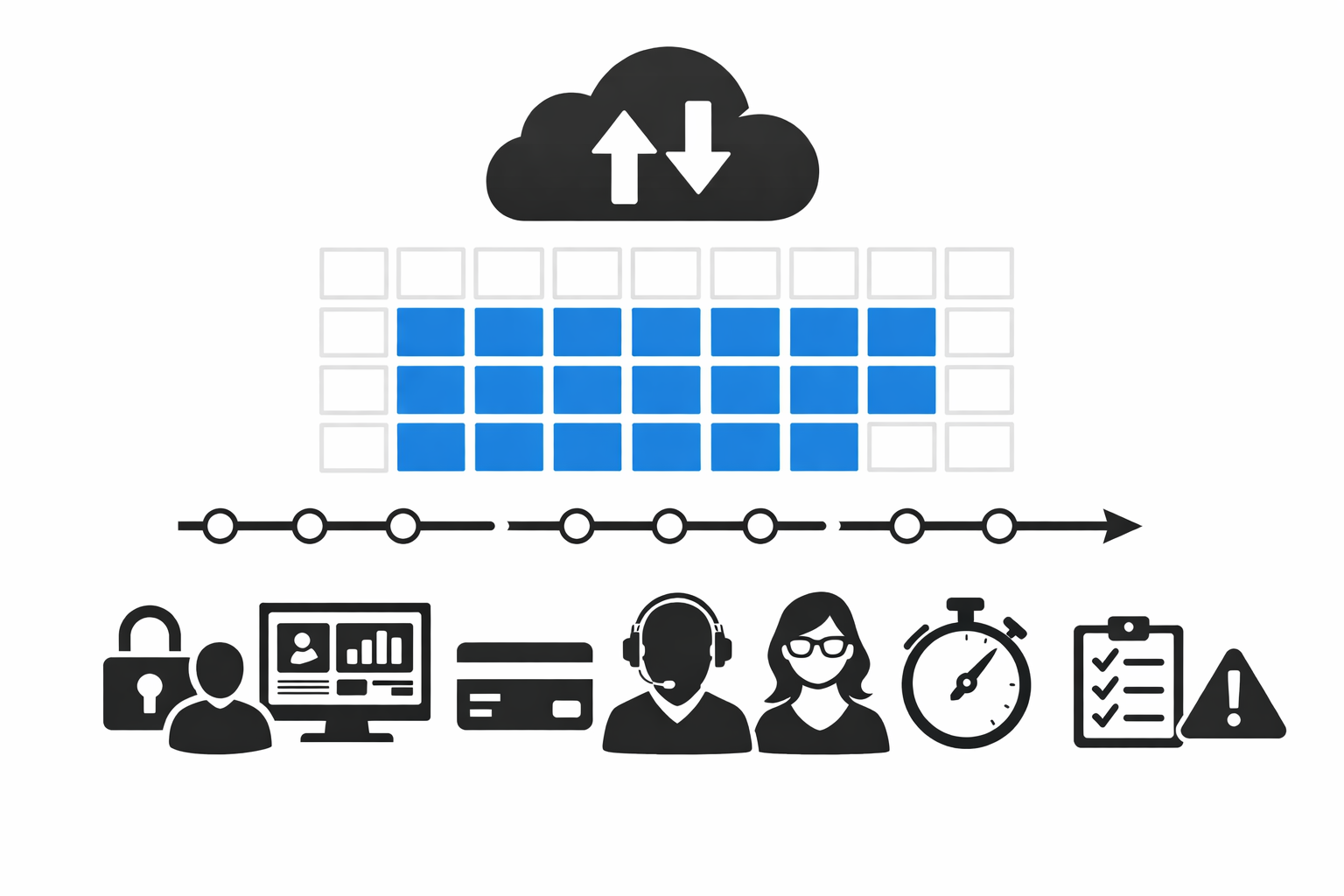
In order for the deadline not to remain a beautiful figure, it needs to be turned into a specific rhythm. The first week is not so much about the code as about the accuracy of the wording. The team captures the target audience, one main scenario, function limitations, and readiness criteria. During the same period, prototypes are created, the user's path is agreed upon, and decisions are made that cannot be endlessly reviewed later.
The second week is the core of the development. This is where the main screens, business logic, database, user roles, and administrative minimum are collected. It is important not to spray on jewelry. If some element does not affect the demonstration of value, it must wait for the next iteration. In parallel, it is worth connecting analytics: without it, the launch turns into fortune-telling.
The third week is not about "finishing everything in a row," but about purposeful refinement. The team tests critical scenarios, corrects blocking errors, prepares a landing page or presentation, gathers the first users and sets up a feedback channel. A good quick launch is always a combination of a product and the mechanics of communicating with the market.
- Days 1-3:
- Days 4-6:
- Days 7-14:
- Days 15-18:
- Days 19-21:
without this, will the MVP stop testing the hypothesis?
Team, budget and tools: what the deadlines can't stand without
Launching in 21 days is almost impossible alone, if we are talking about a full-fledged SaaS, even in a minimal version. Yes, a solo founder can build a product on no-code or low-code platforms, but as soon as non-standard logic, integration, or scaling requirements appear, at least a small but assembled team is needed. Most often, this is a product leader, developer, short-term designer, and a person who is responsible for testing or script control.
In terms of budget, a lot depends on the approach. If you build MVP on ready-made services, the start can be relatively affordable. But skimping on architecture, clear UX— and the quality of key scenarios is a bad idea. The user forgives the lack of ten functions, but rarely forgives the feeling that the service cannot be trusted. For SaaS, trust is almost a currency.
On the side of tools, those teams that don't unnecessarily complicate the stack win. Ready-made authorization, cloud database, template UI kit, email services, error monitoring, simple analytics — all this saves days. A fast MVP is born not out of heroism, but out of mature limitations. The team agrees in advance: we use reliable ready-made solutions where it does not interfere with the product value.
In projects for the B2B segment, this model often works: in the first 21 days, a working version is made, then another 2-4 weeks are spent adapting to real customer comments. That is, the quick launch itself is not the finish, but the entry point into the normal product development cycle.
Typical mistakes of founders at a fast startup
One of the most common mistakes is trying to prove your own expertise to the market with the number of functions. It seems that the more features there are in the first version, the more serious the product looks. In fact, the opposite happens: the team is dispersed, the interface becomes heavier, the deadline shifts, and the user still does not understand what the main advantage of the service is.
The second mistake is to confuse speed with lack of preparation. Some founders believe that if the goal is an MVP, then you can do without interviews, without describing scenarios, and without clear criteria for success. But a fast startup requires not less, but more precise thinking. You can't afford to "look for yourself" for a month inside a three-week plan.
The third mistake is not to communicate with the market until the development is completed. Sometimes a team builds first, then polishes, then refines a little more, and only then shows the product to people. As a result, even a fast MVP starts blindly. The model works much more strongly when future users are involved in advance: they confirm the pain, evaluate the prototype, and wait for access to the first version.
Finally, many underestimate the importance of post-launch analytics. An MVP without metrics is just published code. You need to understand in advance which signals you consider success: the number of registrations, activations, re-entries, demonstration requests, and willingness to pay. Otherwise, in 21 days you will not have an answer, but even more questions.
How to understand that the MVP is ready, even if you want to finish more
There comes a moment in almost every project when the team thinks, "Just a little more and it will be perfect." This moment is dangerous because it is what most often kills a fast startup. An MVP is considered ready not when the creator likes everything about it, but when the user can complete a key scenario without critical obstacles and receive the promised value.
There are several practical criteria for readiness. First, the new user understands what to do without additional phone calls from the founder. Second, the main scenario completes predictably and without failures. Third, the team is able to observe user behavior and collect feedback. Fourth, there is a clear way to convert interest into the next step — an application, payment, demo or interview.
if ten target customers get access to the product tomorrow, will it be a useful experiment?
Sometimes the best move is to release a slightly less beautiful but working version today than an "almost perfect" product three months later. This is especially important for SaaS: the real form of the product does not manifest itself in Figma or in calls, but in real use.
Bottom line: is it really possible to make a SaaS MVP in 21 days
Yes, it's real
No, it's unrealistic.
The most accurate wording here is this: you can launch MVP SaaS in 21 days if you are ready to build not everything you want, but only what you need to test demand. And this is precisely where the maturity of the modern product approach lies. Not to promise loudly, but to learn quickly in the real market.


Related articles

AI sales agent from 1000 ₽: is it really possible to automate sales in Avito, Max and on the website?

Mistakes in the development of SaaS: the main miscalculations that are expensive
How to choose an architecture for SaaS: a practical guide for CTO and product teams

SaaS: vibe coding or studio — how not to lose money when launching a product

Transition to SaaS: strategic approach, risks and guidance for top management