RAG in business: what is it and how to implement it — a step-by-step guide


Content:
- What is RAG in simple terms?
- Why does a business need RAG
- How does RAG work in practice
- Where does RAG benefit the most
- How to prepare the data for implementation
- Step-by-step implementation of RAG in a company
- Typical mistakes and risks
- How to evaluate the effectiveness of a project
- Bottom line: when is the implementation really justified
What is RAG in simple terms?
RAGRetrieval-Augmented Generation
linked to the actual contents of your documents
Imagine a new employee who can write, analyze, and explain quickly, but looks into the corporate knowledge base before each answer. This is exactly how RAG works. This is not a "magic artificial intelligence", but a practical layer between your data and a generative model.
The main value of RAG for business is not that the model is "smarter", but that it responds based on your data, rather than the abstract Internet or old knowledge.
Why does a business need RAG
Companies almost always have the same problem: knowledge is distributed across dozens of sources. Some of the information is in PDF files, some is in Google Docs, some is in CRM, some is in correspondence, and some exists only in the minds of experienced employees. Because of this, even a simple question can turn into a long search for an answer.
RAG helps to put this knowledge into a working outline. An employee, client, or manager asks a question in natural language, and the system finds the necessary materials in seconds and forms an understandable answer. This reduces the time for routine requests, reduces the burden on support, and increases the speed of decision-making.
In practice, companies implement such solutions for the sake of measurable results.:
- shorter response time
- reducing dependence on specific experts
- accelerating employee adaptation
- improving the quality of responses
In executive terms, RAG is a way to turn a company's accumulated information into a working asset. Documents stop gathering dust in folders and start participating in sales, service, training and operational activities.
How does RAG work in practice
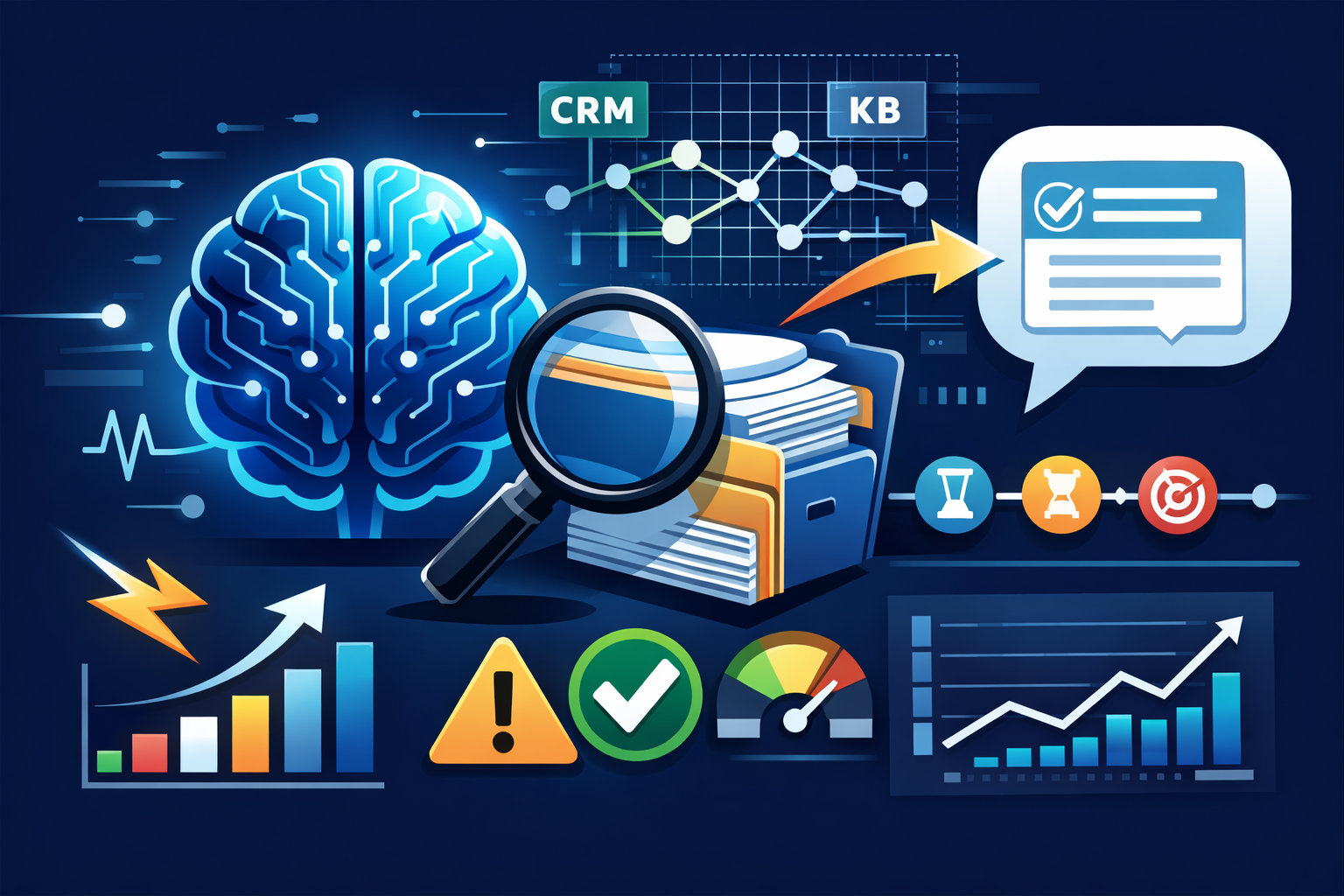
From a technical point of view, architecture usually consists of several stages. First, the company's documents are uploaded to the system, cleaned, and broken down into small semantic fragments. These fragments are then transformed into vector representations — mathematical descriptions of the meaning of the text. After that, they are stored in a special storage, which is able to quickly find the pieces of information that are closest in meaning.
When a user asks a question, the system does not generate an answer immediately at first. She searches the knowledge base for the most relevant fragments, transmits them to the model as a context, and only then forms the final response. This reduces the risk of fictional facts and increases accuracy.
Simplified, it looks like this:
- The company uploads documents and knowledge to the system.
- The system indexes them and prepares them for search.
- The user asks a question.
- The search layer finds the appropriate fragments.
- The model builds a response based on the found context.
It is important to understand here that the quality of the response depends not only on the model, but also on the quality of the data, text splitting, search logic, and correctly configured instructions. Therefore, a successful RAG is always not just a purchase of a model, but a carefully assembled product process.
Where does RAG benefit the most
Not every company needs a complex AI project, but almost every company has processes where RAG can quickly show results. It works especially well where employees or customers are constantly asking repetitive questions, and the answers are already in the documents, but they are difficult to find quickly.
Support service
sales departments
The approach also works well in the following areas:
- HR and training
- legal function
- IT and DevOps
- Finance and procurement
On average, pilot projects most often start with those areas where there is a lot of text data, repetitive questions and a high cost of error. That's where the return on investment becomes visible the fastest.
How to prepare the data for implementation
The most common illusion when launching such solutions is: "Now just connect the model to the file folder, and everything will work." In fact, the bulk of the work is almost always related not to the model, but to data preparation. If the knowledge base is outdated, contradictory, or chaotic, RAG will only deliver the same information mess to the user faster.
The first step is to audit the sources. You need to understand where valuable knowledge is stored, which documents are relevant, who is responsible for updating them, and which materials cannot be used at all without additional verification. Already at this stage, many companies discover duplicates, outdated versions, and documents without an owner.
Next, it is important to bring the data to a working form.:
- remove outdated and contradictory materials;
- mark up documents by topic, roles, and access levels;
- Identify priority sources that the system should trust more.;
- set up regular updates of the knowledge base.
It is a good practice to start not with the entire company, but with a limited body of data. For example, you can download only up-to-date support instructions, product FAQ, and a database of typical sales cases. This approach allows you to get a high-quality pilot faster and not drown in the scale ahead of time.
Step-by-step implementation of RAG in a company
The implementation of RAG should be considered as a product project, and not as a one-time technical integration. It should have a goal, metrics, owners, and usage scenarios. If you approach the task this way, the probability of getting real business benefits increases significantly.
The process usually looks like this. First, the team chooses one specific scenario: for example, an assistant for support operators or an internal assistant for sales managers. Then, a set of data sources, quality criteria, and the range of users for the pilot are determined.
Then you can follow this roadmap:
- Define a business goal.
- Select an implementation scenario.
- Prepare the data.
- Set up the search and generation.
- Run the testing.
- Collect feedback.
- Scale the solution.
In the experience of projects, a pilot can be assembled in a few weeks, if you do not try to cover the entire organization at once. For example, a company with a database of 2-5 thousand documents can get a working internal prototype in 3-6 weeks, and the first measurable effects can be achieved within the first month after the launch of a limited group of users.
Typical mistakes and risks
One of the most common mistakes is to start with technology rather than a business task. The management hears the buzzword, the team quickly launches a pilot, but no one can answer the question: what specific problem are we solving? As a result, the system looks impressive on demo, but does not take root in everyday work.
The second mistake is underestimating the quality of the data. Even a strong model will not fix a weak knowledge base. If the instructions contradict each other and the documents have not been updated for years, the answers will be unstable. This undermines user trust faster than any technical error.
There are other risks to keep in mind.:
- lack of access control
- high expectations
- lack of an update process
- ignoring feedback
Finally, we must not forget about the legal and reputational risks. If the solution is used in the client's circuit, especially in finance, medicine, or the legal field, an additional level of response validation is needed. Sometimes it's better to run RAG as an employee assistant first, rather than as a fully autonomous external assistant.
How to evaluate the effectiveness of a project
Any implementation must be linked to numbers, otherwise it quickly turns into an expensive toy. The good news is that RAG can be measured quite objectively. Moreover, it is worth evaluating both the quality of responses and the real business effect.
At the product level, they usually look at the accuracy of the fragments found, the usefulness of the response, the proportion of successful sessions, and the number of times a user does contact a person. At the business level, metrics can be even clearer: the average response time, the cost of processing a request, the speed of adaptation of new employees, conversion in sales, or reduction of internal time losses.
For example, in the support service, a pilot can show the following results: a reduction in the average response time by 20-35%, a reduction in the burden on senior specialists by 15-25%, and an increase in the proportion of requests handled on the first line by 10-18%. The specific numbers depend on the quality of the data and the maturity of the processes, but the approach itself lends itself well to analytics.
Important:
Bottom line: when is the implementation really justified
RAG is not a fashion label, but a practical mechanism that helps companies use their own knowledge meaningfully and quickly. It is especially useful where there is a large amount of textual information, repetitive questions, a high cost of error and the need for quick access to relevant data.
It makes sense to implement RAG if you already have accumulated documents, instructions, knowledge bases, standards or cases, but it is difficult for people to use them in their daily work. In this case, the system becomes not a substitute for the expert, but an amplifier of the team. It removes the routine, reduces the search time and makes the quality of responses more stable.
If the company has not yet built processes, the knowledge base is chaotic, and the project goals are vague, it is better to start not with a complex architecture, but with putting the data in order and choosing one understandable scenario. That's where real value is born. And only then does the technology begin to work not as a spectacular novelty, but as a mature business tool.


Related articles
A chatbot in simple words: what is it and what is it for?
Personal AI Business Assistant: how to choose between Hermes, OpenClaw, a self‑written system and Softrestchat
Profit-killing Minutes: How Response Speed Turns into Money

AI Agents and 152‑FZ: how to ensure legitimate data processing and risk management

How to choose a Russian platform for AI agents: 4 key criteria for business