Software development for AI agents and multi-agent systems: from architecture to implementation


Content
- Introduction
- Basic concepts of AI agents
- Architectures of multi-agent systems
- Software design for agents
- Tools and technology stack
- Testing and debugging
- Safety and ethics
- Cases and examples
- Conclusion and recommendations
Introduction
Software development for AI agents and multi-agent systems (MAC) combines the principles of artificial intelligence, distributed systems and the classical engineering approach to software creation. In this article, we will look at key concepts, architectural patterns, practical design recommendations, technology stack selection, and testing methods. The material is aimed at developers, architects, and technical supervisors seeking to understand how to translate research ideas into workable, scalable solutions.
It is important to understand that an agent is an autonomous component that perceives the environment, makes decisions and performs actions to achieve its goals. Multi-agent systems are a collection of such agents interacting with each other and with external resources. Practical projects require the team to pay attention to communication, data consistency, fault tolerance, and security.
Basic concepts of AI agents
Agents differ in their level of autonomy, learning ability, and interaction. There are reactive agents (reacting to events), agents with an internal representation of the environment, and intelligent agents using planning and training. For development, it is important to determine the agent's behavior: deterministic or stochastic, one-step or multistep planning.
Key characteristics of the agent:
- Perception is the collection of data about the environment.
- Knowledge modeling is the storage of internal state and representations.
- Decision making — algorithms for planning, optimization, or learning.
- Actualization — performing actions and interacting with the environment.
Architectures of multi-agent systems
Architectural approaches to MACS are often built around centralized, distributed, or hybrid management models. The central architecture simplifies coordination, but becomes a bottleneck when scaling. Distributed architectures enhance fault tolerance and scalability, but make it more difficult to ensure consistency and communication.
Popular agent interaction patterns include:
- Client-server interactions for data requests and commands.
- Publish-subscribe (pub/sub) for asynchronous messages.
- Auctions and task allocation mechanisms for cooperation and competition.
Software design for agents
Design should begin with formalizing requirements: agent goals, environment boundaries, success criteria, and resource constraints. At an early stage, it is useful to build formal behavior models — finite automata, state diagrams, or POMDP for partial observation tasks.
The organization of code and modules is important for maintainability: highlight the layers perception, reasoning, decision-making, action, and communication. The interfaces between the layers should be obvious and minimally connected. To configure behavior, use declarative descriptions (rules, policies) that can be changed without recompilation.
Tools and technology stack
The choice of technologies depends on the tasks: Python (ML libraries, simulators) is often used for prototyping, and high—level ML components are combined with reliable Java, Go, or Rust services for industrial implementation. gRPC, WebSocket, and message brokers (Kafka, RabbitMQ) are popular for agent-to-agent communication.
Recommended stack:
- ML frameworks: TensorFlow, PyTorch for training behavior models.
- Orchestration services: Kubernetes for scaling agents as microservices.
- Simulation tools: OpenAI Gym, SUMO for transport scenarios, mat. models for interaction testing.
Testing and debugging
Agent testing combines unit tests of components and scenario tests to evaluate behavior in the environment. Use a simulation environment to reproduce complex scenarios and regression testing. In addition, metrics are important: goal achievement efficiency, fault tolerance, reaction speed, and communication delays.
Debugging distributed agents requires observability: logging, distributed tracing, response time and status metrics. To reproduce bugs, it is useful to save the seed of the random generator and the control points of the environment.
Safety and ethics
MACS can interact with critical systems, so safety and ethics are an integral part of development. Provide authentication and authorization for messages between agents, encryption of communication channels, and verification of input data. Also, provide mechanisms for rollback and safe shutdown of agents in case of errors.
Ethical aspects include transparency in decision-making and responsibility for agents' actions. For mission-critical scenarios, implement human-centric controllers and solution logs so that the behavior of the system can be explained.
Cases and examples
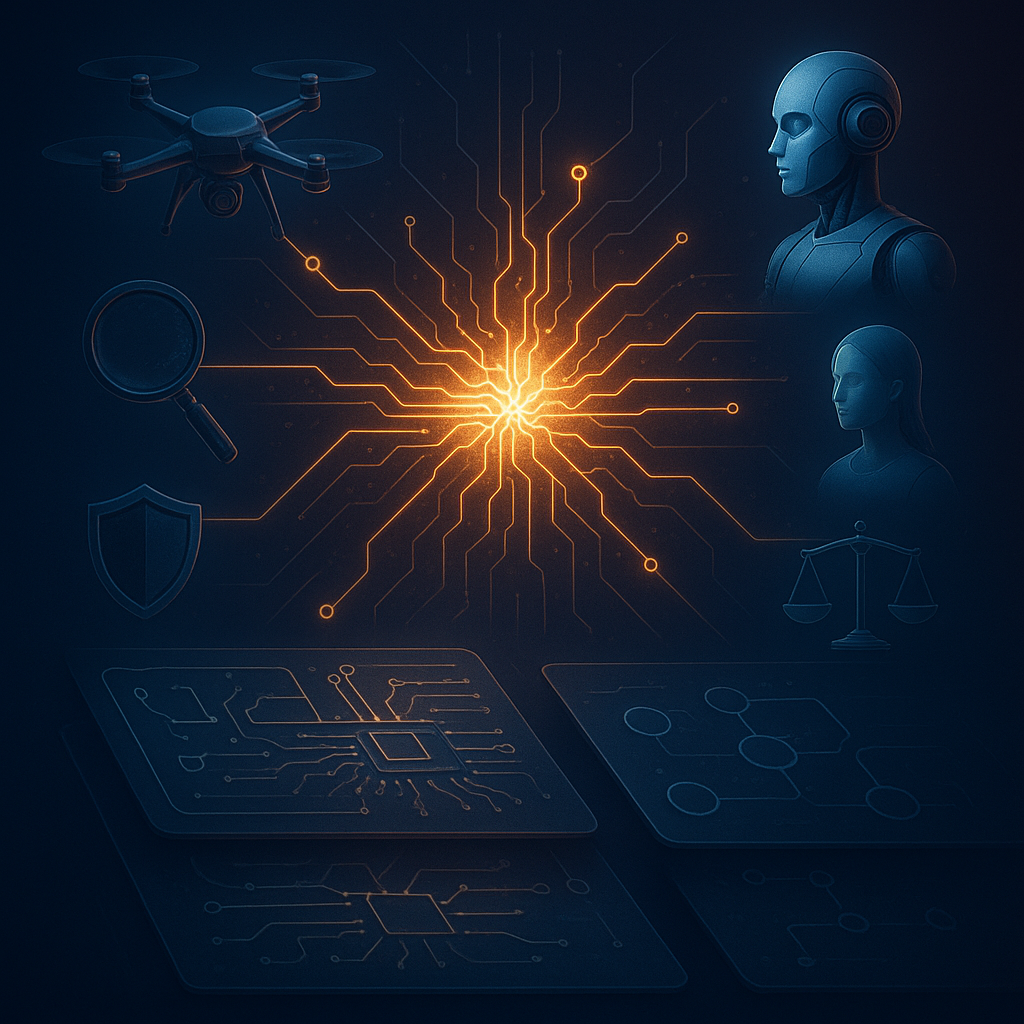
Examples of successful MAC applications include fleet management of drones, distributed trading in financial systems, and robot coordination on production lines. In each case, the architecture and technologies were tailored to meet the requirements: tight time constraints, high fault tolerance, or the need for on-the-fly learning.
Brief case study: In logistics, distributed agents assign loading tasks and transport routes in real time by combining predictive demand models and heuristic task allocation algorithms. This approach has reduced downtime and increased throughput.
Conclusion and recommendations
Software development for AI agents and MAC requires an interdisciplinary approach: a combination of ML, distributed systems, and engineering practices. Start with prototypes and simulations, then gradually transfer critical components to reliable services. Always consider monitoring, security, and the ability to explain solutions.
Key recommendations: plan an architecture for scaling, share responsibility between agents, automate testing in simulation, and implement control and rollback mechanisms. This approach will help create stable, efficient, and secure multi-agent solutions.
 Автор
Антон Амосов
Автор
Антон Амосов


Related articles
A chatbot in simple words: what is it and what is it for?
Terms of reference for an AI agent: template, structure and examples of formulations
AI Agent Constructor: what is really possible to assemble without a programmer and where is the code needed?
Personal AI Business Assistant: how to choose between Hermes, OpenClaw, a self‑written system and Softrestchat
Profit-killing Minutes: How Response Speed Turns into Money