ROI of telegram bots: how to calculate the payback


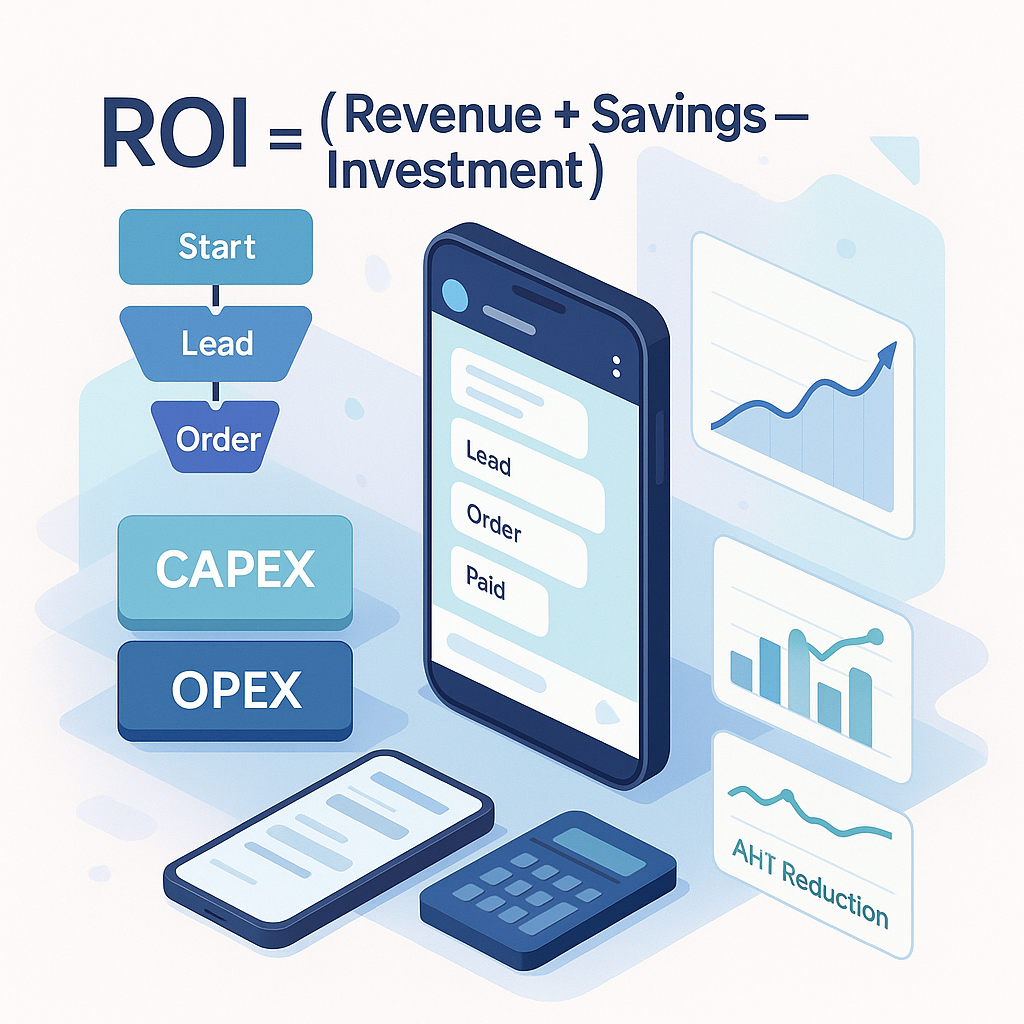
ROI of telegram bots: how to calculate payback on real numbers and what to consider in the model
Sometimes it seems that a bot is just a convenient button in a messenger. In fact, this is a small "engine" next to your business: it works quietly, saves fuel, but with proper configuration it takes you far. In order for him to get the right budget, he needs a story in numbers: a clear formula, a discipline of measurement and a few sober assumptions — without illusions and exaggerations.
Dictionary of terms used in the article
ROI (Return on Investment).(Income + Saving Is an Investment) / Investment
Payback (payback period).CAPEX / monthly net effect
CAPEX.
OPEX.
Marginality.(Revenue – variable costs) / Revenue
AOV.
GMV.
Hold on.
CR.
Incrementality.
Cannibalization.
Deflection.
AHT.
FTE.
Retention.
LTV.
CAC.LTV/CAC
Attribution.
Holdout.
UTM tags.
Deep-link.
NLU.
NPS.
Cohort analysis.
ROI Logic
ROI = (Income + Saving Is an Investment) / Investmentincremental margin profit
Three model blocks
Revenue block (incremental sales).because
The savings unit (automation).
The cost block.
Where do we get the numbers from
startlead_sentorder_paidhandover_to_agent
Three examples based on real numbers
Case 1. The bot's lead in services (B2B)
8 0006%30%35%12%120 000 ₽40%240 000 ₽14,000 ₽/month6,048290 304 ₽145 152 ₽131 152 ₽/monthPayback period is about 1.8 months+556%
Case 2. Telegram store (retail)
3000 MAU12%3601,24322 200 ₽~950 400 ₽35%40%2,8%330 000 ₽15,000 ₽/monthThe net effect107,412 ₽/monthpayback — ~3.1 months~+291%
Case 3. Support service
4 000AHT 6 min600 ₽/hour35%1 minute180 000 ₽10,000 ₽/month110,000 ₽/month100,000 ₽/monthPayback period — ~1.8 months~+567%
How not to "inflate" the ROI
incrementalityCannibalizationOPEX-tails
How to capture the effect correctly
holdout-experimentlead_source = telegram_botorder_source = telegram_bot
Checklist of input parameters
Traffic and funnel:
Increment/cannibalization:
Automation:
Expenses:
Result
1.8–3 months


Related articles
The cost of developing Telegram bots in Russia in 2025

AI agent or chatbot: how to choose a business automation tool

AI chatbot in Avito: the first line of support for product consultations
Which Telegram bot should I choose: in the constructor or in Python?
Automation using Telegram bots