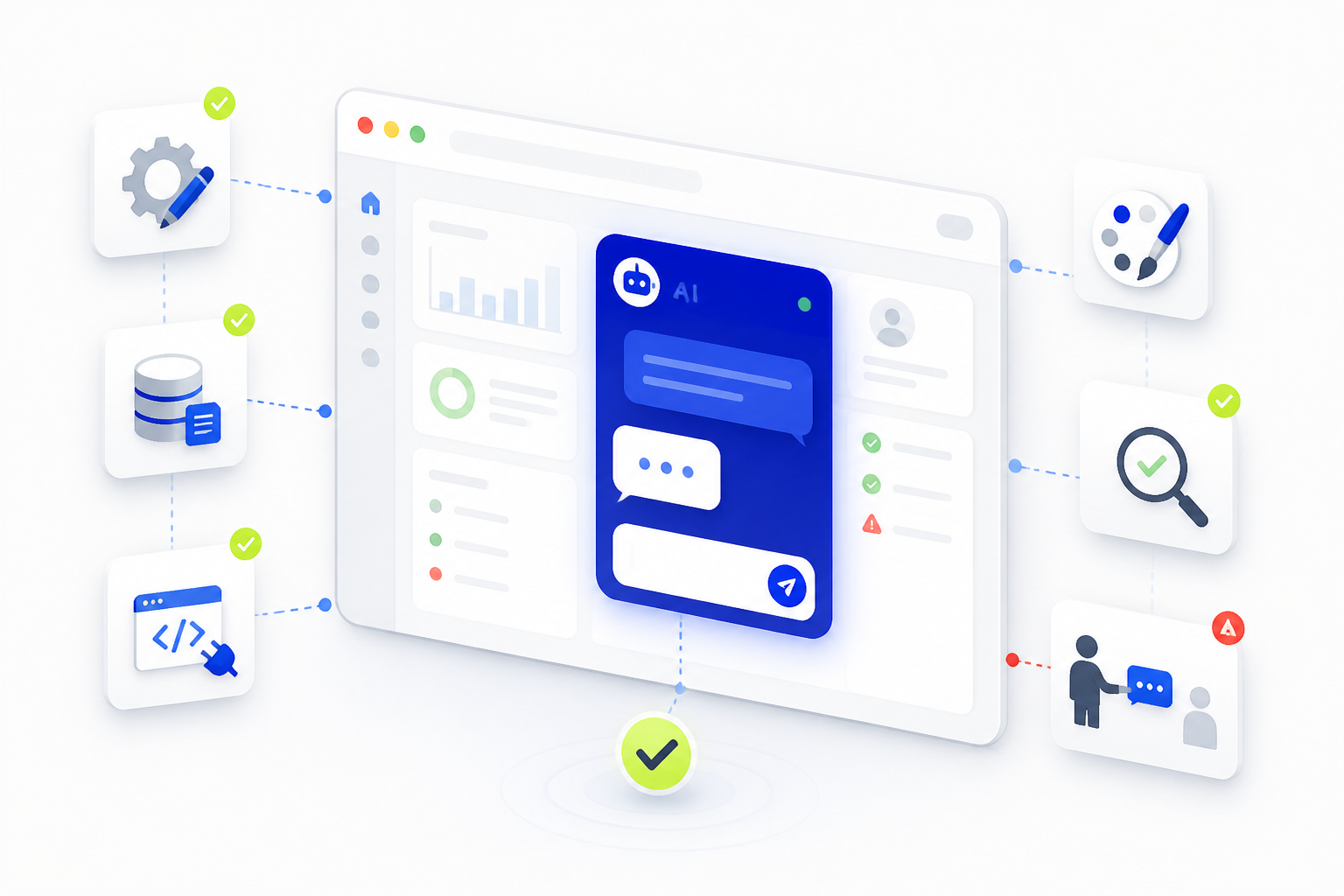
Introducing AI into business: where to start and how to get a quick effect



Content
- Why AI has become a practical business tool
- What question does the implementation start with?
- Where AI gives a quick effect
- How to audit processes before launch
- How to build the first pilot project
- Data, team, and Responsibility
- Typical risks and mistakes
- Economics of implementation and metrics
- How to build a 90-day roadmap
- Conclusion
Why AI has become a practical business tool
Until recently, artificial intelligence was perceived as an expensive technology for large corporations, research centers, and companies with huge IT budgets. Today, the situation has changed: AI-based tools have become more accessible, are being implemented faster, and solve fully applied tasks rather than abstract ones. For businesses, this means one thing: we are no longer talking about a fashion trend, but about a working tool that can save time, reduce costs and improve the quality of operations.
In a business context, AI is most often understood not as a "smart robot", but as a set of technologies that help automate routine actions, analyze large amounts of data, predict customer behavior, improve service, and accelerate decision-making. These can be chat assistants for support, call analysis systems, the generation of commercial offers, intelligent search of internal documents, forecasting demand or automatic processing of applications.
A good start in AI always starts not with technology, but with a problem.
A mature approach to AI looks like this: first the business goal, then the process, then the data, and only after that — the choice of a tool.
What question does the implementation start with?
where is money, time, or quality lost in our company?
For example, if a company's managers process dozens of identical incoming requests every day, a logical starting point would be intelligent routing of requests or an AI assistant for the client's primary qualifications. If it takes a lot of time to compile reports, you should look towards automating analytics and generating management summaries. If it is difficult to maintain a single standard of quality in negotiations, communication analysis and tips for employees are useful.
To choose the right entry point, it is useful to answer three questions:
- Which process repeats most often?
- Where is the most manual routine?
- Where does an employee's mistake cost a business particularly dearly?
The answers will quickly show that AI is needed not "everywhere at once", but in several understandable areas where you can get quick and noticeable results.
Where AI gives a quick effect
The most successful first projects are not grandiose transformations, but local implementations with a short cycle of hypothesis testing. It is important for the business to feel the impact, and for the team to see that technology really helps. That is why it is best to start with scenarios where the result can be measured in the first weeks.
In practice, AI often pays off quickly in the following ways:
- Sales:
- Support:
- Marketing:
- Operations:
- HR:
A good guideline for the first project is the task that people are involved in today, but the work itself is largely repeatable and built according to clear rules. There, AI does not replace expertise, but removes the mechanical load. This is also important from the point of view of adoption within the team: employees are more willing to support implementation when they see that technology removes the routine, rather than "coming in their place."
According to the experience of small and medium—sized businesses, one of the most affordable starts is the introduction of AI in working with text, knowledge and communications. The entry threshold is low here, the effect is quickly visible, and the risks are lower than in complex production or financial scenarios.
How to audit processes before launch
Before the first implementation, it is useful to conduct a short audit of the processes. It doesn't have to be a heavy consulting project for three months. It is enough to record exactly how the work is being done today, who is involved in it, where delays occur and what actions are repeated from day to day. Such diagnostics are often eye-opening: the company discovers that the problem is not the lack of AI, but an undescribed process, scattered data, or unnecessary manual steps.
In practice, an audit can be conducted in several meetings with function managers and on-line staff. The task is to assemble a process map from the input to the result. It's important to find out:
- what data is used?;
- Where do they come from;
- Who makes the decisions;
- which steps take the most time;
- where errors or refunds for revision occur most often.
After that, it is convenient to evaluate the processes according to four criteria: frequency, labor costs, impact on the result, and complexity of automation. If the process occurs daily, takes a lot of time, affects revenue or customer experience, and is sufficiently standardized, this is a strong candidate for the pilot.
Important:
How to build the first pilot project
A pilot is a test run in a limited area of a business that allows you to quickly understand if there is value in an idea. His task is not to "close the AI topic once and for all," but to get the facts: how much the speed has increased, whether the quality has improved, whether the burden on people has decreased, and whether the costs are being recouped.
There are several signs of a good pilot. Firstly, it is limited in scope: one department, one function, one type of tasks. Secondly, it has an understandable owner within the company — a person who is responsible not only for the launch, but also for the actual use of the solution. Thirdly, the pilot has measurable goals: for example, to reduce the response time to the client by 30%, reduce manual document processing by 50%, or increase the conversion from the initial request to a qualified lead.
The optimal design of the first pilot usually looks like this:
- Choose one narrow task with a measurable effect.
- Define metrics "before" implementation.
- Prepare a limited set of data and scenarios.
- Run the solution on a small group of users.
- Compare the result with the baseline after 2-6 weeks.
It is often the pilot who helps to remove internal skepticism. When the manager sees that the manager has started processing 35 requests a day instead of 20, and the client receives a faster and better response, the conversation about implementation goes beyond theory and becomes a conversation about numbers.
Data, team, and Responsibility
One of the most common illusions is to think that it is enough for AI to buy a service and grant access to employees. In fact, the result depends on three pillars: data, people, and usage rules. If at least one of them is lame, the implementation begins to stall.
Data
Team
Responsibility and rules
Typical risks and mistakes
Companies often make similar mistakes at the start. The first is to try to implement AI "from top to bottom" as an image initiative without reference to a real operational task. As a result, presentations, demos, and discussions appear, but there is not a single sustainable process that has improved.
The second mistake is to want to implement everything at once. Sales, marketing, support, finance, analytics, document management — the list is growing rapidly, and the team is losing focus. It is much more efficient to select one scenario, bring it to a working state, collect the numbers, and then scale the approach to neighboring processes.
The third mistake is to expect AI to work without quality control. In practice, models can allow inaccuracies, "hallucinations" and logical failures. Therefore, especially at the first stages, human control, verification templates and clear criteria for the acceptance of the result are needed. A business doesn't need "magical intelligence"; it needs a manageable tool with predictable quality.
The fourth mistake is underestimating communication within the team. If employees only hear the word "automation", they may perceive the project as a threat. If they are told that the goal is to remove the routine, speed up work and free up time for more valuable tasks, resistance decreases noticeably. Implementing AI is not only about technology, but also about managing people's expectations.
Economics of implementation and metrics
To prevent AI from becoming an expensive experiment with no clear future, you need to determine the economics of the project in advance. The most common mistake is to look only at the cost of a subscription or development. In fact, you need to think more broadly: how much time it takes to prepare data, how much integration costs, employee training, script setup, maintenance, and quality control.
But the effect should not be considered abstractly either. There are several clear groups of metrics:
- Speed metrics:
- Quality metrics:
- Economic metrics:
- Acceptance metrics:
Let's give a simple example. If the support department processes 3,000 requests per month, and AI removes 25% of typical requests, this already means a significant release of resources. If sales managers save 40 minutes a day on preparing materials, it turns into dozens of hours per week on the scale of the team. It is such calculations that turn the conversation about AI from a fashionable topic into a manageable investment project.
Good practice
How to build a 90-day roadmap
For most companies, a reasonable start is not an annual digital transformation program, but a roadmap for 60-90 days. This period is enough to select a scenario, conduct an audit, launch a pilot and get the first figures. This pace allows you not to lose momentum and not drown in endless preparation.
An approximate roadmap might look like this. In the first two weeks, the team sets goals, selects a process, and captures basic metrics. Then another 2-3 weeks are spent collecting materials, setting up the script and testing on a limited set of cases. After that, the pilot operation begins in real operation, which lasts from 3 to 6 weeks. The final stage is to analyze the result, make adjustments, and decide on scaling.
To describe it more concisely, the sequence would be like this:
- Days 1-14:
- Days 15-30:
- Days 31-75:
- Days 76-90:
An important principle is that each next step should build on the proven effect of the previous one. It is not necessary to expand the implementation just because "the topic is promising." They scale not the idea, but the result.
Conclusion
It is best to start implementing AI in a business calmly and in a meaningful way. Not from a global strategy, not from the desire to "be modern" and not from the purchase of the maximum number of services, but from one understandable process, where there is repeatability, manual workload and measurable business pain. This approach allows you to quickly see the real value of the technology and reduce the risk of disappointment.
start not with artificial intelligence, but with a business task.
For companies that follow this path consistently, AI provides more than just operational savings. It is changing the speed of work, the quality of solutions, and the management culture itself: businesses are becoming more attentive to data, testing hypotheses faster, and building processes more confidently in which technology enhances people rather than replacing common sense.


Related articles

Top 10 platforms for building AI agents: what's inside each service
Terms of reference for an AI agent: template, structure and examples of formulations

AI Agent Constructor: what is really possible to assemble without a programmer and where is the code needed?

GPT-6 Astra: a breakthrough to AGI or thoughtful marketing?
How to create an AI agent: clear architecture, tools, and typical errors