How to choose an architecture for SaaS: a practical guide for CTO and product teams


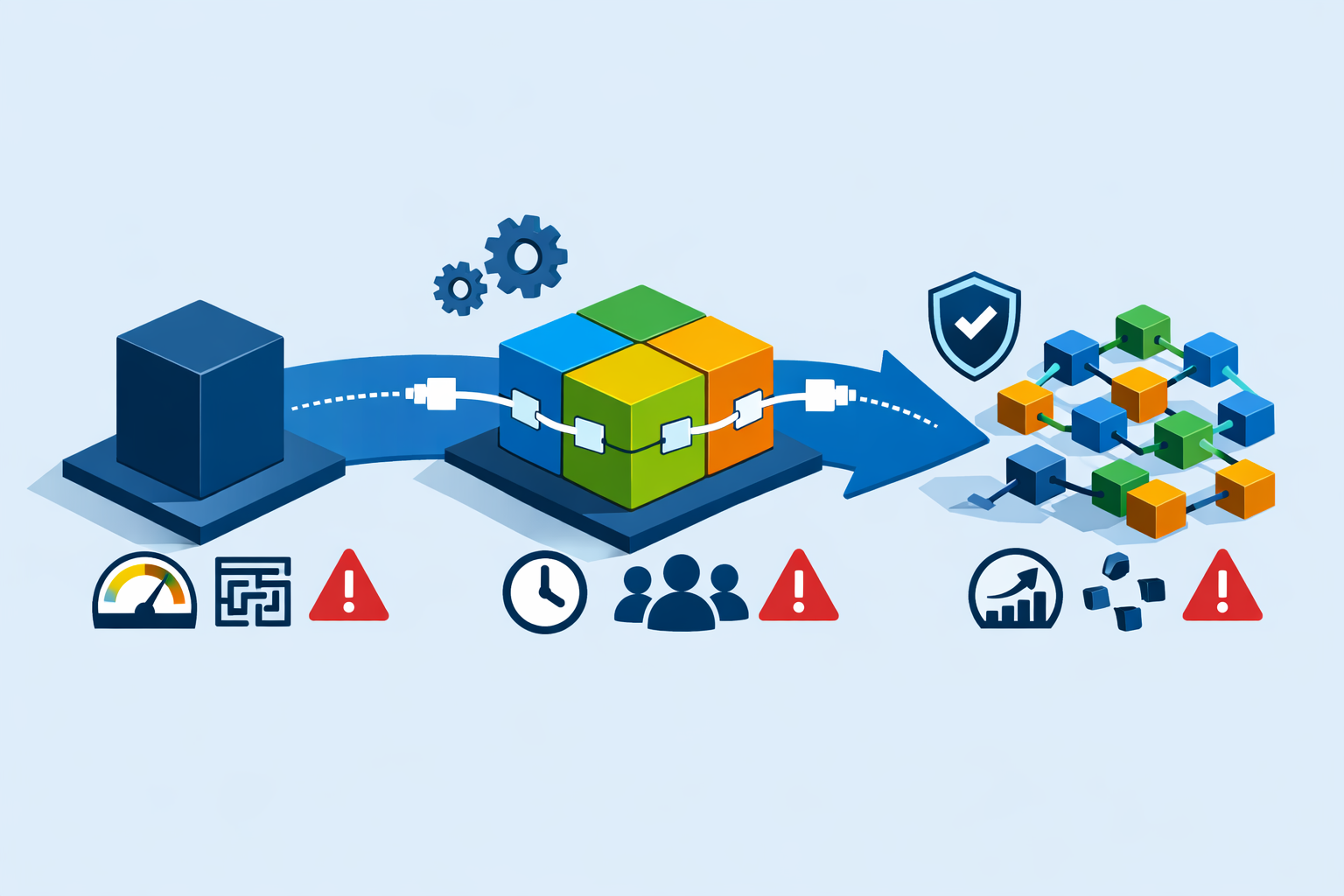
Content:
- Why architecture defines the future of a SaaS product
- How to start choosing an architecture
- Monolith: When is the best time to start
- Modular monolith as a practical compromise
- Microservices: when they are really justified
- Data, integrations, and system boundaries
- Non-functional requirements and scaling
- Typical mistakes when choosing an architecture
- A practical approach to decision-making
- Bottom line: which architecture to choose
Why architecture defines the future of a SaaS product
Choosing an architecture for a SaaS product is not just a technical decision, but a managerial step that affects the speed of product launch, the cost of development, the resilience to growth, and the team's ability to make changes without constant crises. At the start, it seems that architecture is a matter of taste: monolith or microservices, synchronous or asynchronous interactions, one database or several. In practice, it's a matter of the business model, the maturity of the team, and the planning horizon.
SaaS differs from a "regular" software product in that it lives in constant operation. You can't just let it out and forget it. It is necessary to support multi-user mode, security, billing, integration, updates without downtime and a manageable increase in workload. Therefore, architecture should help not only to write code today, but also to support the product tomorrow, when new tariffs, corporate clients, requirements for fault tolerance and analytics appear.
There is no perfect architecture.
The SaaS architecture is a balance between the speed of development today and the manageability of the system tomorrow.
How to start choosing an architecture
You don't need to start with the service schema or the choice of a framework. You need to start by answering a few basic questions.: how many users do you expect in the first year, how complex the subject area is, how often requirements will change, how many teams will work on the product, and how critical downtime is. These questions set the context, without which architectural decisions turn into fortune-telling.
For example, SaaS for internal automation of small businesses and a B2B platform with corporate clients are two different worlds. In the first case, it may be more important to quickly launch the MVP, test hypotheses and not complicate the infrastructure. In the second case, at an early stage you will have to think about access control, audit of actions, integration with external systems and the possibility of customization for a large client.
It is useful to evaluate the system along four axes:
- Domain complexity
- Expected load
- The pace of change
- Maturity of the team
If you answer these questions honestly, it becomes easier to choose an architecture not based on trends, but based on a real need.
Monolith: When is the best time to start
Monolith has a bad reputation for only one reason: it is often confused with a chaotic codebase. But the monolith itself is not a problem. Moreover, monolith is the most rational choice for most SaaS products at an early stage. It is faster to develop, easier to deploy, easier to debug, and does not require complex operational wiring.
If you have one team, a limited budget, and the goal is to reach the first paying customers as quickly as possible, Monolith almost always wins. In such an architecture, it is easier to implement basic functions: authorization, user management, billing, administrative dashboard, CRM logic, reports and integrations. Everything is in one application, which means fewer network interactions, fewer sources of failures, and easier error tracing.
high rate of product change
Monolith is especially appropriate if:
- are you creating an MVP or an early commercial version;
- 1-2 teams are working on the product;
- The load is predicted to be moderate;
- The speed of market launch is more important than the ultimate scalability of individual components.;
- the team does not have a strong need for an independent release cycle for different parts of the system.
In other words, a monolith is not a compromise from poverty, but often a mature solution to start with.
Modular monolith as a practical compromise
If a regular monolith seems too risky due to future growth, and microservices seem too expensive in terms of complexity, a modular monolith becomes a good option. This is an approach in which the application remains unified in terms of deployment, but internally it is divided into clear modules: billing, user management, notifications, catalog, reporting, integration, and so on.
boundaries of responsibility
This is especially convenient for SaaS, because many typical subsystems are well isolated logically. For example, authentication and authorization can be one module, billing can be another, and the functional core of the product can be a third. With this approach, you get the benefits of simple deployment, but at the same time you prepare the foundation for future separation of individual services, if it is really needed.
In practice, companies often go this way: they launch on a modular monolith, confirm demand, find areas of real workload or organizational pain, and only then bring specific parts into independent services. This saves both money and the attention of the team.
Microservices: when they are really justified
The microservice architecture looks attractive: independent services, separate releases, scaling of only the necessary components, and technological flexibility. All this is true, but only if the company has the appropriate scale of tasks and maturity of processes. Otherwise, microservices quickly turn into a source of endless operational load.
For SaaS, microservices are usually justified in three cases. First, the product has really grown, and different parts of the system have radically different load profiles. For example, the user management API is stable, and the analytics or event processing subsystem requires separate scaling. The second is that several autonomous teams are working on the product, which need independent development and release cycles. The third is that the business domain is so wide that a single code base is beginning to interfere with development.
But you have to pay for the benefits. Difficult questions are emerging: how to ensure data consistency, how to handle partial failures, how to build distributed monitoring, how to organize local development, how to manage versions of contracts between services. The costs of DevOps, testing, security, and operation are also increasing.
Unless you have a clear reason for microservices, chances are you don't need microservices yet.
Data, integrations, and system boundaries
The choice of architecture for SaaS is almost always based on data. Where is the customer information stored? How is tenant data shared, i.e. tenants? Is there a need for a "one database for all" or a "separate database for the client" model? How will integrations with CRM, ERP, payment systems, mail services, and analytics work? These issues cannot be considered secondary — they often determine the real boundaries of the system.
For most SaaS, a scheme with a common database and logical separation of tenants is suitable at the start. It's cheaper to maintain, easier to analyze, and faster to develop. But if you are targeting the enterprise segment, where data isolation, security compliance, and the ability to customize storage policies are important, you may need a more complex model - for example, dedicated databases or at least dedicated schemas.
It is worth considering an integration strategy separately. A common mistake is to mix the internal domain logic and the integration layer. When the code of business processes is tightly tied to external APIs, the system becomes fragile: any changes from the partner begin to break the internal scenarios. It is much more reliable to build integrations through separate adapters, event queues, and clear contracts.
A good architectural sign is when you can answer three questions.:
- Which data is the source of truth inside your system.
- What events and states can be published outside.
- Which external dependencies are critical and what happens when they are unavailable.
If these answers are there, architecture becomes much more resilient to growth and change.
Non-functional requirements and scaling
Architecture is often chosen with only functionality in mind.: what the system should be able to do. But in SaaS, non-functional requirements are equally important: performance, fault tolerance, security, observability, speed of releases, and cost of support. They determine whether the product can withstand the transition from the first customers to hundreds and thousands of users.
For example, if uptime is critical for you, then at an early stage you need to think about a no-downtime deployment strategy, backups, health-check mechanisms, error monitoring, and metrics. If the product works with sensitive data, you will need to think through auditing, encryption, secret management, and access policy. If there are many background tasks in the system, it is important to separate interactive user requests from asynchronous processing.
Scaling can also be different. "Horizontal growth of everything in a row" is not always necessary. Sometimes it's enough to put heavy tasks in a queue, add caching, optimize database queries, and separate reads and writes. In many cases, this has a greater effect than an early switch to a microservice architecture.
Practice shows that in SaaS, the bottleneck is often not the architectural paradigm itself, but the lack of engineering discipline.: no profiling, no metrics, no performance degradation monitoring. Therefore, the architecture must be supported by processes, otherwise even a beautiful solution quickly loses its value.
Typical mistakes when choosing an architecture
One of the most common mistakes is to design a system for a hypothetical scale that doesn't exist yet. The team is afraid that one day there will be a million users, and is building an overly complex platform already at the start. As a result, time is spent not on finding a product-market fit, but on servicing your own engineering ambitions.
The second mistake is to ignore the organizational context. The architecture does not exist separately from the team. If you have no experience operating distributed systems, dozens of services will create chaos rather than flexibility. Complexity migrates from code to processes, and then comes back in the form of incidents and slowdowns in development.
The third mistake is not to define architectural boundaries explicitly. When the modules are not separated, and the responsibility is spread out, any changes begin to "flow" through the entire system. In SaaS, this is especially dangerous because changes in billing, access rights, or customer data affect multiple scenarios at once.
There are also more applied miscalculations.:
- lack of a multi-tenancy strategy;
- mixing administrative and client logic;
- excessive coupling of integrations with external APIs;
- the lack of an event model where there are many background processes;
- neglect of logging, monitoring, and query tracing.
The good news is that most of these mistakes can be prevented not by expensive technology, but by the discipline of design.
A practical approach to decision-making
If you remove the marketing noise, the practical choice of architecture for SaaS usually looks like this: first you describe the key business scenarios, then identify domain zones, evaluate data requirements and integrations, and then choose the minimum sufficient architecture. That is, not the simplest and not the most difficult, but the one that covers the real risks for the next 12-24 months.
To start, it is useful to apply the principle of evolutionary architecture. It means that you deliberately leave the system the opportunity to change without a complete correspondence. In practice, this translates into modularity, clear interfaces, separation of business logic from infrastructure, use of queues where asynchronous processes exist, and documentation of architectural solutions. Not for the sake of bureaucracy, but for the sake of manageability.
You can use a simple guideline.:
- MVP and Early growth
- The growing number of functions and commands
- Strong organizational and technical complexity
This approach allows you not to overpay for the complexity in advance and at the same time not to drive the system into a dead end. Architecture ceases to be a dogma and becomes a product development tool.
Bottom line: which architecture to choose
start with a monolith or a modular monolith, and switch to microservices only if you really need to.
The architecture should be chosen not according to fashion, but according to a combination of factors: the stage of the product, the complexity of the domain, the team structure, security requirements, the nature of the load and the need for independent scaling. If you don't have a proven demand yet, architecture should help you learn and change the product quickly. If demand is confirmed and the system is growing, the architecture should help to share responsibility and manage complexity.
In a good SaaS, the architecture is invisible to the user, but critical for business. It determines how quickly you release new features, how much support costs, how stable the service is, and how confidently the company is going through the growth phase. Therefore, the best choice is not the one that impresses on the diagram, but the one that makes the product sustainable, economically reasonable and developable.


Related articles

Fine-tuning LLM: how to turn a model into a business partner

When AI makes code more expensive: Why generation makes maintenance more expensive

From Machine Optimization to Token Optimization: How AI Agents are Changing Development

AI Development: from fundamentals to business solutions and implementation

AI Agents: A Complete guide to how they work and help automate tasks