
Web services for SEO automation (for beginners)



Automated SEO services
Comprehensive all-in-one platforms
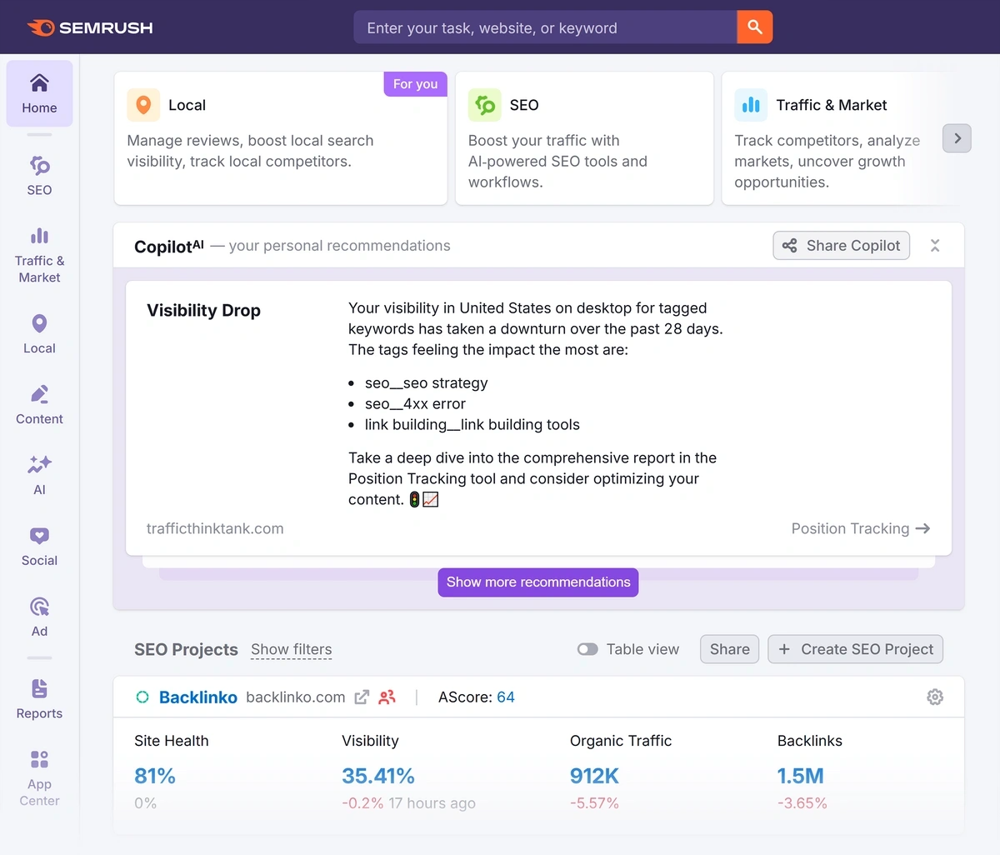 Example: Semrush interface with AI recommendations for improving the site. The daily "SEO Copilot" offers automatic tips to increase visibility.
- Ahrefs is a powerful web service, initially known for best–in-class analysis of the reference mass. Now it is a full–fledged platform: auditing backlinks, competitor research, keyword selection and position monitoring are the main strengths of Ahrefs. The tool will help the site owner understand which external links lead to his resource, analyze the strategy of competitors and find new key queries for traffic growth. The Ahrefs API is widely used in the industry to upload data (such as link metrics and frequency) to third-party systems.
- Moz Pro is a comprehensive SEO solution with an emphasis on user convenience and support. Moz has a weekly website audit with notification of problems found, keyword ranking tracking, link analysis, and recommendations for content optimization. The platform is famous for its ease of learning and a large number of educational materials, so it is suitable for small companies and beginners. Moz also provides APIs for developers (for example, the Mozscape API for link data).
- Serpstat is a multifunctional SEO platform originally from Ukraine, popular all over the world. It includes modules for position monitoring, site audit, backlink analysis, as well as semantic core selection and competitor analysis. Serpstat is especially valuable for creating the semantic core of a blog: the service will offer relevant keywords, topics, and hints for articles. The Serpstat API is also supported for getting keyword and domain data.
- SE Ranking is a cloud–based SEO service aimed at both professionals and small business owners. The all-in-one platform combines site audit, competitor monitoring, position tracking, keyword selection and clustering, backlink analysis, and even automated professional reporting. Users note the simplicity of the SE Ranking interface and the availability of ready-made report templates. The SE Ranking API allows you to automate monitoring and integrate with other systems.
- Mangools is an intuitive set of SEO tools for beginners. The following services are provided in one package: KWFinder (keyword search), SERPWatcher (monitoring positions and competitors) and LinkMiner (link analysis). Mangools is famous for its simple interface and affordable price, which makes it ideal for small business owners without deep SEO knowledge. Despite its simplicity, the kit covers all basic needs: it will find the right keywords, show how the site is growing in search results, and help evaluate the link profile of competitors.
- Ubersuggest is an SEO platform from Neil Patel, created specifically for small and medium-sized businesses. The tool is friendly to beginners and offers an affordable price. Ubersuggest simplifies keyword search, provides content insights, and analyzes competitors' websites. It's not as powerful as Semrush or Ahrefs, but it's great for the first steps in SEO: you'll get basic query metrics, content tips, and basic site auditing. Note: Ubersuggest also has an API (in the paid version) for accessing keyword data.
- Topvisor is a Russian system for webmasters and marketers that combines position verification, keyword planning, analytical site audit, and other tools. Although Topvisor is aimed more at specialists, for small businesses it can automate the monitoring of site visibility in search and help in collecting semantics. Integration functions with Google Analytics and search engines are built in; there is an API for obtaining data on query positions and frequency.
- Yandex Business is a remarkable service for automating local SEO and advertising from Yandex. It automatically creates and adjusts ads, showing them in Search results, on Maps, and on the Yandex Advertising Network. Although this is more about advertising, for a small business owner in Russian-speaking countries, Yandex Business closes some of the tasks of attracting traffic without the participation of a specialist.: The service will select the keywords itself and launch the campaigns. (The API is not directly provided, the service works as a ready-made solution.)
AI tools for SEO content
In addition to general–purpose platforms, there are services that specialize in automating work with content - selecting themes, keywords, and even generating texts based on SEO.
- Surfer SEO is a popular data–driven content optimization tool. Analyzes the top pages by a given keyword and provides clear recommendations on which terms and in what quantity should be included in your article. Surfer actually helps to create a semantic core for an individual text: it advises LSI keywords, optimal text volume, heading structure, etc. Its powerful capabilities are supported by AI, and most importantly, the service is very easy to use even for an unskilled user. Surfer does not require SEO knowledge, but it is able to significantly improve the quality of content and page position.
- MarketMuse and Clearscope are advanced AI platforms for content marketing. With the help of AI, MarketMuse evaluates the completeness of the topic disclosure in your text and suggests large-scale improvements; thematic modeling algorithms suggest which aspects are missing. Clearscope, in turn, uses machine learning to compare your content with the best pages in search results and generates a list of recommended words and topics. Both tools are aimed at ensuring that your content meets the expectations of search engines and users as much as possible. These services are especially useful for creating blog content, as they actually act as an SEO expert editor.
- Frase combines AI–based text generation with SEO research. Frase can automatically create a content brief (outline of the article), taking into account popular issues, competing materials and targeted keywords, as well as suggest how to optimize the finished text. The tool is convenient for blog owners to use: you enter a topic, and Frase collects the core of the article for you – headlines, subtopics, important terms – and, if desired, generates a draft text. Thus, even without SEO and copywriting skills, you can get well-structured, search engine-optimized material. (API: Frase provides an API for creating and updating content briefs through external applications.)
- Seometry is an all-in-one Russian AI platform for creating SEO content that is really moving forward. The service covers the entire cycle: from the analysis and formation of the structure of the article to its generation and optimization to meet the requirements of search engines. Seometry is focused on content for Yandex and Google and will be useful for businesses and agencies that want to automate turnkey SEO copywriting. (No API has been declared, the service operates via a web interface.)
Audit and Technical SEO services
There are separate services for automating the technical optimization of the site. They are useful to find and fix errors on the site without manual checks (broken links, indexing problems, download speed, etc.).
- SEOptimer is a simple and affordable tool for fast SEO audit of a website. In a matter of minutes, SEOptimer scans your resource, identifies the main SEO problems and provides clear recommendations on how to fix them. The service checks meta tags, the structure of headings, the content of the text on the page, and other important elements. The advantage is a very simple interface (literally one "Analyze site" button) and a report that is understandable to a layman. The free version is suitable for small sites, while the paid version provides a deeper analysis. (There is no API provided, but reports can be exported.)
- Google Search Console is a free service from Google that every website owner needs. GSC automatically monitors the technical condition of your site in search results: indexing issues, mobile optimization, security, Core Web Vitals, and more. For a beginner, the Search Console is valuable because it itself signals critical errors (for example, the unavailability of pages for indexing or imposed sanctions) and suggests what needs to be fixed. Although GSC is not a full–fledged "SEO automation", you can't do without it.: this is the base to start with before using third-party tools. There is a Google Search Console API that allows you to automatically receive data on clicks, impressions, site positions and indexing status.
- Screaming Frog SEO Spider is a desktop program (for PC/Mac) for deep technical auditing, widely used by SEO specialists. It scans the site like a search robot, identifying problems with indexing, redirects, duplicates, meta tags, etc. Screaming Frog provides very detailed reports and integrates with Google Analytics and other services. However, it may seem difficult to a beginner – it requires an understanding of the technical aspects of SEO in order to use it effectively. However, for a small website, you can run the free version (up to 500 URLs) and get an instant error list. (This is not SaaS, it is installed on a computer; there is no API as such, but it is possible to automate launches through scripts.)
- Sitebulb is a more user-friendly alternative to Screaming Frog for desktop auditing. It offers powerful site scanning with data visualization and prioritization of problems found. The main thing is that Sitebulb explains the detected errors in simple language and gives step–by-step tips on how to fix them. This approach makes the tool suitable even for teams with different levels of training, including entrepreneurs without deep technical knowledge. Sitebulb is installed locally and does not have a cloud interface, but the license is purchased once (convenient for small companies).
- Deepcrawl (Lumar) is a cloud–based service for automatically scanning large websites. It is mainly used by companies and agencies, as it is able to regularly audit sites with thousands of pages and immediately report new problems. Deepcrawl works entirely in the cloud, supports scheduled monitoring (for example, weekly audit) and comparative analysis of results over time. An important feature is that a powerful API and integration is available, which allows you to integrate site audit into any workflow or your own dashboards. For example, you can set up an automatic notification in Slack when a critical error appears on the site. Despite its focus on the corporate segment, the advantages of Deepcrawl are useful to any website striving for perfect technical health.
- Labrika is a Russian–language service for comprehensive website and content analysis. It checks the site for more than 30 factors, taking into account the requirements of search engines, and compares your page with competitors. Labrika can automatically suggest how to improve the relevance of the text (for example, add missing keywords), correct technical errors, and improve behavioral factors. For beginners, it will be valuable that the service provides a final "optimization rating" of the page and a list of specific steps that are understandable without special training. (The API is not found in the documentation, probably not supported.)
- Seobility is an all-in-one online tool popular in Europe. It offers a beginner-friendly interface and includes: regular site audits with priority tasks, position tracking, competitor research, and even an AI-based SEO content briefing module. Seobility helps you keep your finger on the pulse of optimization: you see your site's overall SEO rating, which problems are the most critical, and get advice on improvements. There is a free tariff for one small website, which is often enough for a small business at the start. (There is an API available as part of business tariffs for exporting data.)
Self-hosted and open solutions
If you prefer to host the tools yourself or look for free alternatives, there are several options.:
- SEO PowerSuite is a desktop suite of 4 programs (Rank Tracker, WebSite Auditor, SEO SpyGlass, LinkAssistant). Suitable for DIY enthusiasts: you install the software on your PC and get tools for keyword planning, site auditing, link analysis, and outreach. PowerSuite can be a bit difficult for a beginner, but the masters note its power and the lack of monthly payments (one-time purchase of a license).
- SEO Panel is an open-source SEO management platform. This is a free SEO dashboard: you install it on your server or hosting (requires PHP/MySQL) and get basic functions - position monitoring, page auditing, backlink tracking, etc. The development community has created many plugins that enhance the capabilities of the SEO Panel. The solution is great for tech-savvy users who want to fully control their data and not depend on external services.
- Yoast SEO (plugin) – although it is not a web service, but a plugin for WordPress, it deserves a mention. Yoast automatically analyzes every post on your blog for SEO-friendliness: it checks the keyword in the text, density, meta description, readability, etc. For the site owner on WP, this plugin is an indispensable assistant: with color indicators (red, yellow, green), it will tell you what to fix so that the article is optimized.. Analogues – Rank Math, All in One SEO Pack – perform similar functions. All of them do not require SEO knowledge and actually "teach" how to optimize content in the process of its creation.
Services with API for integration
Many of the listed platforms provide API access that allows you to automate SEO tasks on your own website or in an application. This is useful if, for example, you want to regularly update position data or integrate key metrics into your CRM. Here are some examples:
- Deepcrawl API – allows you to receive site scan results and error information programmatically, which is convenient for automated monitoring of technical SEO.
- Ahrefs API – provides access to data about links, organic keywords, domain ratings, etc. It allows you to automatically replenish your keyword database or track your competitors' link profile.
- The Semrush API is one of the most extensive: it allows you to receive reports on keywords, domain analytical data, site positions, and even run audits through queries. The Semrush API integration helps, for example, to update your own business dashboard with up-to-date SEO statistics on a daily basis.
- SE Ranking API – supports uploading positions, traffic data, visibility, and more. This is convenient for marketing agencies that want to combine data from multiple sources.
- Serpstat API provides access to keyword databases and competitive analytics, which is valuable for developing semantic matching applications.
Almost all major SEO services (Moz, SpyFu, Serpstat, etc.) have APIs. This means that as your project grows, you will not only be able to use a user-friendly interface, but also integrate SEO analytics functions into your business processes.
In conclusion, automated SEO services are an excellent choice for small website owners and companies who want to improve their search presence without hiring expensive specialists. Modern tools (from MarketGoo and rankingCoach with step-by-step plans to powerful Semrush and Ahrefs) close the knowledge gap by providing ready-made recommendations and automating routine. For example, the AI-supported rankingCoach service trains a small entrepreneur in SEO steps through clear videos and tasks, selects relevant keywords on its own, and identifies hidden website problems. Thanks to such tools, even a beginner can create a competent semantic core for a blog, correct technical errors and gradually bring his site to the top. The main thing is to choose a service that suits your needs and budget, and follow the recommendations that it generates automatically. Modern SEO platforms make complex things simple, helping you to improve your website step by step and increase search traffic without specialized knowledge.
 Автор
Антон Амосов
Автор
Антон Амосов


