AI chatbot in Avito: the first line of support for product consultations



Content
- Why does a business need a chatbot in Avito
- What tasks does the first support line cover?
- How an AI chatbot works for product consultations
- Customer communication scenarios
- Stages of solution development
- Implementation and integration
- Performance metrics and business results
- Risks and limitations
- Who is this solution suitable for?
- Conclusion
Why does a business need a chatbot in Avito
Avito has long ceased to be just a platform for placing ads. For many companies, this is a full-fledged sales channel, where the customer not only finds the product, but also makes a purchase decision directly in correspondence. It is at this point that the speed and quality of the response begin to directly affect the conversion. If the manager answers after twenty minutes, and the buyer has already written to three competitors, part of the potential revenue is lost even before the first call.
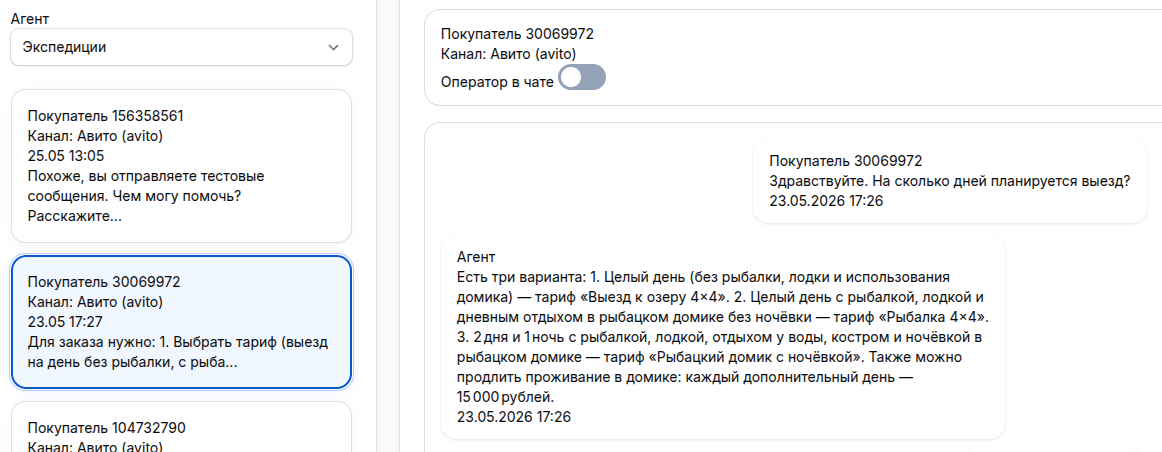
The AI chatbot in Avito solves this problem through instant reaction. He takes over the first line of support: greets the customer, clarifies interest in the product, answers standard questions, helps to choose an option, collects contact information and, if necessary, transmits the dialogue to the employee. This is especially important in niches where customers ask the same questions: is the product in stock, what size, what package, is delivery possible, what are the differences between the models and what are the payment terms.
reducing the load on operators by 30-60%
The closer the product is to an impulse purchase, the higher the value of a quick and accurate response in the chat. In Avito, this rule works especially noticeably.
What tasks does the first support line cover?
The first line of support is a communication front, where complex expert advice is not required, but efficiency, courtesy and structurality are needed. The bot can take over most of the routine requests that consume managers' working time. Instead of explaining the basic parameters of a product dozens of times a day, employees connect only to really important or non-standard cases.
answers to standard questions
This approach is especially useful for stores with a large catalog, manufacturers, dealers, service companies, and sellers whose incoming traffic depends on the season or advertising campaigns. If an ad gets a surge of views, managers often can't handle the barrage of similar messages. The bot stabilizes this area and prevents the sales funnel from "flowing" at the very entrance.
- Instant response
- Collecting needs
- Reducing the percentage of lost requests
How an AI chatbot works for product consultations
Such a solution is usually based on a bundle of several components. The first is the communication channel, that is, the chat itself in Avito. The second is the message processing logic. The third is a knowledge base about goods, terms of sale, delivery, and communication rules. The fourth is the module for transmitting the dialogue to a person or to an internal CRM, if the conversation has reached the stage of a transaction or an unusual question has arisen.
To put it simply, a bot should not be just a "talking box" with common phrases. A good solution is based on specific business data: product cards, model descriptions, frequently asked questions, discount rules, delivery geography, opening hours, and sales scripts. Then the answers are not abstract, but useful. The client asks about compatibility, timing, or configuration, and gets an answer that really helps move towards the purchase.
Technologically, two approaches can be distinguished. The first is a scenario bot, where the answers are prescribed in advance and the transitions between them are strictly limited. It's reliable, but it quickly hits the ceiling of flexibility. The second is an AI bot with a language model that can understand natural speech, reformulations, and mixed queries. For Avito, the hybrid option is most often the most effective: a scenario framework for critical steps plus AI processing for consultations in free form.
Hybrid architecture
Customer communication scenarios
In order for the bot to really work as the first line of support, it is important to think through not only the answers, but also the logic of the dialogue. Buyers in Avito write briefly, do not always formulate the question in full, and often expect to be understood at a glance. Therefore, scenarios should take into account the real manner of communication: "Is it available?", "How much is the delivery?", "Is it suitable for 10 squares?", "What is better to take?".
One of the most common scenarios is a quick response based on availability and conditions. The client writes, the bot confirms the availability of the product, briefly lists the key characteristics and immediately suggests the next step: specify the parameters, select an analog or transfer the conversation to the manager. Another common scenario is selection assistance. Here, the bot asks 2-4 clarifying questions to narrow down the options, and then suggests relevant positions.
SKUCRM
A separate scenario is the transfer of dialogue to a person. This should happen not "by failure", but at the right moment: when the client is ready to discuss the purchase, asks for individual conditions, asks a difficult technical question, or expresses dissatisfaction. A good bot doesn't argue or pretend to know everything. He carefully captures the context and transmits the conversation to the employee with the information he has already collected.
Stages of solution development
The development of a chatbot for Avito does not begin with code, but with analysis. First, you need to understand which requests come most often, where managers spend the most time, and where leads are lost. Usually, for this purpose, they study the history of correspondence, identify recurring questions, classify typical intentions — that is, user intentions — and define the boundaries of automation. Already at this stage, it becomes clear what exactly should be given to the bot, and what should be left for the person.
The next stage is the design of the knowledge base and scenarios. You need to collect information on products, terms of sale, logistics, refunds, discounts, promotions, and communication standards. Then a dialog map is designed.: how the bot greets the client, what questions it asks, how it clarifies the need, when it offers an alternative, and how it processes the transfer to the manager. The better the logic is worked out here, the fewer problems there will be after launch.
After that, the technical implementation begins. Integration with data sources is configured, response templates are created, an AI model is connected, restrictions and protective rules are prescribed. Then there are tests based on real scenarios: short questions, incomplete formulations, aggressive messages, typos, ambiguous queries. This stage should not be skipped, because it reveals weaknesses that are not visible "on paper."
The project usually follows the following logic:
- Audit of correspondence and support tasks.
- Knowledge base and scenario design.
- Development and integration with business systems.
- Testing on real cases.
- Pilot launch and subsequent retrofitting.
On average, a pilot can be prepared in a few weeks if the company already has structured product data and clear rules for handling requests. If the information is scattered and the managers' scripts are not described, it will take a significant part of the time to restore order in the support process itself.
Implementation and integration
Successful implementation depends not only on the quality of the model, but also on how well the bot is integrated into the existing infrastructure. If he does not know the current balances, does not understand the delivery status, or does not know how to transfer leads to CRM, his benefits quickly decrease. Therefore, even before launching, it is important to determine where the bot will get the truthful information from and where it should transfer the results of communication.
Most often, we are talking about integration with CRM, product catalog, warehouse system, price tables, or the company's internal API. Thanks to this, the bot can not only respond with general phrases, but also provide relevant information. Ideally, the manager, accepting the transmitted dialogue, already sees the context in the client's card: what the person was interested in, what parameters he named, what product he was offered and at what stage he is.
It is also important to define escalation rules during the implementation phase. For example, if a client reformulates a question three times, asks for a personal discount, asks a controversial question about a guarantee, or expresses dissatisfaction, the dialogue automatically leaves the employee. This reduces the risk of irritation and helps maintain trust. AI is good where speed and consistency are needed, but human involvement is still critical in complex negotiations.
Companies that implement the solution consciously usually go through a pilot on a limited number of ads or product categories. This approach allows you to compare the "before" and "after" indicators, catch errors without serious reputational risk, and only then scale the system to the entire flow.
Performance metrics and business results
You need to evaluate a chatbot not by how "beautifully" it writes, but by its impact on business performance. The first metric is the speed of the first response. The second is the proportion of dialogues that were closed without the manager's participation. The third is the conversion from a request to a targeted action: a call, receiving contacts, ordering, booking, or visiting a point of sale. The fourth is customer satisfaction and the quality of the transmitted leads.
If the implementation is done correctly, the business usually sees several results at the same time. Firstly, the workload on employees is reduced, and they spend more time on those customers who are really ready to buy. Secondly, the number of unprocessed requests is reduced. Thirdly, the uniformity of the service increases: the client receives an understandable response regardless of the time of day and the workload of the team.
According to the experience of automation projects, even a moderate increase in conversion on incoming traffic can have a significant financial effect. If a company receives hundreds of requests per month, then a 10-15% improvement in lead processing is already turning into significant additional revenue. And if operational support costs decrease in parallel, the payback of the solution becomes even more obvious.
The main value of a bot is not that it replaces a person, but that it frees up a person for really valuable work: consulting, selling and closing a deal.
Risks and limitations
Despite the obvious advantages, this solution has limitations that cannot be ignored. An AI bot should not go beyond the current data and business rules. If the knowledge base is outdated, he will confidently give incorrect answers. And in sales, this quickly turns into complaints, cancellations, and loss of trust.
The second risk area is excessive automation. Not every dialogue should be kept inside the bot until the last one. If the customer is already ready to buy or the question requires an individual calculation, it is better to transfer the conversation to the person faster. Otherwise, automation will start working against conversion. There is also a reputational aspect: users feel when they are being talked to formally and too formulaically.
Therefore, it is important to provide for restrictions and quality control at launch. We need regular knowledge base audits, dialog logs verification, tracking of unrecognized requests, and a system for quickly updating responses. AI is not a boxed "turned on and forgotten" solution, but a tool that requires support and managerial discipline.
Another important point is legal and ethical correctness. A bot should not promise something that the company cannot fulfill, collect unnecessary data unnecessarily, or provide inaccurate information as a final guarantee. The more transparent the rules of communication, the safer the scaling.
Who is this solution suitable for?
The first-line chatbot in Avito is especially useful for companies that have a regular stream of incoming messages and repeatable consultation scenarios. These can be hardware stores, furniture stores, building materials stores, auto supplies, equipment, household goods, as well as service companies where the customer needs to quickly explain the terms of the service and collect the primary order parameters.
The solution works well where managers are overwhelmed with routine, and the speed of response is critical to the transaction. If a business has a long sales cycle and each application requires complex expert analysis from the first message, the automation potential will be lower. But even in such cases, the bot can act as a filter: greet, collect input data, and direct the client to the right specialist.
The most noticeable effect is obtained by companies with three signs: a stable incoming flow, a wide range or a lot of repetitive questions, as well as the need for answers outside of working hours. In such circumstances, the bot becomes not an "additional function", but a full-fledged element of the sales funnel.
Conclusion
The AI chatbot in Avito for product consultations is a practical first-line support tool that helps businesses respond faster, maintain leads, and systematically process incoming traffic. Its value is revealed not in the spectacular technology as such, but in the concrete result: the client receives timely help, managers — less routine, the company — a more stable and predictable funnel.
For a solution to really work, it's important not to limit yourself to a beautiful idea. We need a high-quality knowledge base, well-thought-out scenarios, integration with internal systems, rules for transferring to a person, and constant customization of real dialogues. Only in this case, the bot becomes not a toy, but a working sales and service tool.
For businesses that already receive applications through Avito and want to improve communication efficiency, the introduction of such a first line of support can be one of the most rational steps in automating the customer journey.
 Автор
Антон Амосов
Автор
Антон Амосов