How a selling chatbot works: turning a conversation into a sale


Content
- Why does a business need a selling chatbot
- How does a selling bot differ from a regular one?
- What does the mechanics of selling in a chat look like?
- What does an effective chatbot consist of?
- How the bot works with objections
- Where does a chatbot do the most good?
- Which indicators are important to monitor
- Typical startup errors
- How to introduce a bot into a business without chaos
- Result
Why does a business need a selling chatbot
A selling chatbot is not just a window with automatic responses, but a digital manager who knows how to meet a customer, ask clarifying questions, select an offer and lead a person to a targeted action. Depending on the task, this may be an application, a reservation, an appointment for a consultation, a purchase, a payment, or going to the manager at the most appropriate moment.
The main value of such a tool is that it does not get tired, does not skip calls and does not lose the interest of the client in the first minutes of contact. It is the first 3-5 minutes after the request that often decide the fate of the transaction. If a person is not answered quickly, he goes to a competitor. The bot closes this risk and keeps the dialogue moving even when the sales department is busy or the company is working outside the office.
For businesses, this means not only convenience, but also measurable benefits. According to internal estimates of companies that implement automatic initial processing of requests, the response rate can increase 5-10 times, and the share of lost leads is noticeably decreasing. This is especially noticeable in highly competitive niches: services, online education, medicine, real estate, e-commerce, b2b services.
A good chatbot does not replace sales entirely. It removes the routine, speeds up the lead's qualifications, and frees people up for difficult negotiations.
How does a selling bot differ from a regular one?
An ordinary chatbot most often answers typical questions: work schedule, cost, address, delivery, refund. It's useful, but it's not a sale in itself. The selling bot is built differently: its scenario is aimed not just at informing, but at promoting the client through the funnel — from interest to a solution.
Such a bot has a qualification logic. He clarifies exactly what a person needs, at what time, with what budget, for what purpose. Based on this data, the bot segments the audience and shows a relevant offer. For example, one visitor will be offered a free consultation, another a tariff selection, and a third a case study from a similar industry.
Another important difference is the presence of built—in commercial logic. The bot understands which arguments to show to a novice and which to show to a "warm" lead. He is able to give out reviews, cases, figures, comparison of solutions, bonuses and time limits. In other words, this is no longer just an FAQ, but a scenario seller, albeit a digital one.
- A regular bot
- The selling bot
- A strong selling bot
What does the mechanics of selling in a chat look like?
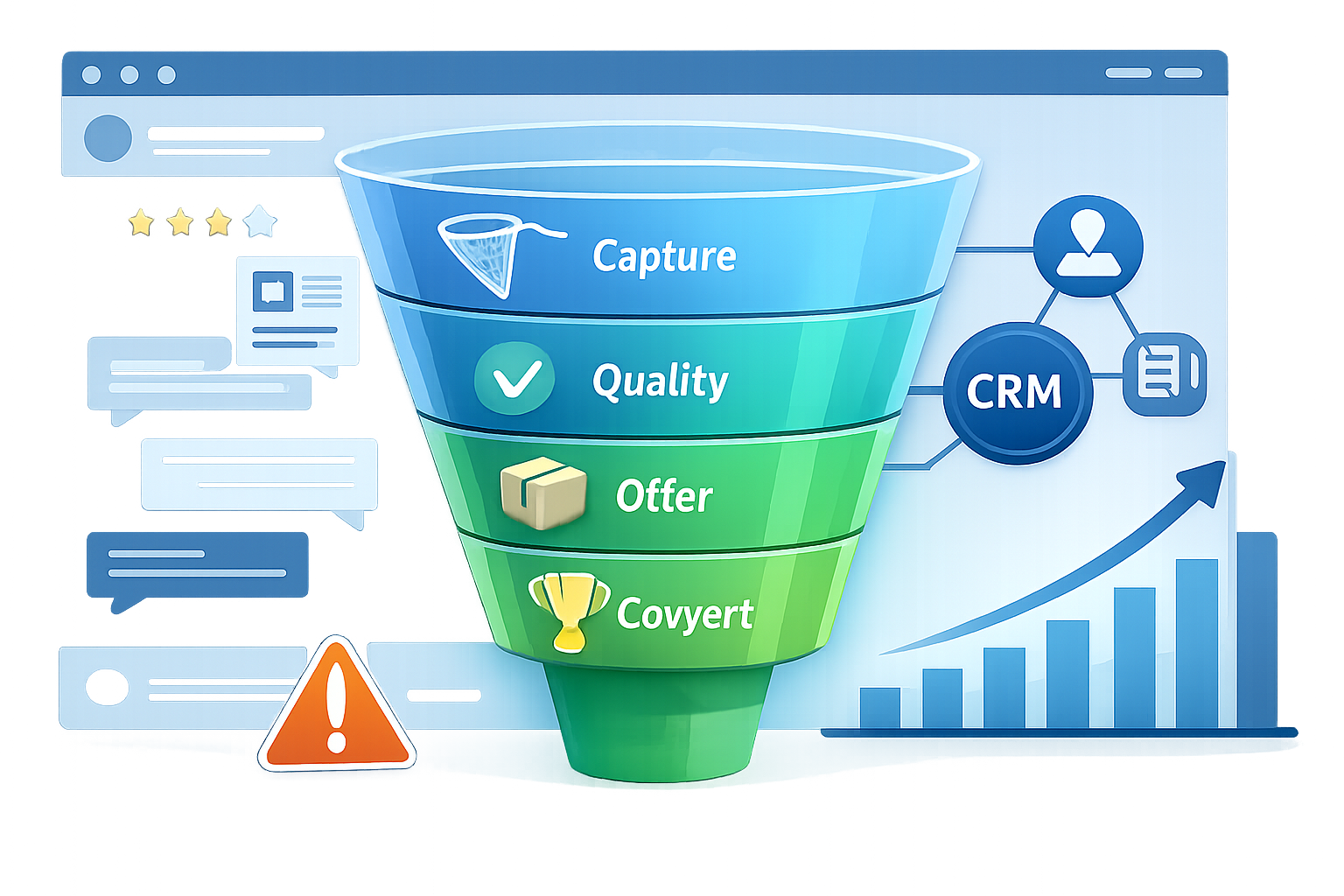
The selling chatbot is based on simple but precise mechanics: capturing attention, identifying needs, increasing interest, removing doubts, and translating into action. In fact, this is a classic sales funnel, only packaged in a short dialogue.
Let's say a person comes from an advertisement and clicks the "Learn more" button. The bot doesn't overload it with a long text, but starts with a simple question: "Choose a solution for your company or show the cost?" This step already divides traffic into different branches. Next, the bot asks 2-4 questions to understand the context, and only then gives the most appropriate next step.
If the interest is high, the bot can offer a quick transfer to the manager or leave contacts. If the person is not ready yet, the script holds the attention through useful material: calculation, checklist, a selection of cases, demonstration of the result. This is important because not every customer buys right away, but almost everyone appreciates how well they are being talked to.
The working scheme often looks like this:
- A greeting and a promise of benefit.
- One short question for segmentation.
- Clarifying the need.
- Showing a relevant offer.
- Processing a typical objection.
- Call to action: request, call, order, payment.
What does an effective chatbot consist of?
For a bot to really sell, it needs not only a technical shell, but also a high-quality architecture. The first element is the script. It should be short, understandable, and guide a person through natural logic rather than through a maze of buttons. The fewer unnecessary steps there are between the interest and the target action, the higher the conversion rate.
Social proof
The third element is integration. The bot must be connected to CRM, messengers, calendars, forms, payment systems, and analytics. Then he doesn't just talk, but turns communication into a controlled process. The contact gets into the system, the manager sees the history of the dialogue, and the manager sees the statistics on the stages.
Finally, the language of communication is important. The bot should not sound like a manual for household appliances. The best tone is clear, respectful, confident, without clerical language. When a digital interface speaks human language, trust builds faster and resistance falls.
How the bot works with objections
One of the most overlooked tasks of a chatbot is dealing with customer doubts. In practice, people rarely say directly, "It's dear to me" or "I don't trust you." More often, this manifests itself more mildly: "I'll think about it," "Now is not the time," "We need to compare options." A well-tuned bot is able to recognize these signals and respond not with pressure, but with logic.
If the question is about the price, the bot can show what the cost is, what results the client gets, and what format is suitable for the current budget. If doubt is associated with risk, feedback, case studies, and specific indicators are appropriate. For example: "We helped reduce the processing time of applications by 43% in two months" — this argument sounds more convincing than the abstract "we have high quality".
Sometimes a bot can gently take a person to the next step without a direct sale. Instead of "Buy now" — "Get paid", "See examples", "Sign up for a short review". This reduces tension and gives you a sense of control. This is especially important in sales: it is more comfortable for the client to take a small step than to immediately make a big decision.
A chatbot sells best where it doesn't argue with the customer, but helps them make decisions calmly and consistently.
Where does a chatbot do the most good?
Selling bots are most active where there are a lot of repetitive requests and where the speed of the first contact is important. In online stores, they help you pick up goods, check availability, offer accessories, and bring them to checkout. In services, they collect an application, determine the client's task and send it to the right specialist.
In the b2b segment, the bot is especially useful as a qualification tool. He can find out the size of the company, the field of activity, the current problem, the target date and budget. As a result, the sales department no longer receives "raw" requests, but clearer leads with context. This saves managers time and improves the quality of communication.
In educational projects, the bot helps you choose a training program, talk about the format, show alumni reviews, and sign up for a trial lesson. In medical and service niches, it is convenient for recording, pre-polling, and reminders. Wherever the client wants a clear and fast route, the chatbot works especially effectively.
The most noticeable effect is usually obtained by companies that:
- a large flow of similar requests;
- there are several tariffs or services that need to be selected;
- Quick response to ads and incoming leads is important.;
- managers are overwhelmed with routine and waste time on initial responses.
Which indicators are important to monitor
If a bot is embedded, but no one is looking at the numbers, it quickly turns into a beautiful toy. The effectiveness of a sales scenario is assessed not by "whether the team likes it," but by specific metrics. The first is the conversion from the beginning of the dialog to the target action. The second is the percentage of users who have reached the key steps. The third is the proportion of dialogs sent to the manager.
It is also important to keep track of the average response time, the depth of the script, the frequent exit points and the quality of the leads. The quality of a lead is the compliance of a request with your criteria: budget, need, urgency, client profile. Sometimes the bot generates a lot of requests, but if they are weak, then the scenario needs to be adjusted.
It is useful to compare the indicators before and after the implementation. For example, if a company used to process 100 requests per week and lost 30 due to a delay, but after launching the bot it loses only 10, this is already a tangible financial effect. In some projects, automation of the initial contact increases the conversion rate to the application by 15-35%, but the exact value always depends on the niche, traffic and the quality of the script.
Important:
Typical startup errors
The most common mistake is trying to make a bot all at once. As a result, the company builds a cumbersome scenario where the client has to go through dozens of steps for a simple answer. The more difficult the entrance, the higher the outflow. The bot should not surprise with its complexity, but make the path easier.
The second mistake is launching without understanding the goal. If the team has not decided what exactly the bot should sell and which stage of the funnel to strengthen, the scenario will be blurry. It's one thing to collect leads, another is to sell an inexpensive product directly, and the third is to warm up the audience with content. Each task has its own communication logic.
The third mistake is the lack of a live sequel. The bot collected the contact, but then the manager responds after six hours and asks again what has already been clarified. It ruins the user experience. Good automation does not cut off the client's path, but passes it on without losing context.
Finally, the role of copywriting is often underestimated. You can connect an ideal platform, CRM, and analytics, but if the bot's cues are boring, vague, or artificial, sales will be weak. In a chat, each phrase works as a microelement of the funnel.
How to introduce a bot into a business without chaos
The sensible way is to start not with a large platform and dozens of branches, but with one specific scenario. For example, you can automate the processing of incoming requests from advertising or the selection of services based on three parameters. Such a launch is easier to measure, refine, and scale.
Next, you should collect a minimal set of materials: a list of frequently asked questions, arguments for sale, objections, cases, examples of successful transactions. A script is created on this basis, then integrations and analytics are connected. After the launch, it is important not to consider the project completed: the first 2-4 weeks usually show where users get lost, which formulations are unclear, and where a stronger offer is needed.
launch — analysis — adjustment — restart
Strategically speaking, a chatbot is part of a common communication system. It is especially powerful when it is connected to marketing, sales and analytics in a single chain. Then each conversation turns not into a random chat, but into a managed business process.
Result
A chatbot that sells works at the intersection of speed, logic, and trust. He meets the client at the right moment, asks the right questions, helps with the choice, removes some of the objections and leads to action. For businesses, this is a way not only to automate routine, but also to make sales more predictable.
But the result does not appear because of the very fact of implementation. It's not a "bot at all" that brings sales, but a well-thought-out scenario, strong meanings, correct integrations, and constant work with metrics. Where these elements are brought together, the chatbot becomes not a fashionable feature, but a full-fledged asset that brings applications, saves resources and helps the company grow.