Choosing a platform for AI agents: review, comparison and checklist for business


In short: which platform to choose
Platforms for creating AI agents have ceased to be an experiment for technology departments. Today it is a practical tool for sales, support, lead qualification, application administration, and automation of repetitive communications. A good AI agent doesn't just answer questions: he understands the context, accesses the knowledge base, creates transactions in CRM, transmits complex requests to the operator, and works in channels where customers are already located.
no-code platforms
cost of ownershipintegration with local CRM and channelsdata control
What is an AI Agent platform?
AI Agent Platformaccess the knowledge base
Selection criteria: checklist for business
Choosing a platform should start not with a fashionable model or a beautiful interface, but with a business scenario. One agent can accept initial applications, another can advise on the catalog, and the third can resolve typical support issues. Each scenario requires different requirements for accuracy, response speed, integrations, and price.
Before buying or launching a pilot, it is useful to set targets. For example: reduce the load on operators by 30-50%, respond to customers within 10 seconds, automatically create transactions in CRM, and increase the proportion of processed requests after business hours. Without such guidelines, the platform easily turns into a showcase experiment that looks beautiful on a demo, but does not change the economics of the process.
- The purpose of the implementation:
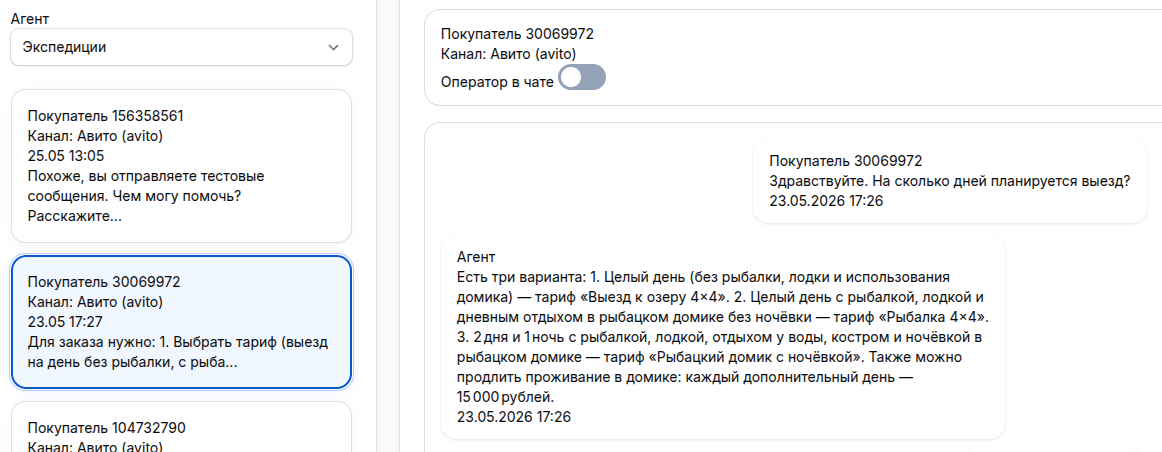
- Channels:Avito
- Integrations:webhooks and API
- Data:
- Cost:
- Quality control:
Special attention should be paid not only to the functions "at the start", but also to how the platform behaves with increasing load. A small business can start with one agent and several hundred conversations per month, and after six months reach tens of thousands of requests. If the tariff model is not transparent, the growth of a successful project suddenly turns into an increase in costs.
Platform types: no-code, low-code and developer-first
no-code of the platform
low-code solutions
developer-first platforms
In practice, the choice often looks like this: if you need to launch an AI manager on the website and in the messenger in a day, they take a no-code. If you need to link an agent to several internal systems and non—standard rules, use low-code. If AI is to become part of a large product platform, development and API—first architecture.
Comparative opportunity matrix
Below is a practical matrix that helps to compare platforms not by advertising promises, but by operating parameters. It can be used as the basis for an internal tender or a request for a commercial offer.
| Criteria | No-code platform | Low-code platform | Developer-first approach |
|---|---|---|---|
| Launch speed | From 1-2 hours to several days | From a few days to 2-4 weeks | From 1-3 months and longer |
| Do I need developers? | Usually not | Preferably for complex scenarios. | Necessarily |
| Flexibility of logic | Average, depends on the constructor | High | Maximum |
| Integrations | Ready-made CRM and channels | Ready-made integrations plus API | Any, but through development |
| The cost of the start | Low or medium | Average | High |
| Suitable for | Sales, support, consultations | Complex business processes | Product teams and enterprise architectures |
It is important to remember that the most functional platform is not always the best. For the sales department, it is not abstract flexibility that is more valuable, but a fast launch, stable responses, integration with CRM and an understandable cost. For a bank or a large holding company, on the contrary, auditing, access control, contractual guarantees and infrastructure manageability are critical.
SoftRest: Russian no-code platform for AI agents
The main value of SoftRest is a quick transition from an idea to a working agent. In business, applications are often lost not because the product is weak, but because the customer was answered too late. The AI agent closes this pause: it answers in seconds, does not leave for lunch, does not forget the rules and does not burn out from the same type of questions.
| The business problem | How SoftRest helps |
|---|---|
| Customers leave until the manager responds. | The AI agent responds in about 8 seconds, 24/7, seven days a week |
| Managers are drowning in the same type of issues | AI takes care of up to 80% of routine calls. |
| Implementing AI seems expensive and difficult. | No-code setup in 1-2 hours without developers |
Ready-made scenarios are available in the platform: AI is a sales manager, AI is a lead qualifier, AI is a technical support operator, AI is a consultant, and AI is an administrator. Each scenario can be adapted to a specific business through a prompt, which is a detailed instruction describing the agent's role, communication rules, restrictions, and the desired outcome of the dialogue.
In terms of integrations, the platform closes the typical sales circuit: amoCRM, Bitrix24, automatic creation of transactions, contacts and tasks. If the agent has qualified the lead, he can send the information to the CRM so that the manager can continue working with the prepared context, and not with an empty card.
The knowledge base deserves special attention. You can upload documents, instructions, and FAQ to it, so that the AI agent responds not "out of his head", but according to the company's materials. This reduces the risk of fake responses and allows you to update information without completely reconfiguring the agent. For example, the terms of delivery or tariffs have changed. It is enough to update the document, and the agent will start using the current data.
Another practical block is booster messages. They help to automatically remind the client of an incomplete request, return to the dialog and make repeated touches. In sales, this often has a noticeable effect: some leads do not refuse to buy, but simply get distracted. A gentle and timely reminder returns them to the funnel.
If the issue goes beyond the competence of the AI, escalation is activated for the operator. This is an important function of a mature platform: the agent should not pretend to be omniscient. He must understand the boundaries, convey a complex dialogue to a live manager, and preserve the entire context of the conversation.
Other classes of solutions on the market
In addition to specialized no-code platforms, there are several classes of solutions on the market. The first is chatbot designers, which gradually add AI functions. They are convenient for simple scenarios, but sometimes they are limited in working with a knowledge base, complex actions, and high-quality escalation.
The second class is corporate process automation platforms. They are strong in workflow, approvals, and integrations, but launching conversational AI in them may require more setup and involvement from the technical team. Such solutions are often chosen by companies where the AI agent must become part of a large internal process.: procurement, HR, document management, or employee support.
The third class is frameworks for developers. They allow you to build agent systems with almost no restrictions: connect tools, assign roles between agents, create memory, route tasks, and manage complex chains of actions. But with freedom comes responsibility: architecture, tests, monitoring, cost control for models, and data protection are needed.
For most companies, the right path does not begin with choosing the "most powerful" platform, but with a pilot in a limited scenario. For example: an agent answers questions about delivery and payment, qualifies requests from the website, or helps customers on Avito. If the pilot shows an economic effect, the system can be scaled.
No-code or development from scratch: which is more profitable
The No-code approach wins where speed is important. A business gets a working agent without hiring developers, designing an infrastructure, or building an administration interface from scratch. This is especially noticeable in typical tasks: answering frequently asked questions, primary lead qualification, consulting on services, recording a call, creating a deal in CRM.
Development from scratch is justified if the AI agent is part of a unique product or must perform complex operations with internal systems. For example, you can calculate individual financial conditions, work with several closed databases, run approval chains, or coordinate a group of specialized agents.
A compromise option is to start with a no—code platform, test the hypothesis and collect statistics, and then decide whether to delve into custom development. This approach reduces the risk: the company does not invest a large budget in the system until it has proven that customers really use the agent, and employees get time savings.
As a rule of thumb: if the scenario can be described in one regulation and connected to one or two CRM or channels, start with the no-code. If the scenario requires complex logic, internal APIs, and multi-step solutions, plan ahead for low-code or development.
Integrations, CRM and API: what to check before implementation
An AI agent becomes useful not when it responds beautifully in a chat, but when it is integrated into a business' operating system. For sales, this is CRM, for support — helpdesk, for e-commerce — catalog, warehouse and order statuses. Therefore, before choosing a platform, you need to check which integrations are available out of the box and which ones will require development.
The minimum working outline for the sales department looks like this: the client writes to the chat, the agent clarifies the need, collects contact information, asks qualifying questions, creates a deal in CRM and transmits a brief summary to the manager. If the client asks a typical question, the agent answers it himself. If the issue is complicated or requires personal conditions, it is transferred to the operator.
Webhook
In a good architecture, the agent does not store anything superfluous and does not get access to everything. He should see only the data that is needed for the task. For example, a delivery consultant does not need access to financial reports, and a lead qualification agent only needs contact information, the source of the request, and the client's responses.
Security and data requirements
The more an AI agent communicates with clients, the more serious the issue of security becomes. Phone numbers, addresses, order details, claims, commercial terms and other sensitive information may appear in the dialogues. Therefore, choosing a platform should include not only a functional test, but also a legal and technical check.
For Russian companies, data storage, access rights, contractual obligations of the supplier, the ability to delete information, and transparency in the use of LLM models are especially important. If an agent works with personal data, you need to understand where it is processed, who has access to it, and how the actions of the system's users are recorded.
- Localization of data:
- Encryption:
- NOW:
- Audit:
- SLA:
Security is not a brake on implementation, but insurance against expensive mistakes. It is better to spend a day on the checklist before the launch than to figure out later why the agent used an outdated document, transmitted unnecessary data, or responded to the client outside the schedule.
Cost of ownership and budget calculation
Tokens
For a small business, a typical scenario may look like this: one agent on the website and in the messenger, several hundred dialogues per month, basic CRM integration. In this case, a platform with a low subscription and a fast launch is advantageous. For example, if you subscribe 1,000 ₽ per month for an agent and spend a moderate amount of tokens, you can conduct a pilot without a significant budget.
Scaling is more important for medium-sized businesses: multiple channels, two CRM funnels, a knowledge base, pressure messages, quality reports, and the transfer of complex requests to operators. Here, the cost of tokens already needs to be predicted: consider the average length of the dialogue, the number of requests, the selected model, and the proportion of requests that escalate.
TCO
| The script | What is included | What to look at in the budget |
|---|---|---|
| Small business | 1 agent, website or messenger, simple knowledge base | Subscription, tokens, setup time |
| Medium-sized businesses | Multiple channels, CRM, pressure, analytics | Token consumption, integration, training of managers |
| Big business | Roles, Auditing, SLA, Multiple scenarios, Security | TCO, contractual guarantees, workload, support |
AI Agent Performance Metrics
Launching an AI agent without metrics is like turning on a navigator without a map: there is movement, but it is unclear whether it is getting closer to the goal. Sales, support, and administration require different metrics, but the basic set can be determined in advance.
FCRMTTR
In sales, it is worth evaluating the speed of the first response, the conversion from dialogue to application, the proportion of qualified leads, the number of transactions created, and the percentage of dialogues transmitted to the manager with full context. For the customer experience, you can use NPS or a short assessment after the dialogue.
It is a good practice to review a selection of dialogues every week. You need to look at where the agent answered exactly, where he evaded the question, where the knowledge base was missing, and where the client should have been transferred to the operator earlier. This is not a one-time setup, but a live process: the agent gets better when the business regularly updates documents, prompta, and escalation rules.
Quick Start: how to launch an agent without developers
A quick launch of a no-code agent usually starts with a narrow script. You should not try to automate the entire sales department and all technical support on the first day. It is better to choose a site where there are many repetitive questions and a clear result: consultation on services, application collection, delivery answers, registration for a demonstration or the initial qualification of the lead.
The typical implementation path in the no-code platform looks simple. First, an agent is created: the name, time zone, and schedule are set. Then the prompt is set up: who the agent is, how he should communicate, what questions to ask, what not to promise, and when to transfer the dialogue to the person. After that, channels are connected — for example, chat on the website, Avito or messenger. Then the knowledge base is loaded and a series of test dialogues are conducted.
In SoftRest, the basic script can be run in 1-2 hours if the materials are already ready: FAQ, description of services, terms of payment and delivery, rules for transfer to the manager. More complex integrations can take several days, especially if you need to coordinate the CRM structure, transaction fields, statuses, and access rights.
Before the public launch, it is worth conducting a "control shift": give the agent 20-30 standard questions, several provocative requests, a couple of unusual situations and check how he transmits the dialogue to the operator. It's like training a new employee: first the rules, then the training, then the work under supervision.
Final recommendations
A platform for creating AI agents should be chosen not by the number of fashionable functions, but by the ability to solve a specific business problem. If the goal is to quickly automate sales or technical support, connect a website, messengers, Avito and CRM, the no—code platform will be the best start. It lowers the entry threshold and allows you to check the economic effect without much elaboration.
If a company needs complex scenarios, internal APIs, multi-agent orchestration, and deep customization, low-code or developer-first solutions should be considered. But even in this case, it is useful to start with the pilot: it will show the real questions of customers, weaknesses of the knowledge base and the expected workload.
SoftRest fits well into the rapid implementation scenario for Russian businesses: no-code setup, ready-made agent roles, channel connectivity, integration with amoCRM and Bitrix24, knowledge base, pressure messages, escalation to the operator and a clear starting price. For companies that do not want to "play with AI", but rather put a virtual employee in a specific area of work, this format is especially practical.
 Автор
Антон Амосов
Автор
Антон Амосов