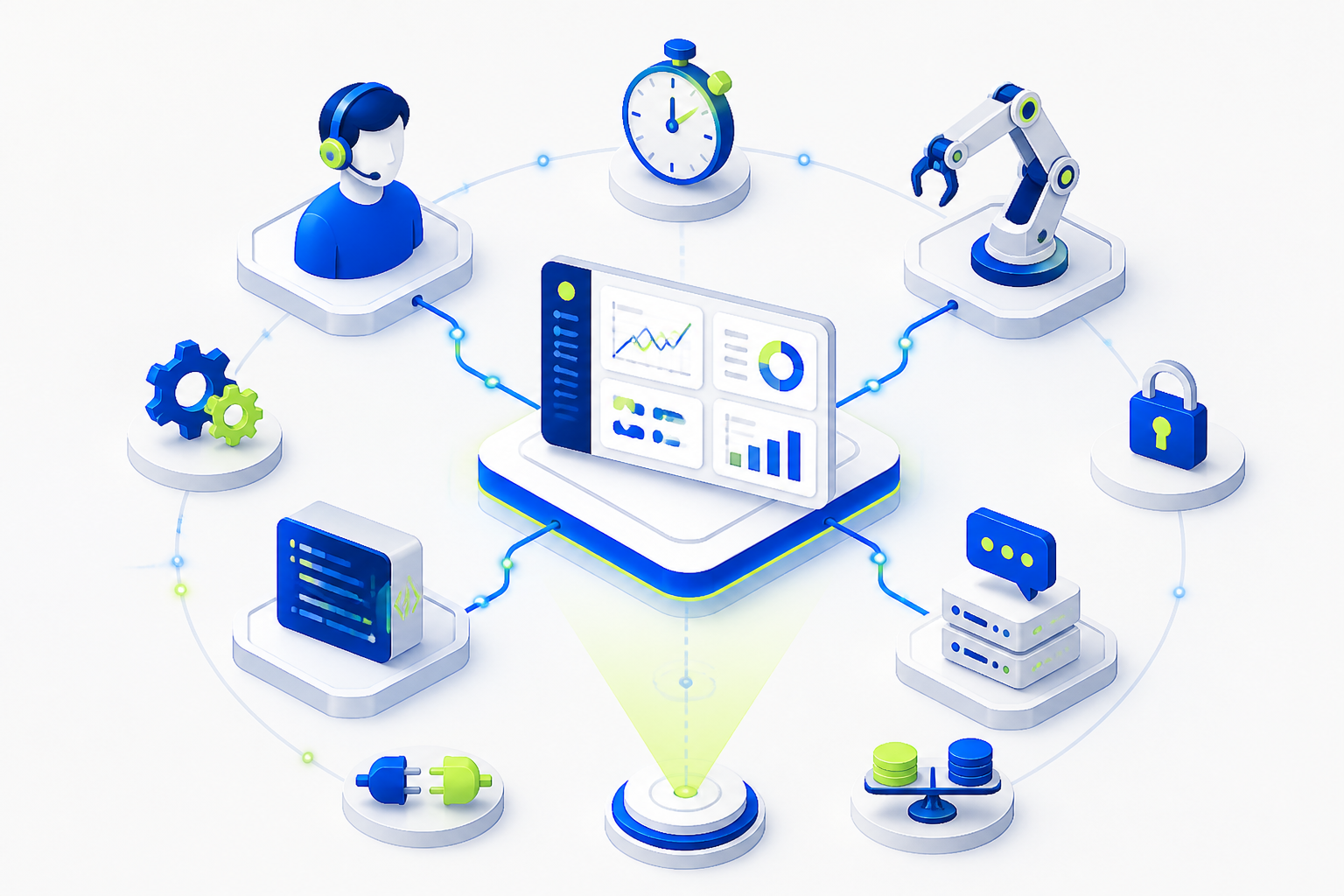
How to implement AI in companies: a practical strategy for real business



TL;DR:
AI has already ceased to be an experimental toy for innovative laboratories. It becomes the working contour of the business: it helps to predict demand, accelerate customer support, detect fraud, prepare documents, personalize offers and reduce the burden on employees. But this is where the main management risk arises: you can implement the technology quickly, but you can only get a measurable effect if you have a strategy, owners, data, safety rules, and measurement discipline.
Below is a business—oriented framework for implementing AI in a company: from setting goals to calculating ROI, roadmap, risk management, impact assessment, and social consequences. The material is intended for managers, transformation directors, IT, data leaders, operational directors and function owners, for whom it is important not to "try AI", but to integrate it into the company's economy.
Setting goals for the introduction of AI in business
The most common mistake companies make is to start implementing AI with technology: choose a model, buy a platform, launch a corporate chatbot, and only then look for where to apply it. This approach creates the appearance of movement, but rarely leads to a sustainable result. Setting goals correctly begins with a business problem: where a company loses money, speed, quality, customers, or manageability.
AI should be tied to a specific economic or operational effect. For example, not to "implement generative AI in support," but to "reduce the average response time of the operator by 30%, increase the proportion of resolved requests from the first contact from 62% to 75% and reduce the cost of processing requests by 18% in six months." This formulation immediately sets the criteria for success, the boundaries of the project, and the logic for calculating the return on investment.
Artificial intelligence
automationstrengthening decision-makingcreation of new products and business models
A good AI Implementation Goal Answers five questions: what metric are we changing, for what audience or process, for how long, what is the acceptable level of risk and who owns the result. If a project does not have a business owner, it almost inevitably turns into a demonstration of the technology's capabilities. If there is no measurable metric, the team will argue about subjective utility instead of managing the effect.
| Type of goal | An example of a business metric | An example of an AI scenario | The horizon of the result |
|---|---|---|---|
| Cost reduction | Transaction processing cost, FTE savings, cycle time | Automatic application processing, document generation | 90-180 days |
| Revenue growth | Conversion, average receipt, retention, LTV | Recommendation models, personalized suggestions | 120-240 days |
| Risk reduction | Error rate, fraud loss, delay, number of incidents | Anti-fraud, scoring, anomaly monitoring | 120-360 days |
| Speeding up processes | Time-to-market, SLA, speed of preparation of the solution | AI-Analyst's Assistant, Developer's assistant | 60-180 days |
A practical start is to take a short inventory of the possibilities. Processes, volume of operations, running costs, pain points, data quality, and potential impact are recorded for each division. The scenarios are then ranked along two axes: business value and implementation complexity. In the first projects, it is worth taking not the most fashionable ones, but those where there is clear data, an interested owner and a measurable effect.
Separately, it is necessary to take into account the context of the state and industry strategy. In many markets, AI is already regulated through requirements for personal data, transparency of algorithms, non-discrimination, cybersecurity, and auditing. GDPR, EU AI Act, NIST AI Risk Management Framework, ISO/IEC 42001 on AI management systems and ISO/IEC 27701 on privacy management are important for international companies. Even if the business operates locally, these frameworks are useful as a guideline for mature management.
The goal of implementing AI should sound like a management hypothesis: "if we use AI in this process, we will change such a metric by such a value under such restrictions." Everything else is a choice of tools.
AI implementation Strategy
An AI implementation strategy is a combination of a business portfolio, data, architecture, team, management rules, and roadmap. She answers not only the question "what to launch," but also the question "how to ensure that AI does not remain a collection of disparate pilots." In mature companies, the AI strategy becomes part of the overall digital transformation and operational model, rather than a separate project of the IT department.
PoCPilotProductive
It is reasonable for medium and large businesses to build a portfolio of three types of initiatives. Quick projects have an effect in 2-4 months: assistants for employees, automation of document processing, analytical tips. Medium-term projects require 4-9 months: demand forecasting, inventory optimization, anti-fraud, recommendation systems. Strategic projects take 9-18 months and change the product model: intelligent client services, autonomous operational circuits, industry-based database platforms.
An important element of the strategy is the management model. We need not only a technical expertise center, but also an AI committee that approves priorities, risk classes, data policies, audit requirements, and acceptable scenarios for autonomy. The committee usually includes business owners, CIO/CTO, CDO, CISO, legal function, HR and risk management. Without such a body, AI scaling begins to spread: different departments buy different solutions, data is duplicated, risks are not fixed, and the effect cannot be compared.
MLOpsDevSecOps
| Outline of the strategy | What to define | Typical artifacts |
|---|---|---|
| Business portfolio | Priority scenarios, expected effect, owners | AI opportunity map, backlog use cases, business case |
| Data | Sources, quality, access, personal data | Data readiness scorecard, data catalog, quality policy |
| Architecture | Models, integrations, cloud/on-premise, API, security | Target architecture, MLOps pipeline, solution magazine |
| Management | Roles, committee, risk register, compliance, audit | AI policy, model cards, audit trail, responsibility matrix |
| People | Competencies, learning, process change, communication | Training plan, role map, adoption program |
A practical roadmap can be built over a horizon of 90/180/360 days. In the first 90 days, the company forms a portfolio of scenarios, evaluates the availability of data, selects 2-3 projects and launches a PoC. By day 180, successful PoC's turn into pilots, the first KPIs, agreed security policies, and the initial MLOps infrastructure appear. By day 360, the company scales solutions, creates a repeatable AI product launch process, and translates effect management into regular management.
| Horizon | Key tasks | Roles | Success metrics | Resource assessment |
|---|---|---|---|---|
| 90 days | Readiness assessment, use cases selection, PoC, basic AI policy | Business owner, CDO, architect, data scientist, lawyer | 2-3 proven hypotheses, business case, data quality above the threshold | A team of 5-8 people, 0.5–2 million rubles for prototypes, depending on the scale |
| 180 days | Real-time pilot, integration, user training | Product owner, ML engineer, DevOps, CISO, Process manager | Target metric change by 10-25%, confirmed ROI scenario | Team of 8-12 people, budget for integration and licenses |
| 360 days | Industrial launch, MLOps, monitoring, portfolio scaling | AI governance board, support, data platform team, HR, compliance | 3-7 productivity decisions, regular KPI panel, risk reduction | Permanent AI CoE and lifecycle budget |
When choosing suppliers, it is worth evaluating not only the quality of the demonstration, but also the ability to work in an industrial circuit. Data ownership conditions, the ability to deploy in the right infrastructure, logging support, SLA, API security, rollback mechanisms, cost transparency, and availability of model documentation are important. For solutions based on large language models, prompt injection protection, sensitive data filtering, and hallucination control are additionally tested.
An architecturally typical outline includes data sources, storefronts, a feature preparation layer, a model layer, API integrations, user interfaces, a monitoring system, and an audit log. For generative AI, a RAG approach is often added - retrieval augmented generation, when the model responds based on corporate documents, and not just on its own internal knowledge. This reduces the risk of fake answers and allows you to refer to approved sources.
What can be done tomorrow: appoint an AI portfolio owner, collect 10-15 ideas from business functions, evaluate them for value and feasibility, select two scenarios with quick effect, audit the data and determine the minimum rules for the safe use of AI by employees. This simple discipline often brings more benefits than a long-term choice of the "ideal" platform.
Goals and plan for the implementation of AI
An AI implementation plan should translate strategy into a sequence of decisions, budgets, and milestones. It is convenient to build it around a business case: goal → metrics → hypotheses → data → solution → cost → effect → risks → criteria for moving to the next stage. Such a document is necessary not only for the investment committee, but also for the team itself: it protects the project from spreading demands and helps to stop a weak initiative in time.
ROI = (financial effect − costs) / costs × 100%
Example: a company processes 120,000 customer requests per month. The average cost of processing is 110 rubles, the share of typical requests is 45%. The AI assistant helps the operator prepare a response faster and automatically classifies the request. In the likely scenario, the processing time for typical requests is reduced by 25%, and the cost is reduced by 18%. The potential monthly savings will amount to about 1.07 million rubles.: 120 000 × 45% × 110 × 18%. If the project costs 8 million rubles, taking into account integrations and training, the payback period is about 7-8 months without taking into account the additional effects of improving the quality of service.
| The plan element | What to fix | Example |
|---|---|---|
| Goal | Changeable business metric | Reduce the cost of processing a request by 18% |
| Hypothesis | Why AI should have an effect | 60% of the response can be prepared based on the knowledge base and the history of requests. |
| Data | Sources, quality, limitations | CRM, knowledge base, chat logs for 24 months |
| KPI | How success is measured | AHT, FCR, CSAT, the cost of treatment, the proportion of escalations |
| Risks | What could possibly go wrong | Incorrect answers, data leaks, operator resistance |
| Transition criteria | When does a PoC become a pilot | Classification accuracy is higher than 85%, the economic effect is confirmed |
The project plan is usually divided into five stages. At the readiness assessment stage, the team checks the data, infrastructure, process owners, legal constraints, and user readiness. At the PoC stage, it is checked whether the model can solve the problem based on historical data or a limited sample. In the pilot, the solution is implemented in a real process with some users. At the stage of industrial launch, integrations, monitoring, support, security and regulations are configured. After the launch, maintenance begins: quality monitoring, retraining, drift control, incident analysis, and functionality development.
Scoring across five blocks is useful for assessing an organization's readiness: data, infrastructure, people, processes, and culture. If the data is of poor quality, even a strong model will give weak recommendations. If there is no owner of the process, the decision will not be made by the users. If the culture does not allow for experimentation and quick adjustments, the PoC will drag on into endless negotiations.
| Ready Block | Verification questions | The red flag |
|---|---|---|
| Data | Is there historical data, are the owners clear, and is the quality measurable? | The data is stored in Excel by different teams and does not have a single directory. |
| Infra | Is there a development environment, API, storage, monitoring? | The model cannot be safely connected to productive systems |
| People | Is there a product owner, analyst, ML/engineering competencies? | The project is conducted by IT only without a business owner |
| Processes | Is the target process described after the introduction of AI? | It is unclear who makes the final decision: the person or the model. |
| Culture | Are the teams ready to test hypotheses and change their usual roles? | Employees perceive AI as a threat, there is no communication |
KPIs need to be tailored to the type of project. To automate processes, cycle time, operation cost, percentage of manual actions, error rate, and SLA are measured. For predictive models — forecast accuracy, MAPE, reduction of write-offs, inventory turnover, planning accuracy. For recommendation systems — conversion, uplift, average receipt, retention, marginality. For generative assistants, the time required to prepare a response, the proportion of recommendations accepted, the quality of expert assessment, the level of complaints, and the number of incidents.
The measurement methodology should include a baseline before implementation. If the company does not know how much the process cost before, it will not be able to prove the effect after automation. The best option is an A/B test, where some users or clients work with an AI solution, while some remain in the same process. If an A/B test is not possible, a before/after comparison is used, adjusted for seasonality, transaction volume, and external factors.
The HR plan is a separate part of the implementation. AI rarely just "replaces people"; more often it changes the content of the work. Operators become quality controllers and solve complex cases, analysts prepare conclusions faster, lawyers use assistants for drafts, engineers accelerate development. But without training, resistance arises. Therefore, the plan includes new roles: AI product owner, data steward, model risk manager, prompt engineer for individual tasks, ML engineer, AI compliance specialist and data quality owner.
Communication must be honest. It is important for employees to explain which tasks are being automated, which competencies will become more valuable, how retraining will take place, and how the company controls the ethical consequences. In organizations where this conversation is postponed, even strong AI solutions are met with hidden sabotage: users ignore recommendations, continue to maintain parallel tables and do not report model errors.
Risks and challenges of AI implementation
The risks of implementing AI are divided into technical, legal, ethical, operational, financial and social. They cannot be eliminated completely, but they can be managed. A mature approach begins with the risk register, a risk register where the probability, impact, control measures, and responsible person are defined for each risk. This turns talking about concerns into a manageable process.
Model drift
Legal risks are associated with personal data, intellectual property, discrimination, explainability of decisions, and cross-border data transfer. For projects involving clients, employees, medicine, finance, or insurance, it is necessary to determine in advance the legal basis for data processing, retention periods, rights of data subjects, and a mechanism for challenging automated decisions. The privacy by design approach means that privacy is designed from the very beginning: data minimization, pseudonymization, access control, and access audit.
| Risk | Probability | Influence | Control measures | Responsible |
|---|---|---|---|---|
| Low data quality | High | High | Data profiling, quality rules, directory owners | CDO, data steward |
| Leakage of personal data | Average | Critical | RBAC, encryption, DLP, logging, DPIA | CISO, DPO, lawyers |
| Discrimination in decisions | Average | High | Fairness-тесты, explainability, human-in-the-loop | Risk manager, model owner |
| Hallucinations of the generative model | High | Medium/High | RAG, source verification, script limits, expert validation | Product owner, AI quality lead |
| Dependence on the supplier | Average | Average | Exit plan, data portability, contractual SLAs, multi-vendor | CIO, procurement |
Autonomous AI agents deserve special attention. Unlike a regular assistant, an agent can not only respond, but also plan actions, call up tools, work with corporate systems, send emails, create requests or initiate payments. This adds value, but dramatically increases the risks: erroneous action, abuse of access, prompt injection, unauthorized data extraction, uncontrolled cycles of operations.
RBAC
Implementation problems often turn out to be organizational rather than technical. Business expects instant results, IT fears an uncontrolled workload, the legal function blocks scenarios due to uncertainty, employees are afraid of cuts, and management is not ready to finance support after the pilot. Therefore, the strategy should include not only the development of a model, but also the outline of changes: communications, training, regulations, SLA, responsibility for incidents and the maintenance budget.
The compliance card helps you translate regulatory requirements into actions. GDPR requires the legality of processing, data minimization, the rights of subjects and the protection of personal information. The EU AI Act introduces a risk-based approach to AI systems, especially for high-risk scenarios. NIST AI RMF offers a risk management framework through the functions government, map, measure and manage. ISO/IEC 42001 helps to build an AI management system. For the company, this means the need to maintain a registry of AI systems, classify risks, document models, provide audits, and appoint those responsible.
The social consequences cannot be ignored either. The introduction of AI can increase productivity, but at the same time change the employment structure. Routine operations are being reduced, and the demand for analytical thinking, quality control, data management, and automated process management is growing. If a company does not invest in retraining, the benefits of AI will be accompanied by stress, loss of trust, and an uneven distribution of opportunities among employees.
Among the mistakes that should be avoided, four are especially dangerous. The first is to launch pilots without scaling criteria. The second is to use sensitive data in public AI services without checking the processing conditions. The third is to consider the accuracy of the model as the only KPI, forgetting about the impact on the process. The fourth is not to assign a model owner after launch. In industrial operation, AI is a living asset, not a completed project.
Effects of implementation
The effects of AI implementation manifest themselves on several levels: financial, operational, client, managerial, and strategic. The financial effect is expressed in cost savings, revenue growth, reduced losses and better capital turnover. Operational — in reducing cycle time, reducing errors and increasing the predictability of processes. Customer experience is based on the speed of service, personalization, and quality of experience. Management needs faster and more accurate solutions. Strategic — in the emergence of new products and the company's ability to adapt faster.
The results depend on the industry and the maturity of the company. In finance, AI often has an effect in anti-fraud, credit scoring, personalization, and compliance automation. In production, it is involved in predictive equipment maintenance, quality control, inventory optimization, and planning. In medicine— it supports diagnostics, patient routing, image analysis, and administrative automation. In retail— they are involved in forecasting demand, recommendations, pricing, and promo management.
| Branch | Typical cases | Possible effect | Key risks |
|---|---|---|---|
| Finance | Anti-fraud, scoring, KYC, personal offers | Decrease in fraud losses by 10-30%, increase in conversion by 5-15% | Discrimination, explainability, regulatory requirements |
| Production | Predictive maintenance, quality control, shift optimization | Reduction of downtime by 10-25%, reduction of defects by 5-20% | Sensor quality, integration with legacy systems |
| Medicine | Image analysis, triage, document management | Acceleration of document processing by 20-40%, diagnostic support | Patient safety, responsibility, personal data |
| Retail | Demand forecast, recommendations, dynamic pricing | Out-of-stock decrease by 5-15%, average check increase by 3-10% | Seasonality, quality of master data, price sensitivity |
Short cases show how the effect occurs in practice. In a service company with 300 operators, an AI assistant for customer support reduced the average processing time of a request by 22% in four months. The solution did not replace the operator, but prompted the answer, searched for relevant knowledge base articles and automatically filled in the category of the request. The main lesson: the quality of the knowledge base turned out to be more important than the choice of a model.
In the manufacturing company, the predictive maintenance model analyzed the telemetry of the equipment and warned about the probability of failure in 7-10 days. After the pilot, the number of unplanned downtime on one line decreased by 14%, and the cost of urgent repairs decreased by 9%. Scaling required not so much new algorithms as changes in the work schedule of repair crews and the spare parts warehouse.
In a financial institution, the anti-fraud model supplemented the existing rules and reduced the number of false positives by 18%. This improved the customer experience: fewer bona fide transactions ended up in manual verification. At the same time, the project underwent enhanced control of the explainability — explainability of the model so that the risk team could understand which factors influence the decision.
In B2B sales, a generative assistant helped managers prepare letters, meeting summaries, and business proposals based on CRM data. After three months, the team recorded a 35% decrease in the preparation time and an increase in the CRM filling discipline, because some of the records were created automatically. The lesson of the project: without data quality rules, the assistant quickly begins to reproduce the old chaos, only faster.
To ensure that the effect does not remain a one-time one, you need a KPI panel. It includes business metrics, technical metrics, and risk metrics. Business metrics show the economy: revenue, costs, speed, quality. Technical — accuracy, response delay, availability, data drift, error rate. Risk metrics — incidents, complaints, cases of manual rollback, policy violations, the proportion of solutions with human confirmation.
| KPI type | Indicator | Formula or measurement method | Frequency |
|---|---|---|---|
| Economy | KING | (Effect − cost) / cost × 100% | Monthly/Quarterly |
| Operations | Cycle time | Average process execution time before and after implementation | Weekly |
| Quality | Error rate | Erroneous operations / all operations | Weekly |
| Model | Data drift | Deviation of the distribution of features from the baseline | Daily/Weekly |
| Risk | AI incidents | Number of confirmed policy or quality violations | Constant monitoring |
The long-term effect of AI occurs when a company develops a repeatable ability: to quickly find scenarios, test hypotheses, safely run models, measure results, and scale successful solutions. This is not just one project, but a new management muscle. Just as companies once learned how to manage websites, CRM, and mobile channels, now they have to learn how to manage intelligent systems.
Sources and regulatory guidelines for further work: EU AI Act as the European framework for risk-based AI regulation, GDPR for personal data protection, NIST AI Risk Management Framework for risk management, ISO/IEC 42001 for AI management system, ISO/IEC 27701 for privacy, as well as national AI strategies of the UK, EU, USA, China and other countries. These documents do not replace the internal strategy, but set the language of maturity, which is understood by regulators, partners and large corporate clients.
Result:
 Автор
Антон Амосов
Автор
Антон Амосов


Related articles
A chatbot in simple words: what is it and what is it for?

GPT-6 Astra: a breakthrough to AGI or thoughtful marketing?
Top 10 platforms for building AI agents: what's inside each service
How to create an AI agent: clear architecture, tools, and typical errors
AI Agent Constructor: what is really possible to assemble without a programmer and where is the code needed?