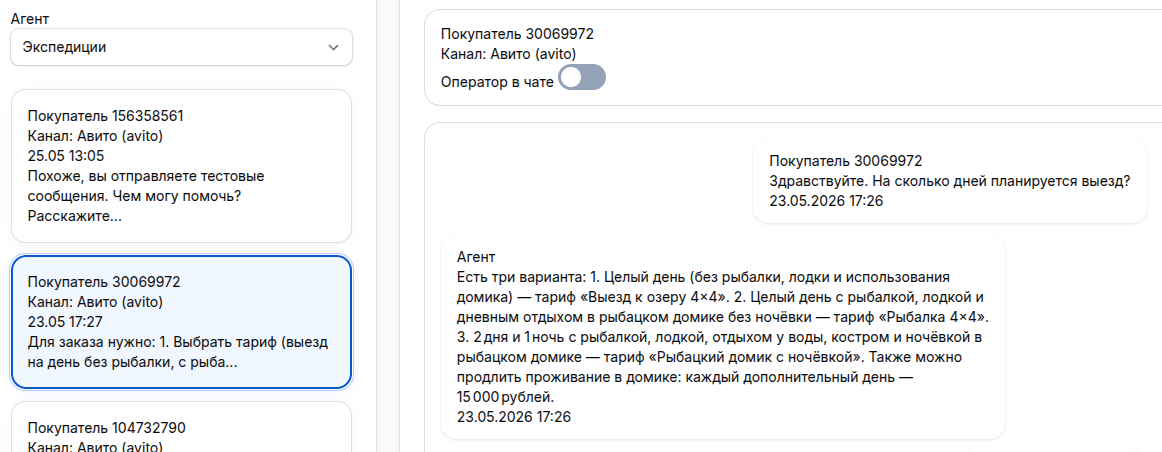
AI agent for processing applications: automating the flow of requests and increasing efficiency


Content
- What is an AI agent for processing applications?
- Why should a business automate its work with applications
- How an AI agent works in practice
- Key advantages for the company
- Where is such a tool particularly useful?
- How to implement an AI agent without chaos
- Typical startup errors
- What to expect from technology in the coming years
- Results
What is an AI agent for processing applications?
An AI application processing agent is a digital assistant that accepts, recognizes, classifies and distributes incoming requests from customers or employees without constant human intervention. It can work with applications from the website, mail, messengers, CRM, feedback forms and internal corporate systems. In fact, it's not just a chatbot, but a working mechanism that can understand the context of a request and run the desired script.
In a typical business, an application is rarely limited to the phrase "I want to buy." More often, this is a stream of heterogeneous requests: a request for a commercial offer, a complaint, a request for advice, a payment issue, a technical problem, a repeat request, a lead from an advertisement. When all this is manually sorted out by managers, some applications are lost, some are processed with a delay, and some go to the wrong specialist. The AI agent removes this narrow area and turns the chaotic flow into an understandable process.
It is important to understand that a modern AI agent can not only answer standard questions. He can extract data from the text, determine the urgency of the request, check the completeness of the information, request missing information, assign priority, tag and send the request to the appropriate department. This is especially valuable for companies where the speed of the first contact directly affects the conversion to a sale.
Simply put, an AI agent is a first-line employee who works 24/7, does not get tired, does not miss calls, and acts according to set rules with elements of intelligent analysis.
Why should a business automate its work with applications
Every company has a point where growth starts to run into operational overload. Advertising leads to more leads, the site collects more requests, the sales department receives more and more requests — and it is at this point that manual processing of applications becomes a drag. Responses are delayed, clients cool down, managers switch between tasks, and the manager sees a drop in quality with an apparently good flow.
Automation is needed not for the sake of the buzzword "neural network", but for the sake of manageability. When applications go through an AI agent, the business receives a single standard for initial processing. This means that the client is answered quickly, the request is recorded correctly, the data is not lost, and the further route of the request becomes predictable. For a manager, this is no longer an abstract "optimization", but measurable indicators: response time, percentage of qualified leads, workload on the team, and the cost of processing a request.
In practice, even reducing the first response from 20 minutes to 1-2 minutes significantly affects the result. In highly competitive niches, a client often applies to several companies at once, and the one who gets involved in the dialogue faster wins. According to the observations of the sales teams, accelerating the initial reaction can increase conversation conversion by 15-30%, especially in the service, B2B and complex product sectors.
- Reducing application losses:
- Increased reaction speed:
- Unloading the team:
How an AI agent works in practice
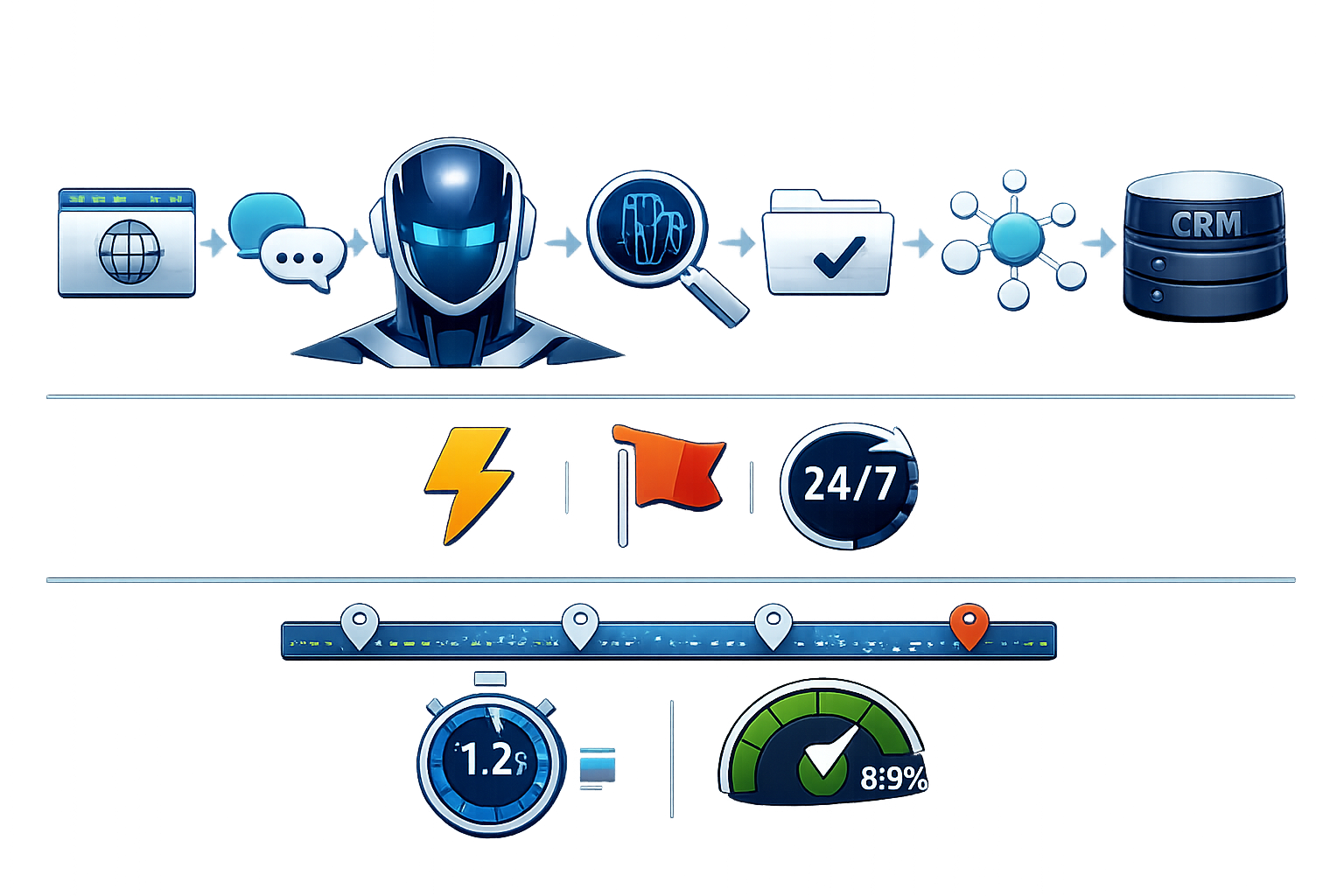
The work of an AI agent is usually structured as a sequence of steps. First, it accepts a request from a specific channel: a website, CRM, mail, Telegram, WhatsApp, or an internal form. The system then analyzes the content of the request: what exactly the person wants, whether there is enough data, which category the request belongs to, how urgent it is, and which scenario needs to be run next.
After the analysis, the agent can perform one or several actions at once. For example, he creates a lead card in CRM, assigns the "hot client" tag, sends an automatic response, asks a clarifying question, sets a task for the manager, or transfers the request to technical support. If SLAs are described in the company, that is, standards for reaction speed, the agent is able to take them into account: urgent requests go to the priority queue, and secondary requests go to the general flow.
A separate value of this approach is that the AI agent does not work only on hard scripts. Due to natural language processing models, he understands the meaning of what is written even when the user does not formulate the query perfectly. The client can write: "we need a cost calculation", "I want to understand the price", "how much does the implementation cost" — and the system will classify it into one category. This removes the limitation of the classical rules, where an exact match of keywords is required.
In more mature scenarios, the agent takes into account the interaction history. If the client has already submitted a request, the system can determine this, pull up the previous data and build a response based on the previous contact. Thus, the business receives not just automatic sorting, but contextual processing, close to the actions of an experienced coordinator.
Key advantages for the company
speed
routing quality
scalability
Finally, the analytical effect is also important. All requests can be structured by category, channel, urgency, reasons for rejection, and recurring issues. This turns application processing into a source of management data. The manager sees which questions come in most often, where customers have barriers, and which channel provides the best leads.
Where is such a tool particularly useful?
AI agents are especially in demand where the flow of requests is heterogeneous and requires rapid initial qualification. In B2B sales, they help separate real customers from random requests, collect project input, and hand over already prepared leads to managers. This saves hours of routine correspondence and increases the chances of a high-quality first call.
In online stores and service companies, the agent removes some of the burden from support: tracks order statuses, answers frequently asked questions, helps to issue refunds, redirects non-standard requests to the right specialist. In medical centers and educational projects, he can make an appointment for a consultation, check for available slots, and collect preliminary data. In real estate, it is important to determine the object of interest, the budget and the stage of decision—making.
An AI agent is also useful in the internal processes of a company. For example, for the HR department, it can sort candidate responses, highlight relevant resumes, and send automated messages. For IT support, it is necessary to receive incidents, classify problems, and transfer tickets by profile. For administrative services, it is necessary to process employee service requests, from ordering access to requesting equipment.
One of the illustrative cases: a company with a monthly flow of about 4,000 incoming calls has implemented an AI agent for the initial qualification of leads. The first response time was reduced from 18 minutes to 40 seconds, the proportion of correctly distributed requests increased to 92%, and the load on first-line operators decreased by about a third. For businesses, this means not only savings, but also a more predictable funnel.
How to implement an AI agent without chaos
The main mistake of the implementation is trying to automate everything at once. It is much more efficient to choose one clear area: for example, processing incoming leads from a website or routing requests from mail. First, the current scenarios are described: what types of requests are received, what data is needed to start work, where different categories of requests are sent, and what prioritization rules apply within the company.
The next stage is the preparation of the knowledge base and business logic. The AI agent needs to understand how a "price request" differs from a "technical problem", which fields are required, when an automatic response can be given, and when a live specialist is needed. The better structured these rules are, the higher the quality of the result. The participation of business people is especially important here, not just the technical team.
After that, the pilot starts on a limited segment. It is a good practice not to completely replace a person first, but to use the assistant mode: the agent accepts and marks applications, and the employee checks the routing quality. This allows you to quickly identify weaknesses and retrain the system without reputational risks. When the accuracy becomes stable, the proportion of automatic actions can be increased.
- Select one process to start.
- Describe the categories of requests and the routing rules.
- Connect CRM, mail, forms, and messengers.
- Conduct a pilot and measure the results.
- Scale only after quality control.
If the implementation proceeds in stages, the business gets a controlled result, rather than another "smart tool" that looks nice in the presentation, but does not solve the real operational problem.
Typical startup errors
The first common mistake is the lack of a clear goal. If a company says "we want AI because it's modern," the project almost inevitably stalls. You need to understand what exactly is improving.: response rate, quality of qualifications, reduced workload, increased conversion, or transparency of analytics. This is the only way to choose the right scenario and measure the effect.
The second mistake is poor initial processes. An AI agent does not fix chaos automatically. If a company doesn't define who should handle different types of applications and how, technology will only accelerate the mess. First, we need minimal process discipline: categories of requests, transfer logic, responsible persons, rules of escalation.
The third mistake is waiting for magic without setting it up. Yes, modern models are strong, but they still need restrictions, examples, rules, and quality control. Without this, the agent may classify requests too generically, ask unnecessary questions, or, conversely, fail to collect important data. Therefore, the launch is not "turned on and forgotten", but a controlled development of the system.
There is also a reputational risk: if you completely hide the involvement of automation and do not think through the transfer to a person, the client may feel the coldness of communication. A good AI agent does not replace empathy where it is really needed. He must quickly bring the dialogue to the right point and transfer the conversation to a live specialist in time.
What to expect from technology in the coming years
In the near future, AI agents will become not just classifiers of applications, but full-fledged coordinators of the client path. They will be able to take into account the history of communications, user behavior on the site, traffic source, previous purchases, transaction status and internal regulations of the company. This will create more accurate and personalized request processing scenarios.
Multi-channel operation will also increase. The same agent will work seamlessly with the website, telephony, messengers, CRM and internal systems. For a business, this means that gaps between channels disappear: the client started a conversation in a chat, continued in the mail, and the manager has already received the full picture without manually reassembling the information.
A separate trend is the transition from reaction to proactivity. The system will not only process an incoming request, but also anticipate problems: notice an increase in repeat requests, signal queue congestion, suggest which leads require urgent attention, and even recommend changes to scripts or interfaces. This transforms the AI agent from an execution tool into a management support tool.
This will become a competitive advantage for companies that start building such processes now. In an environment where products and prices are becoming more and more similar, the winner is the one who works faster, more accurately and more calmly with the client's request.
Results
An AI agent for processing applications is a practical tool at the intersection of sales, service and automation. It helps to keep up with requests, respond faster to customer interest, reduce the routine workload on the team, and turn the message flow into a manageable system. Its value is especially noticeable where there are many applications, they come from different channels and require primary qualifications.
For businesses, this is not a story about replacing people, but about redistributing efforts. The machine takes on repetitive tasks: receiving, sorting, clarifying, routing, and recording data. People focus on what really affects the outcome: negotiations, complex consultations, solving non-standard tasks and developing relationships with clients.
Companies that approach implementation systematically receive not only operational savings, but also a higher standard of customer experience. And in today's market, this is increasingly becoming a crucial choice factor.


Related articles
Top 10 platforms for building AI agents: what's inside each service
A chatbot in simple words: what is it and what is it for?
How to create an AI agent: clear architecture, tools, and typical errors
AI Agent Constructor: what is really possible to assemble without a programmer and where is the code needed?
Terms of reference for an AI agent: template, structure and examples of formulations