An AI agent in simple terms: how it thinks, acts, and helps a business


What is an AI agent in simple terms?
The AI agent
For a manager, it's not technological magic that matters, but the managerial essence: an AI agent turns part of the operational processes into a managed digital workforce. It does not replace the team's strategy, responsibility, and expertise, but it removes routine, speeds up information processing, and reduces the cost of repeatable operations.
An AI agent is not a smart chat. It is a bundle of goals, models, data, tools, rules, and controls that performs a business task within a given contour.
How does an AI agent differ from a chatbot and conventional automation?
For example, a chatbot can tell a manager how to fill out a report. Automation can automatically generate a report on a button. An AI agent can collect data from several systems by itself, find discrepancies, ask a clarifying question, prepare conclusions and send a report to the responsible person.
the ability to actERP
How an AI agent works: a simple scheme
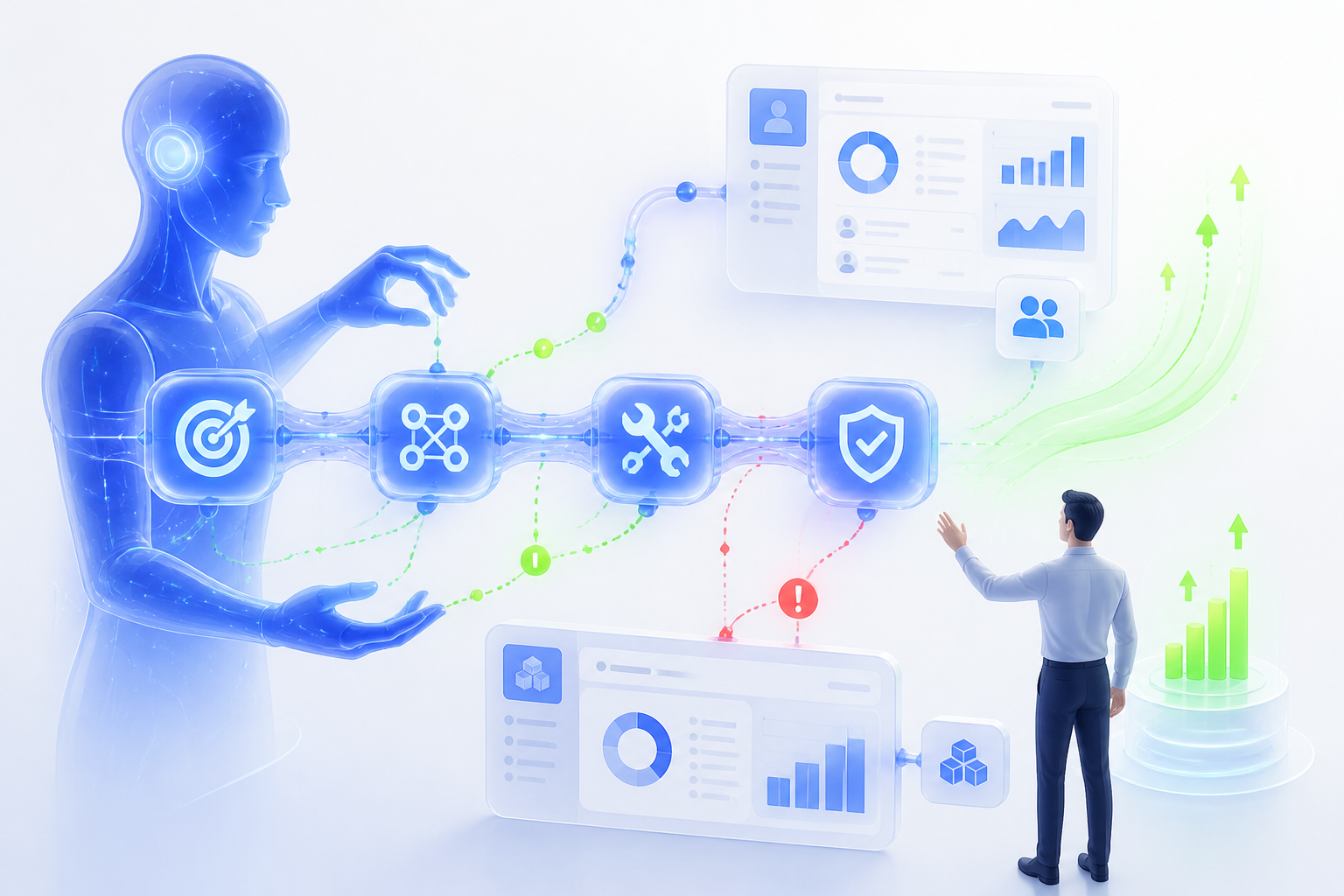
It is convenient to imagine the work of an AI agent as a cycle. The manager or the system sets a goal, the agent analyzes the context, selects a plan, turns to tools, checks the result, and, if necessary, passes controversial decisions to the person.
That is why the introduction of AI agents is not just about purchasing technology. This is a process design project: what data is available, what actions are allowed, where a person is needed, and what metrics are considered success.
Where AI agents have an effect in a company
The best first scenarios are where there are repeatable tasks, lots of textual information, clear quality criteria, and high cost of manual processing. In such processes, the agent does not require a revolution in the organizational structure, but quickly shows the economy.
In sales, an AI agent can prepare meeting summaries, update CRM, generate follow-up letters, and analyze the reasons for losing deals. In the client service, it is necessary to classify requests, offer responses to the operator, collect the client's history and identify the risk of outflow. In procurement, it is necessary to compare commercial offers, check the terms of contracts, and highlight deviations from the company's policy.
In HR, agents help analyze responses, prepare shortlists, and conduct initial communication with candidates. The legal function is to find risky formulations in documents. In finance, they compare payments, prepare explanations for deviations, and collect data for management reporting.
A practical guideline: if an employee regularly copies data between systems, reads the same type of documents, writes similar letters, or manually checks the rules, the process should be considered as a candidate for agency automation.
Economics of step-by-step implementation of AI agents
The economics of AI agents are revealed not in one big project, but in a consistent increase in maturity. At the first stage, the company gets a quick effect on a limited process. Then it scales the approach to related functions, connects more data, and puts some of the operations into a controlled offline execution mode.
Below is a simplified diagram that shows the typical logic: investments grow gradually, and the operational effect begins to noticeably outstrip costs after the introduction of a reusable platform, security templates, and agent library.
In the pilot, the company usually measures the reduction in manual time, processing speed, result quality, and internal user satisfaction. For example, if an agent reduces the preparation of a report from 3 hours to 25 minutes and does it 200 times a month, the savings become visible without complex ROI models.
At the scaling stage, the main source of benefit is reuse. Once created, data access components, product templates, security policies, action logs, and reconciliation mechanisms begin to work for new agents. Therefore, the second and third scenarios are often implemented cheaper than the first.
Risks, control, and the human role
AI agents cannot be deployed as unsupervised digital employees. Their strength lies in their ability to act, and that's why they need boundaries. Access rights, logging of actions, verification of sources, protection of personal data and a clear area of responsibility are critical for the corporate environment.
human-in-the-loop
It is important for the board of directors and the top team to consolidate the management model: who owns the agent, who approves the scripts, who is responsible for the data, who analyzes errors, who decides whether it is possible to increase the level of autonomy. Without such a model, AI initiatives quickly turn into a set of disparate experiments.
Where should a manager start?
process mapsapplication processing
A practical starting approach:
- Select one process
- Describe the target result
- Connect data and tools
- Launch a pilot with a human in the loop
- Scale a successful template
Conclusion
An AI agent is a managed digital executor that helps a company transfer repeatable intelligent work from manual to semi-automatic or automatic mode. Its value lies not in a spectacular demonstration, but in reducing operating costs, speeding up processes and improving the quality of solutions.
For managers and those responsible for AI transformation, the main question is not "can AI respond beautifully," but "what processes are we ready to transfer to agents under control, with an understandable economy and measurable results." Companies that start with point-to-point scenarios and quickly move to platform management receive not a single experiment, but a new layer of corporate productivity.
 Автор
Антон Амосов
Автор
Антон Амосов