When AI makes code more expensive: Why generation makes maintenance more expensive


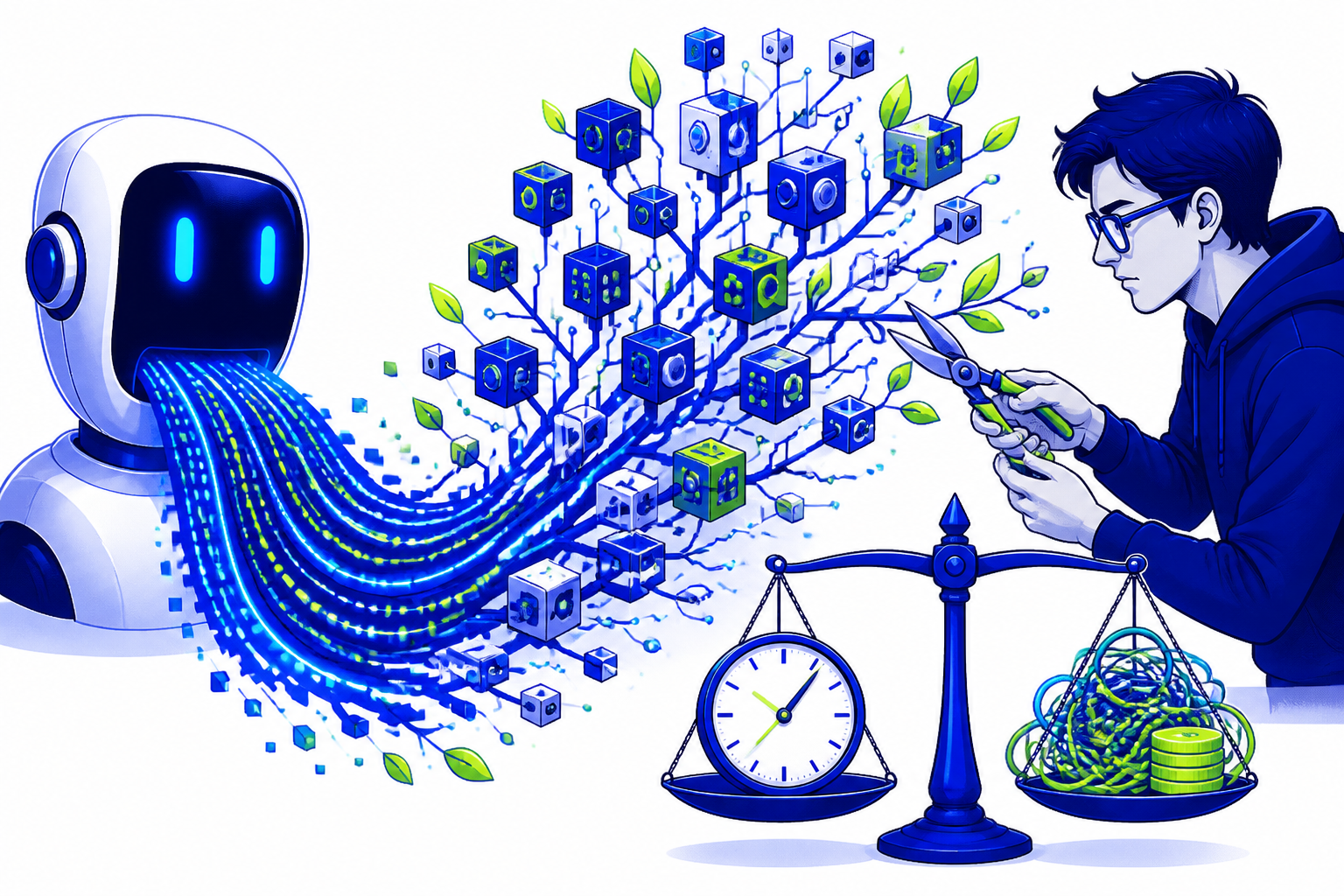
Why is the best code often the one that didn't have to be written?
The code is not free after writing. It needs to be read, checked, changed, ported to new versions of libraries, protected from errors, and explained to new team members. Therefore, the quality of the code is determined not by the volume, but by how easy it is to maintain.
AI speeds up the creation of software fragments, but it does not negate the main principle: extra code increases future costs. If the task can be solved by configuring, removing old logic, or simplifying the process, the new code will only complicate the system.
A good solution is usually short and clear: fewer entities, fewer special cases, fewer hidden dependencies. This approach does not look impressive, but it reduces the cost of maintenance and reduces the risk of errors with the following changes.
How AI is changing the Economics of development
Artificial intelligence-based tools have accelerated day-to-day development. They help you write standard functions, select syntax, prepare checks, explain unfamiliar parts of the project, and assemble the first solutions. Tasks that used to take hours are now often completed in minutes.
The main change is a reduction in the start price. The team gets a working fragment faster and can show the result sooner. This is especially useful in projects with clear architecture, common conventions, and well-defined requirements.
But the cost of creation is only a fraction of the cost. After the code appears, you need to read it, check it, embed it in the system, protect it from errors, and support it when changes occur. If the fragment is poorly aligned with the project, the initial savings quickly disappear.
Therefore, the bottleneck is not the typing speed, but the quality of the engineering solution. It is important to understand in advance what really needs to be written, where the new logic should live, which cases need to be checked and when it is better to simplify the existing code instead of adding a new one.
AI is useful as a developer's assistant, but it does not negate architectural decisions, analysis of changes, and responsibility for maintenance.
The hidden cost of the generated code
The main danger of AI generation is not that the model sometimes makes mistakes. People make mistakes too. The problem is deeper: the generated code may look convincing, be syntactically correct, and even pass initial tests, but it doesn't fit well into the project architecture. It's like furniture bought without measuring the room: it's high-quality in itself, but it blocks the passage.
Code that is easy to generate is not necessarily easy to delete. Namely, removability often shows how healthy the system remains.
A separate problem is the style. AI can adjust to the context, but in large projects, the context is often incomplete: the model does not see the entire history of architectural solutions, does not know the internal agreements of the team, and does not feel the reasons why one approach was once prohibited. As a result, fragments appear in the code base that look like "normal code", but speak a different engineering dialect.
According to the estimates of many teams, the maintenance of a software product can take 60-80% of its life cycle. Even if the specific figure varies from project to project, the principle remains the same: the basic price of the software is often paid after the release. Therefore, the question for AI should be not only "can he write this?", but also "will we be able to support it in a year?"
What is the danger of code base proliferation?
When writing has become easier, it is tempting to add new code instead of simplifying the old one. This creates parallel implementations, temporary workarounds, extra layers, and features that no one dares to remove.
The expansion of the codebase directly affects maintenance. Checks take longer to complete, it is more difficult to find errors, and the risk of breaking a neighboring part of the system is higher. The team can release more changes, but actually move more slowly.
Areas without a clear owner are especially dangerous. They appeared quickly, but no one knows what the requirements are behind them and why this particular solution was chosen.
What is considered high-quality code in the age of AI
High—quality code is not the most complex and not the newest in terms of approaches. It solves the problem, is understandable to the team and does not create unnecessary costs for changes.
Simple signs are important: the purpose of the site is clear without much parsing, logic is not duplicated, dependencies are visible, errors are handled explicitly, and important scenarios are checked automatically.
Another criterion is removability. If the requirement has disappeared, good code can be removed without a chain of unexpected breakdowns. This shows that the solution has not expanded beyond its task.
AI can help you write such code, but the final quality depends on the developers: they make the decision, check the meaning, and are responsible for maintenance.
When generation really helps
Generation is useful where the task is well described, the result is easy to verify, and the cost of error is low. These are typical data transformations, simple checks, usage examples, documentation, and small utility functions.
AI also helps you quickly compare approaches, find repetitive code, and suggest borderline cases. But the proposed option still needs to be simplified, checked, and aligned with the project architecture.
The best mode of operation is short: formulate a task, get an option, remove unnecessary items, write checks, and only then accept the code into the project.
Practices that reduce risks
To prevent AI from increasing the cost of maintenance, the team needs clear rules.
- Design first.
- Small changes.
- Review before acceptance.
- Checks.
- Removing unnecessary content.
- Unified agreements.
These rules slow down only at first glance. In practice, they protect the team from future alterations.
The role of the team, architecture and engineering culture
AI enhances the team's current habits. If the architecture is clear, there are checks and normal analysis of changes, generation speeds up the work. If the rules are blurred, AI creates chaos faster.
Therefore, not only tools are important, but also an engineering culture: discussion of solutions, control of complexity, willingness to simplify and delete. The team should evaluate not the amount of writing, but the impact on support.
The architecture sets the boundaries within which generation is safe. Without these boundaries, even a working fragment can become expensive in the future.
Conclusion: writing faster is not enough
AI speeds up code creation, but it doesn't guarantee lower costs. The most expensive things are unnecessary entities, non-obvious logic, weak checks, and solutions that no one understands.
The benefits come when generation is integrated into a normal engineering process: first the task and architecture, then a short fragment, verification, simplification, and only after that acceptance into the project.
The code becomes cheaper to maintain, not because it is written quickly, but because it is understandable, appropriate and minimal.
 Автор
Антон Амосов
Автор
Антон Амосов


Related articles
The cost of developing Telegram bots in Russia in 2025

How AI improves labor productivity in Russia: cases, impact, and limitations

AI Agents and 152‑FZ: how to ensure legitimate data processing and risk management
Fine-tuning LLM: how to turn a model into a business partner
From Machine Optimization to Token Optimization: How AI Agents are Changing Development