
RAG or regular ChatGPT — which one should I choose for my product and business?


Content:
- What is a regular ChatGPT?
- What is RAG?
- The main difference between the approaches is
- When does regular ChatGPT work better
- When does RAG provide more benefits
- Limitations and risks
- How to choose a business and product approach
- Bottom line: which is better in practice
What is a regular ChatGPT?
The usual ChatGPT is usually understood as the operation of the language model in dialogue mode without connecting to your internal data at the time of the response. The model relies on its trained patterns, general knowledge, language structure, and the context of current correspondence. This is convenient, fast, and really effective in many tasks: you can get a draft text, an explanation of a term, a list of ideas, an article structure, a letter to a client, or a brief reference on a well-known topic.
startup speed and low entry threshold
accurate, fresh, internal, or highly specialized data
That's why regular ChatGPT is great for a wide range of universal tasks, but it's not always good where the cost of error is high: in customer support, legal explanations, technical regulations, medical scenarios, or working with corporate documentation.
What is RAG?
Retrieval-Augmented Generation
a well-organized bundle of search and generation
This is especially important for the company in practical scenarios. For example, an internal employee assistant may be responsible for corporate regulations, an AI consultant on the website for the catalog and delivery terms, and a support service for up-to—date product instructions. In such cases, value is created not only by the intelligence of the model, but also by the quality of the connected knowledge base.
verifiability, relevance, and link to the source
The main difference between the approaches is
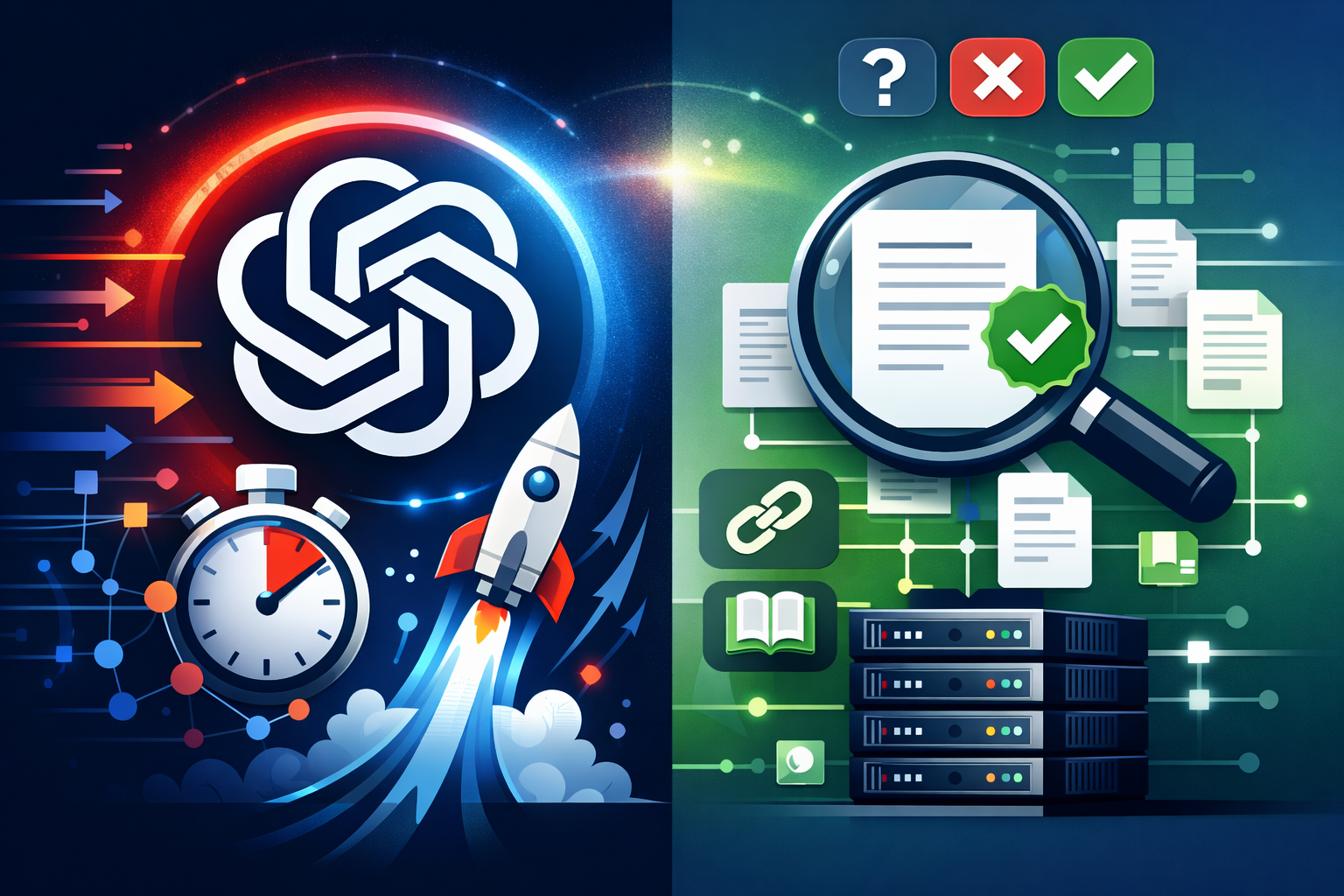
A regular ChatGPT responds from the trained model and the context of the dialog, while RAG responds from the model plus the found documents.
In the first case, you are counting on the general erudition of the model. In the second case, you add access to your data to this erudition. Therefore, comparing them as "which is better in itself" is not entirely correct. It is more correct to ask: for which tasks a universal model is sufficient, and where without an external source of knowledge, the quality of the answer will be insufficient.
There is also an operational difference. A regular chat can be implemented almost instantly: the interface and basic instructions are enough. RAG requires more preparation: you need to collect documents, clean up data, break them down into semantic fragments, set up a search, test relevance, and regularly update the index. That is, the benefits are higher, but the maturity of the system should be different.
At the user experience level, the difference is reflected in the quality of the specifics. A regular chat often provides a "smart general response." RAG often gives an answer related to your context: tariff, instructions, refund policy, product characteristics, API version, or internal regulations.
When does regular ChatGPT work better
Despite the popularity of RAG, in many scenarios it is the regular chat that turns out to be the more reasonable choice. It is suitable where access to private data is not required and where generation speed is appreciated. For example, for marketing, creativity, initial analysis of ideas, writing letters, communication scenarios, product descriptions, or preparing a presentation structure.
He is also good at educational and explanatory tasks. If the user needs to explain in simple words what an API is, how SQL works, how the frontend differs from the backend, or how unit testing works, a regular ChatGPT can handle it quickly and at a good level. Connecting RAG for the sake of this is not always justified.
This is especially important for a product launch. Many teams are trying to build a complex AI infrastructure too early, when real value can be obtained from a simple chat with well-thought-out instructions. In some projects, this reduces the startup time from a few weeks to a few days.
A practical guideline:
When does RAG provide more benefits
answers based on specific documents
Let's imagine a case: a company is implementing an AI assistant for a customer service. Without RAG, he can respond politely and convincingly, but sometimes he gets confused about delivery dates, warranty conditions, or returns. With RAG, the system will first find the exact fragment in the knowledge base, and then formulate an answer based on it. As a result, the risk of misinformation is reduced and the burden on operators is reduced.
20–40%
Another advantage is the ability to link to the source. This is especially valuable in an environment where trust is needed: in employee instructions, compliance, finance, law, and technical documentation. The user gets not only the answer, but also the foundation on which it is built.
Limitations and risks
For regular ChatGPT, the main risk is associated with so—called "hallucinations" - situations where the model confidently formulates an answer without reliable factual support. This does not necessarily look like a clear mistake: often the problem is a semitone, an inaccurate term, an outdated detail, or a fictitious certainty. This is tolerable for content tasks, but it is already dangerous for operational tasks.
RAG has its own difficulties. By itself, this approach does not guarantee quality. If the knowledge base is outdated, documents are duplicated, fragments are cut unsuccessfully, and the search ranks the results poorly, the model will respond based on a weak context. And then the team gets a false sense of reliability: "we have documents connected," although in fact the system is unstable.
There are also infrastructure costs. RAG requires pipeline support: file upload, indexing, monitoring, query testing, and access control to sensitive data. This is no longer just a chat interface, but a full-fledged product component. It requires an owner, metrics, and regular improvement.
regular chat is simpler, but less manageable in accuracy; RAG is potentially more accurate, but more difficult to implement
How to choose a business and product approach
where should the correct answer come from?
It is useful to make a simple diagnosis. Answer three questions.:
- Does the system need up-to-date internal data that is not available in the open learning model?
- Is the price of error in the answer high: financial, legal, reputational, or operational?
- Should the user see which source the response is based on?
If the answer to at least two questions is "yes", RAG usually turns out to be the more mature choice. If the task involves generating ideas, template texts, explanations, training materials, or preliminary drafts, a regular chat will provide the best balance between speed and results.
In practice, many strong products use a hybrid approach. They don't try to solve everything through one mechanic. Creative and universal tasks are assigned to the usual model, while accurate and fact—dependent tasks are assigned to the data search system. This approach reduces the cost of implementation and at the same time increases the usefulness of AI in real business scenarios.
A good AI architecture does not begin with choosing a fashionable tool, but with understanding the nature of the issue, the cost of error, and the source of truth.
Bottom line: which is better in practice
Regular ChatGPT is better where speed, versatility, and generation are needed without reference to internal data.RAG is better where facts, relevance, corporate context, and verifiability are needed.
In business terms, regular chat is a quick way to get value here and now. RAG is the next level of maturity, when AI should not just talk, but work as a reliable layer of access to the company's knowledge. One tool helps you think and formulate, the other helps you reduce the risk of errors and scale access to information.
Therefore, the best choice is not abstract, but applied. For blogging, marketing, training, and quick internal scenarios, a regular ChatGPT is often enough. It makes more sense to build a RAG for support, documentation, internal knowledge bases, and high-responsibility AI assistants.
if you need a smart interlocutor, take a regular chat; if you need a smart interlocutor who relies on your documents, you need RAG


