
AI integration with 1C: automation of routine processes without replacing the accounting system


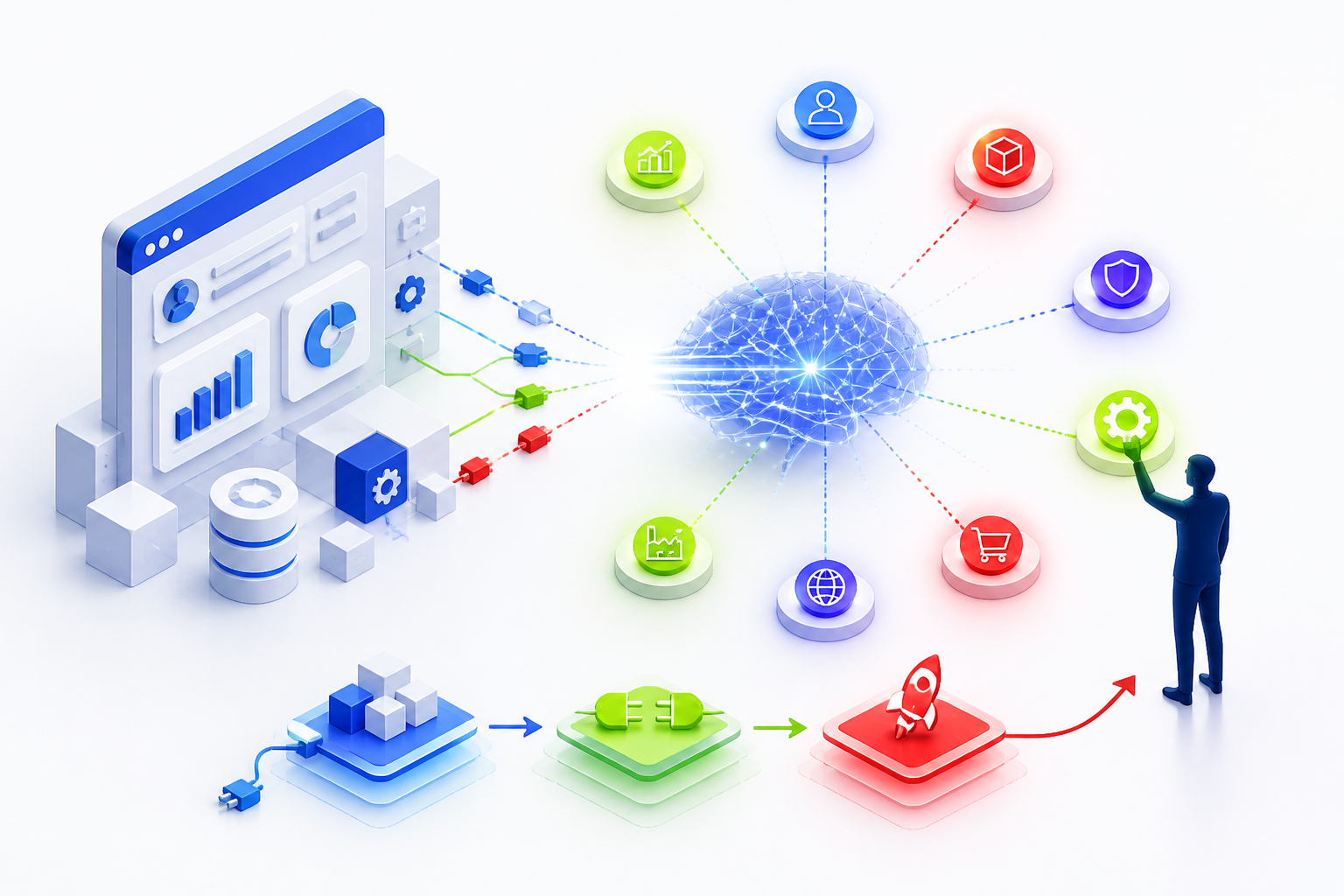
The short answer is that you don't need to change 1C for the sake of introducing AI.An AI agent connects nearby
""The main boundary is not between the "old 1C" and the "new AI", but between the preparation of data and a legally significant action. The agent can fill out the document by 90-95%, highlight the risk, collect information and offer an answer. But the holding, signing, and management decisions are left to the individual. This is not a reinsurance of integrators, but a normal business architecture, where accounting should be verifiable and responsibility should be clear.
what tasks in 1C can already be automated?which section is safer to start from
Content
- What 1C already knows how to do
- Eight Processes that benefit AI
- How does it connect, in short
- Where a person is required — and this is not a reinsurance
- What AI doesn't do in 1C
- Where to start: implementation procedure
- What to do next
What 1C already knows how to do
Before ordering the development of an AI agent, it is worth honestly checking what is already being closed by regular services. This is an important step: sometimes a business does not need a separate module, because the necessary function is already available in ITS subscription or in the cloud service of the 1C ecosystem. This approach saves the budget and helps to avoid turning the introduction of AI into an expensive experiment for the sake of the experiment itself.
An important frame: as of September 2026 in the "1C" platform:Enterprise" there is no built-in universal LLM assistant that you can talk to like ChatGPT, GigaChat, or YandexGPT. The official AI capabilities of 1C are primarily separate ITS cloud services and application solutions for specific tasks.
| Service | What does |
|---|---|
| 1C:Recognition of primary documents | Converts scans and photos into database documents: invoices, TORG-12, acts, invoices, UPD, UKD, cash receipts. It works with PDF, PNG, JPG, BMP, TIFF, Word, Excel and archives, is able to split scans into separate documents and memorize the comparison of the supplier's nomenclature. |
| 1C:Speech Recognition and Speech Synthesis | They are used in STT and TTS scenarios: speech-to-text and text-to-speech translation, including in 1C:Workflow and 1C:CRM. |
| 1C:Sales forecasting and 1C:Universal forecasting | They build ML forecasts based on historical data, and help plan purchases, production, and inventory. |
| 1C:Receipt Scanner, 1C-Products, 1C-Retail Checker | They help with advance reports, demand forecasting, assortment management, and control of retail operations. |
| 1C:A Development Partner | AI is an assistant in 1C:EDT for developers, not an assistant accountant or manager inside the work base. |
"1C:Analytics" is BI, not AI
"Also, "you should not write and expect that "1C has integrated GigaChat or YandexGPT" as a regular feature of the platform: there have been no public statements from 1C about such integrated integration. All such bundles are third—party solutions or individual projects. The conclusion is simple: you need to start by checking ITS and typical capabilities, and an AI agent is needed where dialogue is required, work with multiple systems, the company's own rules and flexible logic.
Eight Processes that benefit AI
A good AI project in 1C does not begin with the phrase "let's implement a neural network," but with a list of repetitive operations. If a task is often repeated, has a clear input, a verifiable result, and does not require an independent legal decision, it can be considered a candidate for automation.
Incoming primary
The agent recognizes scans and photos, extracts banking details, compares the counterparty and the nomenclature, and creates a document with draft status. If standard 1C recognition is sufficient, no development is needed; if there are a lot of documents, non-standard formats, or additional logic is required, a separate circuit is connected.
The person only needs to check the details, amounts, VAT rates, the contract and draw up the document. The effect is usually noticeable quickly: less manual input, less fatigue on the same type of operations, faster processing of the incoming stream. According to one of the industry integrators, AI can fill out documents by 90-95%, but the final verification and implementation remain with the accountant; this should be perceived as a practical assessment, and not a universal measured benchmark.
Responses based on accounting data in natural language
"""" The manager asks: "How many items X are left in the warehouse in Kazan?", "What is the debt of counterparty Y?", "What was shipped to this client last quarter?" The agent contacts 1C through the service layer, receives the authorized data and formulates the answer in human language.
This is not a replacement for reports, but a new interface to them. "I asked for a regular mode" with a phrase — I got a ready answer from the database " there is no 1C, this possibility is made by integration. The person still makes the decision: who to ship to, who to stop, where to specify the numbers. The agent only shortens the path from the question to the fact.
Classification and routing of requests
Emails, messages from messengers, requests from the website and internal requests can be automatically sorted by type: claim, request for documents, change of conditions, new lead, payment issue. After classification, the agent appoints a responsible person and creates a task in 1C:Workflow, CRM, or other application solution.
The effect is especially noticeable where the requests are drowned in the general mail. Managers send emails to each other less, the manager sees the queue of tasks, and the client receives the first response faster. The person remains in the chain where it is necessary to accept the company's position, agree on a discount or respond to an unusual conflict.
Preparation of standard documents
The AI can collect drafts of invoices, commercial proposals, letters to counterparties, responses to inquiries, and accompanying texts. He takes data from 1C, applies the company's template and prepares a document that the employee verifies before sending.
The discipline of templates is important here: the better the rules are described, the more stable the result. For example, if the company has different formulations for new customers, regular customers, and government customers, the agent should select a template based on the characteristics from the database, rather than composing the text anew each time.
Control of completeness and deadlines
The transaction must have a contract, specification, invoice, act, UPD, power of attorney, and shipment confirmation. The agent checks what is missing, reminds those responsible, highlights expired documents and collects a list of problematic transactions.
It's not the most spectacular, but it's a very useful automation. It reduces the risk that the missing report will surface in three months, and the accounting department will restore the chain by correspondence. The person confirms that the document is not really needed or, conversely, requests it from the counterparty.
Search by regulations and knowledge base
He showed which point of the regulations he was relying on.
Help with reconciliation
The agent prepares the data for reconciliation with the counterparty, groups the documents, highlights discrepancies, compares amounts and dates, and forms a list of questions. This is especially useful when reconciliation turns into a manual search for discrepancies between acts, payments, and shipments.
The final confirmation remains with the employee. An AI should not independently recognize debts, write off discrepancies, or change legally significant documents. His role is to put together a picture and show where a person needs to make a decision.
Voice and text acceptance of applications
For service companies, catering, retail, and field services, AI can accept requests by voice or in a chat, clarify missing data, and create an entry in 1C. For example, a customer dictates an order, an employee in the shop leaves a voice request for materials, or the restaurant administrator receives a message from a messenger.
The effect is less lost applications and less manual transfer from the phone, Telegram or mail to the account system. But the recording rules must be strict: which fields are required, which values are acceptable when the application goes for manual verification.
How does it connect, in short
through an intermediary service
The scheme usually looks like this: 1C remains the source of credentials, an integration service appears nearby, and the model connects only to those functions that it is allowed to use. For example, an agent can read the leftovers, create a draft of the application, send the task to the responsible person, but not carry out the implementation without confirmation. It looks simple to the user: he asks a question or sends a document, and the system returns the result in the usual interface.
Technical details — HTTP services, OData, queues, 1C:The bus, access roles, login validation, and confidential data restrictions should be sorted out separately for a specific configuration. In a business solution, something else is more important: AI connects to an existing 1C, rather than requiring it to be replaced with a new system.
Where a person is required — and this is not a reinsurance
According to Article 9 of Federal Law No. 402-FZ, the primary document is drawn up on paper or in the form of an electronic document signed with an electronic signature. Signatures of responsible persons are mandatory details. Therefore, a legally significant document is signed by a person or organization through a qualified electronic signature and a machine-readable power of attorney, and the AI can only prepare data and a draft.
With responsibility, the logic is the same. If the reporting is distorted due to incorrect primary information, the phrase "so suggested by AI" does not exempt anyone from the consequences. The accounting should understand the data source responsible for registering the fact of economic life and the person who confirmed the document. An agent is useful as an assistant, but not as a subject of responsibility.
A separate contour is the MFD. Starting from September 1, 2024, a representative of a legal entity applies a qualified certificate of an individual along with a machine-readable power of attorney. Starting from February 1, 2026, the Ministry of Finance's order No. 1001 dated 11/05/2025 is in effect: the structure of banking details and the method of describing powers are changing, EDI operators are adopting a new format. This once again underlines that authority, signature, and verifiability are important in document management, not just the speed of text preparation.
What AI doesn't do in 1C
AI doesn't fix a dirty base. If the directory contains duplicates of counterparties, the same nomenclature is set up in five ways, prices are outdated, and fields are used "as agreed in the department," the agent will rely on this chaos. Sometimes the introduction of AI quickly shows that normalization of reference books and accounting rules is needed first.
AI is not a substitute for business logic forecasting. The model can find a pattern in historical data, but it does not know by itself about the launch of a new product, changes in taxes, sanctions restrictions, seasonal promotions of a competitor or lack of production capacity. The forecast should be complemented by business knowledge.
The AI should not get direct access to the database. Direct recording can bypass the business logic of paperwork, registration of changes in exchange plans, and rights verification. It is safer to give the agent limited functions through a service role, validate the input before recording and leave a trace in the logs.
AI does not make decisions with legal consequences. He does not sign the primary, does not recognize the debt, does not change the terms of the contract and does not execute the document instead of the responsible person. The accuracy of his work also depends on the quality of the sources: crumpled photos, bad scans, non-standard forms and incomplete letters remain the main source of errors.
Where to start: implementation procedure
one process with a measurable volume
- Select one processrecord the current labor costs
- Check ITS regular services.
- Collect 30-50 real-world examples
- Define the boundaries of responsibility:what the agent does himself
- Set up the exchange and rights
- Launch the pilot on one site
- Expand only after the numbers
This order disciplines expectations. AI ceases to be a magic button and becomes a clear tool: it has an input, rules, restrictions, metrics, and a responsible process owner.
What to do next
If the company already has 1C and there is a feeling that employees are drowning in manual input, data search, reconciliation or similar requests, you should start with an integration scheme for a specific contour. It needs to be divided into three zones: what is already being closed by the regular 1C services, what requires a separate AI agent, and what actions are necessarily left to the person.
The practical first step is to describe the 1C configuration, the most painful process, and the volume of operations per month. Based on this data, it is possible to estimate where the quick effect will be: in the initial application, requests, database search, preparation of documents or deadline control. Then an exchange scheme is built, the rights, risks and cost of implementation are assessed.
AI in conjunction with 1C should not break the accounting system and should not argue with accounting.
 Автор
Антон Амосов
Автор
Антон Амосов


