
AI agent for marketplaces: Manage prices, balances, cards, and customer responses from a single location


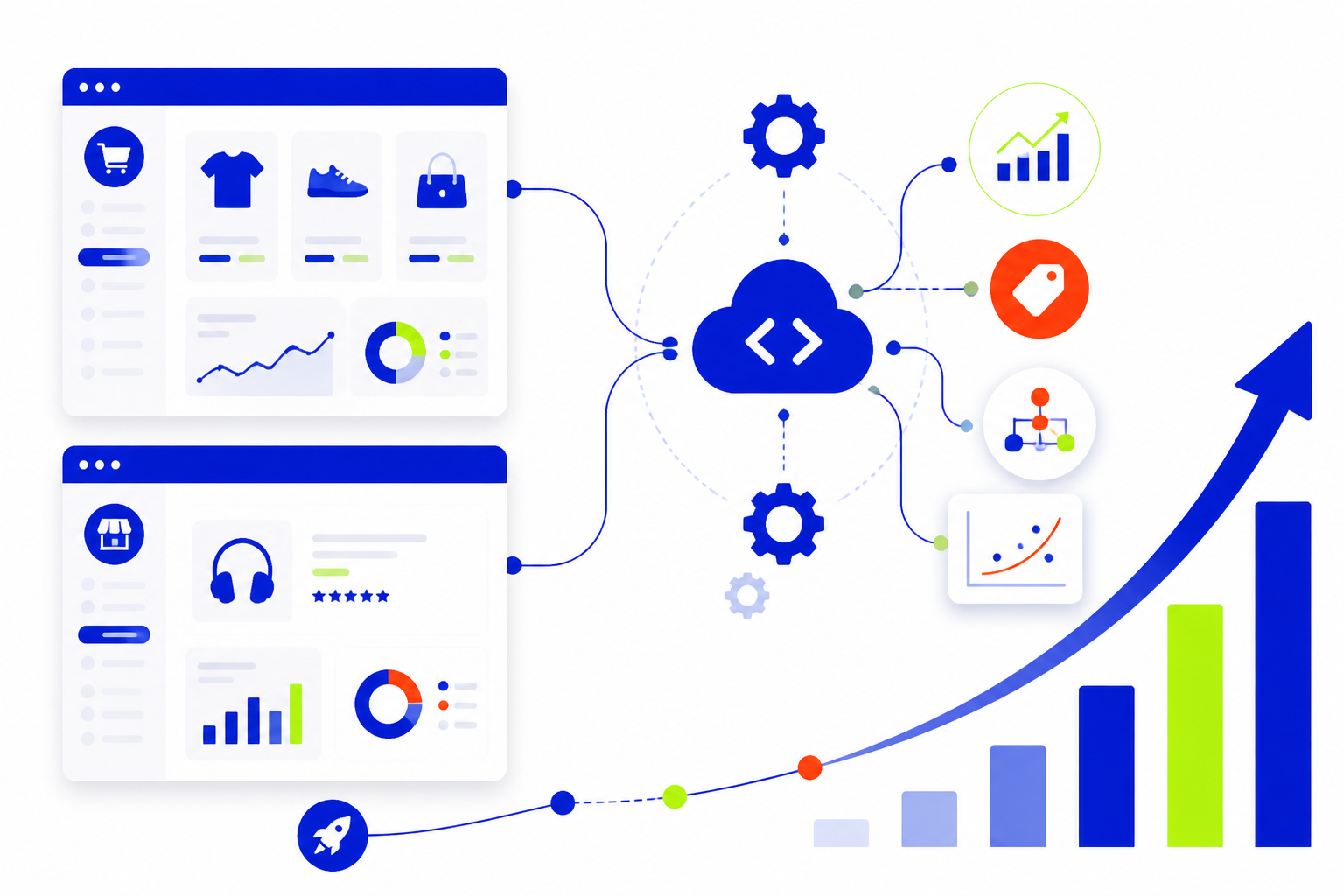
Wildberries and Ozon have already integrated AI into sales offices.
What is already built into the Wildberries cabinet
Wildberries has made significant progress towards AI tools for sellers in 2026. The most understandable example is the generation of descriptions in the product profile. It is available without a separate subscription, but with a limitation: 20 short descriptions in a neutral key per month. For a seller with a small assortment, this may be enough to quickly close the basic cards. For a store with hundreds of SKUs, the limit turns into a probe rather than a working tool.
With a "Jam" subscription or a separate option for generating descriptions without restrictions, the seller gets more freedom: you can choose keywords, tone and length of the text. The free outline also includes 20 slogan generations and up to 3 templates in the photo editor. This is useful if the team is just starting to systematically improve the cards and wants to remove the routine from the content manager.
A separate important block is AI responses to auto-send reviews, launched on February 19, 2026. The settings are quite detailed: you can set the mode with ratings from 1 to 5 stars, choose manual sending, confirmation before publication or automatic mode, adjust the tone, length of the response, address by name, reaction to photos and videos, a list of stop words and personal instructions. If the safe word is found, the auto-reply is not published. This is no longer a toy, but a full-fledged mechanism that can cover part of the operational load.
According to the "Jam" tariffs for 30 days, there are such guidelines in open materials: standard — 22,990 ₽, advanced — 42,990 ₽, premium — from 375,000 ₽. Depending on the tariff, the limits for AI responses, photo studio, and rich content differ. These figures should be double-checked before implementation: tariffs and site limits change faster than most commercial offers on the automation market.
""""Assistant" chat in the "Seller's Analytics" section is another built—in tool, available from May 2026 for Jem subscribers. It works with orders, repurchases, cancellations, balances, ratings, reviews, and search results positions. In other words, Wildberries is gradually turning the office not just into a control panel, but into a workplace with an analytical assistant.
What is already built into the Ozon cabinet
Ozon follows a similar path. On April 28, 2026, the site announced the launch of a "Smart assistant" in the seller's office. At the time of launch, the tool was in test mode and was not available to everyone. The assistant works on the Qwen 3.5 model, answers questions about working with the platform, refers to the "Knowledge Base", shows the store's performance over the past day and makes recommendations. According to Ozon, such an assistant is able to close up to 20% of support requests.
The "Administrator" and "Manager" roles have access to the assistant, and the dialog is visible only to a specific user. This is an important detail: the tool helps the person inside the cabinet, but it does not become the general operating system of the business. He does not set tasks in CRM, does not compare data with 1C and does not see a parallel picture through other sales channels.
For cards, Ozon has OzonGenerator, which generates annotations directly in the form of creating or editing a product. There is no separate fee for it, but according to the limits in the sources there are different values: 50 or 200 generations per month. The average annotation length is about 700 characters. This is enough for some tasks: to quickly get a basic description, remove empty cards, and speed up the work of the content department. But this does not replace the card's strategy, positioning, SEO core, and product differences from competitors.
Tools for images are also available in the cabinet: background removal, quality improvement, edge rendering to 3:4 format, background generation for some categories. Responses to reviews are also automated, but through the "Manage Reviews" subscription. However, the Reviews API requires the Premium Plus tariff. Starting from July 28, 2026, another context should be taken into account: the expansion of the card limit has become chargeable, in packages from 50 to 1 million.
To complete the picture, it is important to remember that not only WB and Ozon are moving in this direction: Yandex Market added an AI chat for sellers back in 2025. In other words, the AI in the marketplace's office ceases to be a competitive advantage and becomes the basic infrastructure of the site.
Where do the built-in tools end
The main boundary of embedded assistants is not in the quality of the text, but in the field of view. The site knows its office, its rules and its indicators well. But the seller's business is broader: he has several sales channels, purchases, warehouses, cost, employees, regulations and management goals. Where this stitching begins, the embedded AI ends.
The first zone consists of several sites at once.
The second zone is the accounting system.Integration with 1C, MySklad, ERP
The third zone has its own rules.
The fourth zone is actions, not texts.
The fifth zone is your channels of work.managers live on Telegram
What can be automated via the API and what are the limitations?
Technically, marketplaces have quite a lot of integration points. Wildberries has API categories available on the developer's portal for content, prices and discounts, warehouses and balances, orders according to FBS, DBW and DBS schemes, FBW supplies, marketing and promotion, customer communication, tariffs, analytics, documents and accounting. This allows you to build an agent that not only reads data, but links cards, balances, reviews, prices, and tasks of managers.
The agent must be able to wait
There are also organizational limitations. WB tokens are created only by the profile owner, the validity period is 180 days, and the notification arrives 3 days in advance. The token is shown once, there can be up to 20 active tokens per store, and when the owner changes, they stop working. This means that the integration requires an extension procedure and a responsible person. Otherwise, reports, balances, and auto-processing will simply stop updating one morning.
In January 2026, another important change appeared: external cloud services from the Catalog of ready-made RVB solutions were transferred to payment for the actual use of the WB API. The API remains free for sellers themselves, their own integrations, and on-premise versions. This changes the economics of choice: all other things being equal, an in-house agent may have a direct price advantage over a cloud intermediary service, especially with a large number of requests.
The Ozon Seller API has products, prices and balances, FBS and FBO shipments, finances, reviews for Premium Plus, and other operations. Starting from February 24, 2026, there is a single limit of 30,000 transactions with goods per minute. If the limit is exceeded, the site returns 429 Too Many Requests. A critical caveat: if the product request exceeds the available limit, not a single product is processed. For example, if 500 operations are available and 1000 are sent, all 1000 are rejected. Therefore, the agent must cut tasks into batches and take into account the available limits.
Prices and algorithms of sites: what an agent should not do
Price automation is the most tempting and most dangerous area. It seems that the agent can look at the index, competitors and automatically reduce the price to the desired level. But without margin restrictions, such logic quickly turns into a beautiful report with poor profits. Metrics are improving, the card looks competitive, and the business sells the product below the economically reasonable limit.
The Ozon price index compares your price with three benchmarks: competitors on Ozon, your prices on other sites and on your own website, as well as the external market. If the product is cheaper than the reference, the "price/reference" ratio is used. If it is more expensive, the formula is "2 − (standard / price)". The green zone is approximately in the range of 0.95–1.01, the red zone is above 1.05. With any particular index above 1.3, the status becomes "Unprofitable".
It is important not to confuse the mechanics of the index with the sanction. Neither Ozon nor Wildberries penalize for an unfavorable index or forcibly hide a card just because of it. The mechanics are different: A favorable index gives a 7.5% free boost in search results, a moderate one — 5%, the "no index" status — also 5%, and an unfavorable index does not give an additional boost. In orders, this may feel like a punishment, but legally and technically it is not a fine.
There is also a price quarantine: in case of a sharp jump, the card may be temporarily blocked until the seller confirms the price. The rule of thumb is to change the price list in steps of no more than 10%, unless there is a separate scenario and control. Therefore, the correct role of an agent is as follows: he offers a price, shows the basis and checks the restrictions, and the person approves the rule. Fully automatic dumping "up to the green index" is poor automation.
How to calculate the effect
they respond to reviews faster
Amazon has an external reference point: the company reported that more than 900,000 sellers use generative listing creation tools, and AI content is accepted without edits or almost without edits in about 90% of cases. This is a self-report from the site, so it cannot be directly transferred to WB and Ozon, but it shows the direction: card generation is becoming a massive working tool, not an experiment for enthusiasts.
You need to calculate the effect on your own data. First, the database is fixed: how many reviews, questions, cards and price changes are processed per week, how many hours are spent on each category of tasks, where delays most often occur. Then a low-risk site is selected: for example, responses to 4-5 star reviews or preparation of draft descriptions. After a month, the time, the proportion of requests processed, the number of escalations, and the presence of incidents are compared.
Only after such a measurement should automation be expanded to more sensitive areas: negative reviews, customer disputes, price recalculation, and supply recommendations. A steady guideline can be seen even in the limits of the sites themselves: 20 free descriptions per month on WB and 50-200 annotations on Ozon are designed for a seller who does a significant part of the work by hand. If you have hundreds of cards and dozens of reviews per week, the manual model quickly stops scaling.
Where to start
from the process mapseparate development
- Assemble a map of sites and systems.
- Separate texts from actions
- Describe the safety rules.
- Launch the pilot on one site
- Measure the result and expand gradually.
You should pay special attention to integrations. The lifetime of the WB token is 180 days, changes in card requirements, new mandatory specifications and labeling rules — all this makes the agent not a one-time development, but a living system. It should have an owner, an error log, an update schedule, and a clear manual bypass scenario if the API is temporarily unavailable.
What to do next
A practical next step is the automation card for the seller's account. It is enough for her to describe which sites you trade on, how many cards you have, how many reviews and questions you receive per week, where the balances are kept and who is managing the prices now. Based on this data, tasks can be divided into three groups: what is covered by the built-in tools of the sites, what makes sense to give to your own agent, and what is better left to a person.
This approach reduces the risk of buying "another service" for the sake of the buzzword AI. Instead, the seller gets a clear outline of where the agent saves time, where it protects against errors, where it helps to maintain margins, and where automation is still more dangerous than manual work. In marketplaces, the winner is not the one who clicked the text generation button faster, but the one who sees the whole operational picture and knows how to turn data into timely action.
 Автор
Антон Амосов
Автор
Антон Амосов


