
Own or ready-made: a corporate platform for AI agents and the real cost of ownership


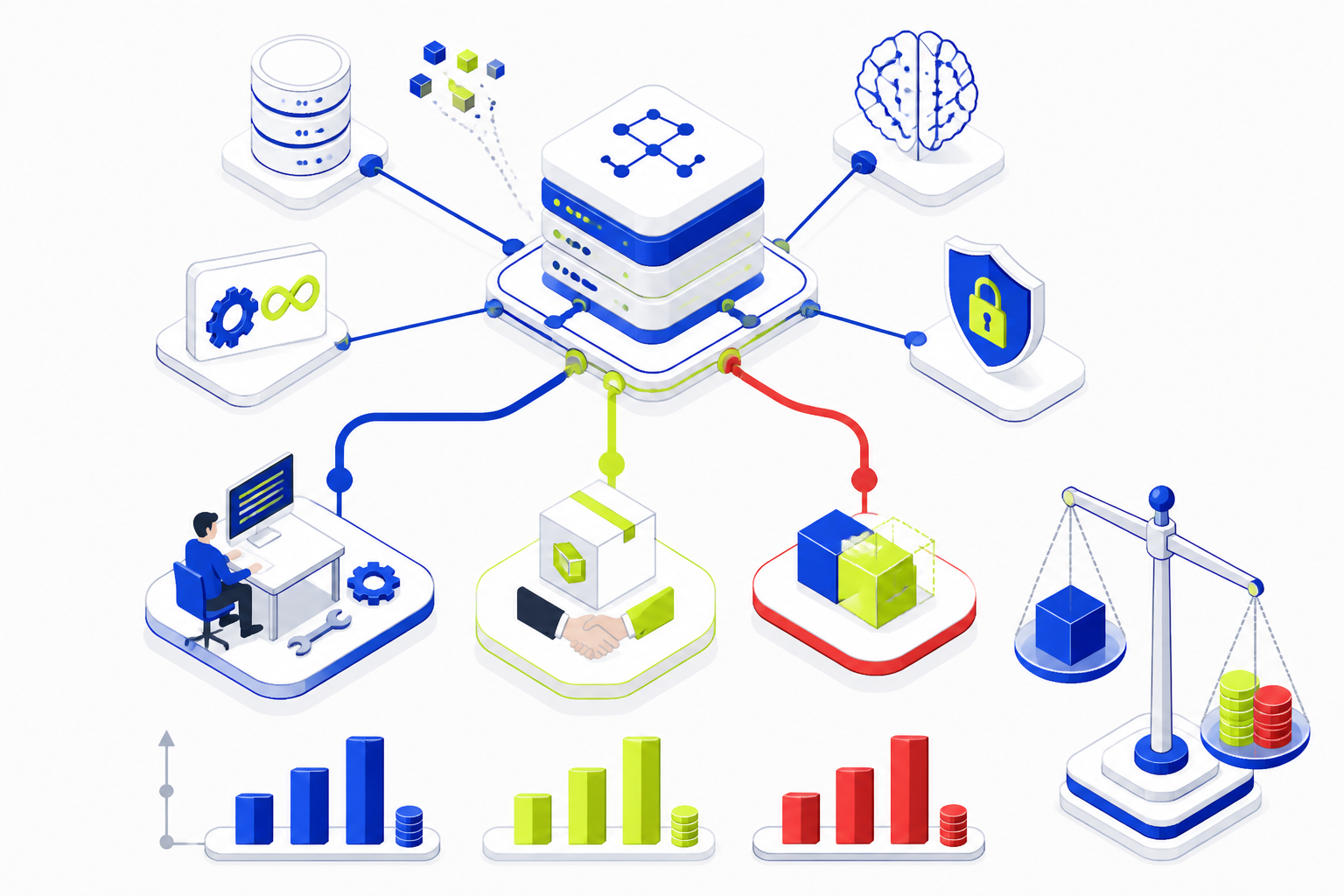
An enterprise platform for AI agents is needed by a company for the controlled implementation of artificial intelligence in its work processes. In most cases, it is more profitable to start with a ready-made platform and quickly test the benefits on real-world tasks. In-house development is justified when the platform becomes a key part of the company's product, full control over data, security and architecture is required, or there is a strong internal team ready to support the solution for years.
The decision to "create your own platform or take a ready-made one" is often discussed as a technical choice. In practice, it's a managerial choice about speed, risk, budget, responsibility, and future flexibility. If the goal is to reduce manual labor, speed up the processing of requests, improve the quality of knowledge within the company, and provide employees with secure AI assistants, a ready—made platform usually leads to results faster. If the goal is to build your own technological asset that will become a competitive advantage, then you need to consider a long path of self—development.
Content
- What issue needs to be resolved before choosing a platform
- What an enterprise platform for AI agents should be able to do
- Ready-made platform: a quick way to verify the benefits
- Own platform: when investments make sense
- What is the real cost of ownership?
- Comparing options over a three-year horizon
- Hybrid approach: how to combine speed and control
- How to make a decision without much debate
- Final recommendation
What issue needs to be resolved before choosing a platform
Before discussing technology, it is important to formulate a business goal. The company needs a platform not for the sake of artificial intelligence itself, but for the sake of a measurable effect: to close tasks faster, reduce the burden on employees, reduce the number of errors, preserve knowledge, and help customers and managers make decisions based on data.
what kind of work should AI agents do and what value does the company expect from them in the first six months?
An example of a practical problem statement:
- The support service wants to reduce the time required to prepare a response to the client;
- The sales department wants to find information about customers and transactions faster.;
- The legal service wants to speed up the analysis of standard contracts;
- HR wants to automate responses to recurring employee questions.;
- The production unit wants to receive reports on incidents and deviations.
Manageability is critical for such tasks: the agent must work within the permitted boundaries, use verified data, record actions and produce a result that can be verified. Therefore, the corporate platform differs from the usual interactive assistant: it includes access rights, logging, connection of internal systems, quality control and maintenance tools.
What a corporate environment for AI agents should be able to do
The corporate environment for AI agents is a space where a company creates, launches, controls, and develops AI assistants for internal and external processes. Such an agent can read documents, search for information in the knowledge base, prepare draft responses, generate reports, run coordinated actions in accounting systems, and transfer complex cases to an employee.
A mature solution has several mandatory features.
Unified agent management
The company must see which agents have been created, who owns them, what tasks they solve, what data they have access to, and how often they are used. Without a single management, chaos appears: different departments launch disparate solutions, and the security service and management lose transparency.
Secure data connection
Agents gain value through access to corporate knowledge: regulations, contracts, correspondence, customer cards, reference books, applications, reports. The platform must take into account access rights. The employee sees through the agent only the information that is allowed to him in the source system.
Setting up instructions and scripts
It is important for the agent to set the role, rules, sources, response format, restrictions, and the way to transfer the task to the person. In a corporate environment, a simple text instruction quickly becomes insufficient. We need templates, versions, approvals, checks, and a history of changes.
Quality control
The company should measure the accuracy of responses, completeness, speed, percentage of requests sent to a person, number of corrections, and user ratings. Without metrics, it is impossible to understand whether an agent is beneficial or just creating a new place for manual verification.
Action log and audit
For many industries, it is important to know who launched the agent, what data it used, what response it gave, what actions it proposed or performed. Logging is necessary to investigate errors, confirm compliance with the rules, and trust management.
Integration with work systems
The platform should be connected to document management systems, customer accounting, task management, file repositories, internal directories, and communication channels. The more tightly an agent is embedded in the work environment, the more likely it is that employees will use it on a daily basis.
Cost management
Queries to language models, data storage, document processing, computing resources, and maintenance cost money. The platform should show consumption by departments, agents, and scenarios so that the company manages the budget consciously.
Ready-made corporate solution: a quick way to verify the benefits
A ready-made enterprise solution is suitable for companies that value startup speed, cost predictability, and managed implementation of AI agents in their workflows. This option is especially useful at the stage when the organization checks which scenarios have a measurable effect: processing requests, consulting on internal regulations, initial qualification of applications, preparing responses to customers, transferring the dialogue to an employee, creating a transaction in the sales management system.
The main advantage of this approach is a shortcut from a business task to a working agent. The team is focused on the process: what questions do clients ask, what data is needed to answer, when to connect an employee, and what actions the agent can perform independently. The technical basis has already been assembled: communication channels, connection of models, scenario settings, dialog log, differentiation of rights, rules for transfer to a person and calculation of the cost of use.
What does the company get when choosing a ready-made solution
A ready-made solution is useful where it is important to run multiple scenarios without having to create your own infrastructure for a long time. The company receives:
- a quick start.
- centralized handling of requests.
- division of responsibility.
- control of work boundaries.
- controlled transmission to a person.
- an understandable economy.
- reducing the burden on internal development.
Cost items when choosing a ready-made solution
The cost of a ready-made solution should be estimated by several items in order to understand in advance the budget for the pilot launch and further scaling.
- Subscription or license.
- Payment for the work of models.
- The cost of implementing and configuring scripts.
- Employee training.
- Support and development.
This cost structure is convenient for step-by-step implementation. A company can start with one agent and one division, evaluate the effect, and then add new scenarios and channels. The budget grows along with the proven benefits, and the decision to scale is made based on dialog statistics, response cost, and time savings.
An example of a ready-made solution: Softrestchat for corporate scenarios
One agent works in several channels at once.
The subscription is made for a specific AI agent.
Communication with Bitrix24 works through the official app and the REST programming interface.
The agent's work area is delimited by the integration settings.
The transaction is created automatically at the beginning of the dialog.
Functions are executed with required parameters.
The "Call the operator" script transmits the dialogue to a live employee.
A custom software interface key is connected separately for each model.
The data is hosted on the Russian infrastructure, payment is made in rubles via bank cards, and it is also possible to work using invoices and certificates.
How does such a service integrate into the company's work?
A practical scenario might look like this. The client writes on the website or in Telegram, the agent clarifies the need, collects mandatory information, creates a transaction in Bitrix24 or amoCRM, appoints a responsible person and continues the dialogue at the permitted stage. If the question goes beyond the scope of the script, the agent launches "Call the operator", and the employee continues the correspondence in the same dialogue.
For a manager, the value of this approach is manageability. You can see how many requests have been received, which channels provide more requests, how many dialogues the agent has processed independently, how many have been passed on to the operator, where customers often ask clarifying questions. This data helps to improve scenarios and calculate the economics of implementation.
For employees, the value is expressed in reducing manual workload. The agent takes care of the recurring issues, the initial data collection and the creation of the transaction. The operator is involved in cases where a human context, negotiation, responsibility, or an unconventional solution is needed.
What to look for before implementing a ready-made platform
When choosing a ready-made solution, it is useful to check several points in advance.:
- which channels does the agent support and where is the dialog history stored?;
- how does the subscription work?: by agents, users, channels, or volume of requests;
- which models can be connected and how is the cost of the response calculated?;
- is it possible to use custom software interface keys for models;
- how are the boundaries of an agent's work set in a sales management system?;
- is there a transfer of the dialog to the operator and how does it affect the costs;
- where is the data placed and in what currency is the payment made?;
- what are the requirements for the Bitrix24 tariff or other operating system?;
- how the dialog history is uploaded and which reports are available to the manager.
This analysis helps to choose the platform as a working tool for business, rather than as an experimental showcase of artificial intelligence. The clearer the channels, scenarios, areas of responsibility, and economics of the response, the easier it is to scale AI agents to new divisions.
Internal development: when investments make sense
Self-development makes sense when artificial intelligence becomes a strategic technological asset of the company. This path requires a budget, a strong team, a mature architecture, and a willingness to support the solution for years. Gains occur where standard market opportunities limit growth or create unacceptable risks.
Internal development is justified in the following situations:
- The platform is part of the core product.
- the data has increased sensitivity.
- We need unique processes.
- the scale of use is very large.
- We have a strong engineering team.
- full control over development is important.
Choosing internal development should be considered as creating your own product. It should have an owner, a roadmap, a budget, a support team, quality rules, a support service, documentation, and a regular benefit assessment. If a solution is created by the efforts of several enthusiasts without long-term funding, it quickly turns into a set of disparate prototypes.
A typical team for such a project includes a product manager, an architect, server developers, data specialists, operations engineers, a security specialist, a user experience designer, an analyst, testers, and process owners from the departments. Even a compact team requires constant workload, as models, security requirements, data sources, and user expectations change.
What is the real cost of ownership?
When choosing a platform, the cost of a license for a ready-made solution and developer salaries are often compared. This comparison gives only part of the picture. The real cost of ownership includes all the costs of startup, operation, security, development, training, and change management.
For a ready-made solution, the calculation includes:
- subscription or license.
- payment for the work of models.
- payment for the agent's responses.
- the cost of implementing and configuring scripts.
- connecting internal systems.
- employee training.
- post-launch support.
- the internal owner of the product.
The list is broader for internal development:
- salaries of the development and maintenance team;
- architecture design and security verification;
- creating user and rights management;
- developing connectivity to models and data sources;
- creation of monitoring, logging and quality control tools;
- Setting up infrastructure, backup, and recovery;
- continuous testing, bug fixes, and component updates;
- documentation, training, support service;
- the cost of delaying the result while the platform is being built.
The most underestimated expense item is maintenance. The environment for AI agents continues to evolve after the first launch: new customer questions appear, sales conditions change, regulations are clarified, channels and scenarios are added. Therefore, the calculation should include regular improvement of the agent based on data from real dialogues.
A ready-made solution benefits from a transparent and step-by-step economy: you can start with one agent, connect the necessary channels, check the cost of the response, estimate the number of transfers to the operator, and only then scale the solution to other departments. Internal development requires a large initial budget and becomes rational where a company is building a strategic technology asset with unique requirements.
Comparing options over a three-year horizon
The approximate logic of the comparison is given below. The specific amounts depend on the size of the company, the number of users, the security requirements, the amount of data, and the complexity of the scenarios. The table helps you see the cost structure and management implications.
| Criteria | Ready-made platform | Own platform |
|---|---|---|
| The date of the first launch | Usually from a few weeks to a couple of months | Usually from a few months to a year for the mature version. |
| Initial investments | Moderate: implementation, configuration, training, licenses | High: team, architecture, infrastructure, security |
| Flexibility | High within the scope of the product's capabilities and the supplier's improvements | Maximum with a strong team and budget. |
| Safety | Depends on the maturity of the supplier and the terms of the placement | It is fully designed internally and requires constant expertise. |
| The speed of development | It relies on the development of the supplier's product and the customer's settings | It relies on the internal priorities and accessibility of the team |
| Risks | Dependence on the supplier, restrictions on unique modifications | Delays, budget growth, shortage of specialists, a long way to maturity |
| The best application scenario | Quick benefit verification and scaling of typical processes | Creating a strategic technology asset |
Over a three-year horizon, a ready-made platform often turns out to be more profitable for companies that need dozens of operational scenarios within their departments. The savings come from speed, a smaller support team, and ready-made management mechanisms. A proprietary platform begins to win where there is a large scale, unique requirements, and a long-term strategy for monetization or deep internal automation.
It is useful to consider not only the direct costs, but also the cost of time. If a ready-made solution is effective in two months, and in-house development reaches a comparable level in a year, a difference of ten months may cost more than any license. This is especially noticeable in customer support, sales, document management, and internal help desks.
Hybrid approach: how to combine speed and control
For many companies, the hybrid path is becoming optimal. The organization starts with a ready-made platform, checks scenarios, collects usage data, and gradually identifies those parts where its own control is needed. This approach reduces the risk of large investments before the benefits are confirmed.
A hybrid strategy might look like this:
- choose a ready-made platform with clear data upload conditions and open ways to connect internal systems;
- run three to five scenarios with measurable effect;
- Set up metrics for quality, cost, and user satisfaction;
- After three to six months, determine which components require more independence.;
- leave standard features on a ready-made platform, and develop unique parts inside;
- create an internal competence center that is responsible for the rules, quality, and development of AI agents.
This way helps to separate real needs from assumptions. It often turns out that departments don't need complex, unique algorithms, but well-connected data, user-friendly templates, clear responsibilities, and regular improvement of instructions. In other cases, the pilot shows that the company really needs its own architecture for individual critical processes.
The hybrid approach also reduces reliance on a single solution. The company designs data portability in advance, stores key instructions and regulations, maintains a single agent catalog, captures metrics, and preserves architectural freedom.
How to make a decision without much debate
To make a rational choice, it is useful to go through a short sequence of questions. It takes the discussion from the realm of preferences to the realm of facts.
Step One: Determine the value
Describe the three main scenarios and the expected effect. For example: reduce the average response time in support by thirty percent, reduce manual preparation of reports by ten hours per week, and speed up contract analysis by half.
Step two: Evaluate the data requirements
Determine what data the agents need, where it is stored, who has access to it, and what restrictions apply to storage and processing. If the requirements are typical, a ready-made platform will speed up the start. If the data contour is unique and extremely sensitive, you need to take a deeper look at your own architecture or secure placement.
Step three: check the availability of the team
In-house development requires a stable team. It is important to assess whether the company is ready to allocate specialists for years, rather than for a one-time project. If the team is already overloaded with key systems, a ready-made platform will keep the focus.
Step four: Calculate the cost of the delay
Compare how much a company loses each month due to manual work, errors, lengthy approvals, and slow support. This calculation often shows that a quick start is more valuable than technical independence at the start.
Step five: Set the exit conditions
When choosing a supplier, check the ability to upload data, transfer settings, access logs, transparency of billing, and the terms of termination of the contract. This creates freedom of maneuver and reduces the risks of addiction.
Step six: assign the owner of the result
AI agents require ownership from the process side. The technical team is responsible for the platform, and the department is responsible for the benefit, quality and acceptance of the result by employees. Without such an owner, even a good platform will remain an experiment.
It is convenient to use a simple matrix for a management decision.
| Situation | A rational choice |
|---|---|
| We need to quickly check the benefits in several departments. | Ready-made platform |
| There are unique requirements for security and data placement. | Proprietary platform or secure hybrid option |
| The platform will become a part of the product for customers | Own platform |
| Dozens of typical internal agents are needed | A ready-made platform with strong controls |
| The company does not yet understand which scenarios will have an effect. | A ready-made platform and a short verification stage |
| There is a mature engineering team and a large scale of use | Own platform or a step-by-step transition to it |
Final recommendation
If a company implements AI agents to improve the efficiency of internal processes, it is wise to start with a ready-made corporate platform. It gives results faster, reduces startup risks, and allows you to test real-world scenarios on company data. In a few months, the facts will appear: which agents are in demand, where savings arise, what limitations hinder scaling, and which components should be developed independently.
Development of AI agents based on its own platform
buy speed where the task is typical, and create your own where your competitive advantage is born.
This approach helps to avoid two extremes: long development without proven benefits and the chaotic use of disparate AI tools without control. The company gets a clear trajectory: first, value and manageability, then scaling, then point independence where it really pays off.
 Автор
Антон Амосов
Автор
Антон Амосов


