Omnichannel in simple words: how to create seamless communication with a client


Definition in simple words
Omnichannel
a unified experience
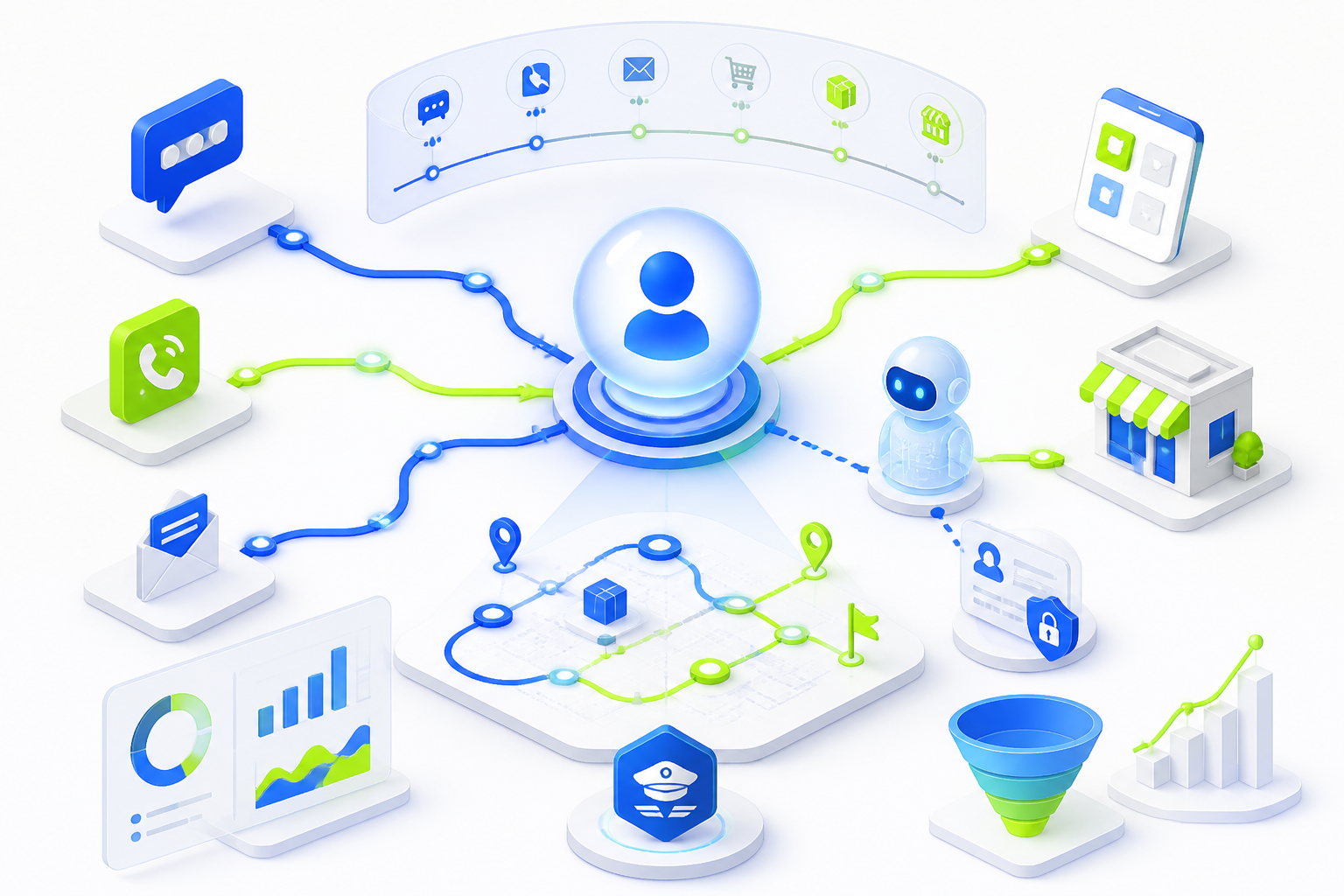
If a person wrote to a chat on a website, then called, and the operator sees his previous question, the selected product, the delivery city, and the result of the previous dialogue, it looks like an omnichannel approach. If the operator asks for the same name again, although the company is present in the chat, on the phone, and in messengers, it is more likely a multi-channel approach without preserving the context.
Therefore, omnichannel communications should be considered not as a buzzword, but as a management principle: the company does not design individual channels, but a complete customer path. In a good scenario, channels do not work as separate doors to different offices, but as entrances to the same space, where the history of interaction already lies.
A household example
Let's imagine a typical situation. In the evening, the client visits the furniture store's website, looks at the sofa, reads the delivery terms and leaves a question in the online chat: "Can I bring it on Saturday after 16:00?" The manager replies that such delivery is possible and specifies the address of the area. The client leaves to think, and the next day writes to the messenger, because it's more convenient from the phone.
In a multi-channel, but not omnichannel, company, the dialogue will begin anew: "Hello, what product are you interested in? To which city do I need delivery? What have you already discussed?" Formally, there are channels: the website is working, the messenger is working, the phone is also working. But for the client, these are three different conversations with the same company.
In an omnichannel scenario, an employee or the system sees that a customer was interested in a particular sofa yesterday, asked about delivery on Saturday, received a preliminary response, and has not yet placed an order. The conversation continues naturally: "Yes, I see your question about the delivery of the sofa on Saturday after 16:00. We can fix this interval if we place an order before 18:00 today."
Then the customer calls to quickly clarify the payment. The operator does not force him to retell the correspondence, but immediately continues the process. This is where the value of omnichannel comes in: it removes the seams between channels. The client does not feel a set of disparate communications, but a calm support from the first interest to the result.
Channel, multichannel, and omnichannel
ChannelMulti-channelOmnichannel
The error often occurs due to the external similarity. A company can have accounts everywhere, respond quickly, and even use the same interface for employees, but if a client loses context when switching between channels, this is not an omnichannel. It's just a convenient multi-channel infrastructure.
| Criteria | One channel | Multi-channel | Omnichannel |
|---|---|---|---|
| The context | It is stored inside a single communication method | It is often scattered across channels | It is saved when switching between channels |
| Data | Limited to a specific dialog | They may be duplicated or diverge | They are collected in a single card or a common history |
| Rules of communication | Configured for a single channel | They differ from channel to channel | They are subject to uniform service standards |
| Customer perception | "I communicate here" | "The company is everywhere, but it doesn't remember me" | "The company understands my story and continues the process" |
Don't call something that just works in multiple channels omnichannel.
What does omnichannel communication consist of?
channels
single customer profile
history of communications
Why would the client need it
For the client, omnichannel is valuable primarily because it reduces fatigue from communicating with the company. Repeating the same question to different people is a small thing only at first glance. In practice, it is precisely such repetitions that create the feeling that the client is not important, his time is not valued, and the company is designed like a maze.
The omnichannel approach gives a person the freedom to choose a convenient channel without fear of losing progress. In the morning, he can start from the website on the computer, continue in the messenger in the afternoon, and call from the road in the evening. If the process persists, the client is not tied to a single communication method and is not forced to adjust to the internal organization of the company.
predictable quality
Finally, the client gets continuity. This is especially important where the solution requires several steps: selecting a tariff, signing up for a service, agreeing on a commercial offer, delivery, and warranty treatment. The fewer the gaps between the stages, the higher the trust. The client feels that he is not being "processed", but accompanied.
Why would a business do that?
For businesses, omnichannel is not only about customer care, but also about manageability. When requests are scattered through different channels and employees, the company loses some information: which questions are repeated, where customers leave, what promises have already been made, how many times the same person contacted before the purchase. As a result, decisions are made based on feelings, not data.
A single communication history reduces the number of duplicates. Employees spend less time restoring context, asking questions, and manually searching for correspondence. Even if the savings per request is only 2-3 minutes, with hundreds of conversations per month, this turns into hours of working time that can be spent on sales, service, and developing customer relationships.
Omnichannel also helps to maintain uniform standards. The manager sees how the company responds at different points of contact, where deadlines are violated, which formulations cause misunderstandings, who is overloaded with requests. This transforms communications from a "black box" into a managed process.
Funnel
Examples
Retail.
Services.
B2B.
In all three examples, omnichannel manifests itself in the same way: the company retains the thread of the conversation. The channels are different, but the client's path does not break up into fragments. That is why omnichannel is especially noticeable not in advertising promises, but in everyday situations where a person expects simple respect for what has already been said.
Typical misconceptions
"it's enough to create accounts everywhere"
"omnichannel is needed only by large companies"
"one interface automatically creates a unified experience"
There is also a more subtle mistake — to consider omnichannel as an exclusively technical project. Technology is needed, but the customer experience breaks down not only because of the lack of integrations. Sometimes the problem lies in the rules: it is unclear who is responsible for continuing the dialogue, when to send the request to a specialist, what data is required to be recorded, and how the quality of the response is measured.
How to implement it in stages
A practical implementation plan might look like this:
- Describe the customer's path
- Create a single card
- Set up transfer rules
- Launch the pilot
- Measure Metrics
This approach reduces the risk of costly implementation for the sake of a beautiful scheme. Omnichannel should solve specific problems of the client's path: loss of context, fragmentation of data, different response standards, unclear responsibility. If you start with these problems, technology becomes a tool, not an end in itself.
The role of the AI agent
The AI agenttypical questionsa single knowledge base
Softrestchat
Metrics
Omnichannel should be evaluated not by the number of connected channels, but by how connected the client's path has become. If, after implementation, a person repeats the same data anyway, employees do not see the history, and the manager does not understand where the applications are lost, then the main task has not been solved.
Repeated requests on the same issueDecision timePercentage of saved context
customer satisfactionconversion between stages
The simplest first step is to draw the path of one real customer through your channels and mark the places where they are forced to repeat information. Where repetitions, pauses, and lost context appear, the main reserve for improving communications is usually hidden.
 Автор
Антон Амосов
Автор
Антон Амосов


Related articles
A chatbot in simple words: what is it and what is it for?

How AI improves labor productivity in Russia: cases, impact, and limitations

AI Agents and 152‑FZ: how to ensure legitimate data processing and risk management
Fine-tuning LLM: how to turn a model into a business partner
When AI makes code more expensive: Why generation makes maintenance more expensive