
How to create an AI agent for a business: 6 stages, deadlines and results


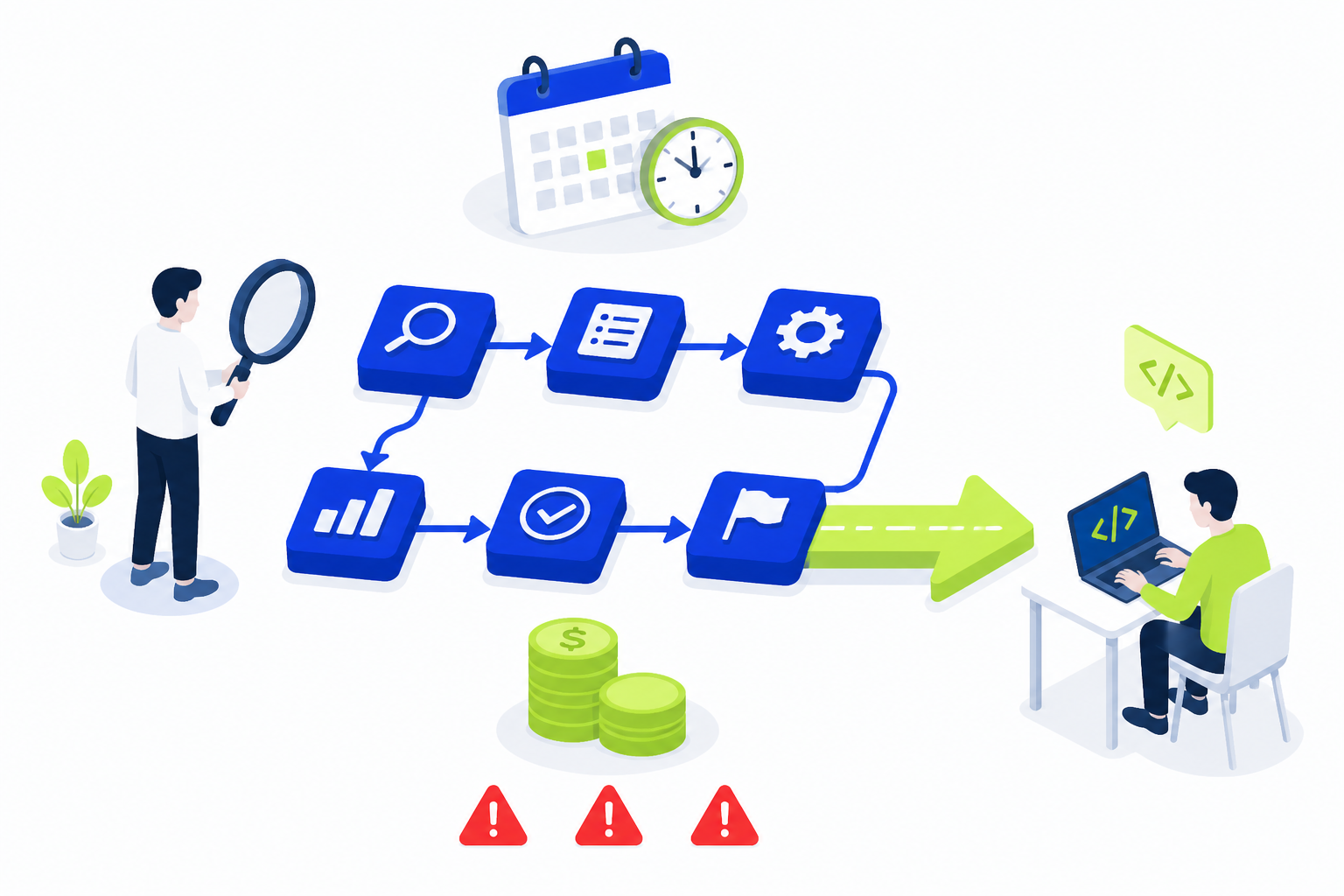
Business development usually takes place in six stages and takes from 3 to 8 weeks for one limited process.
selecting a model or framework
AI agent development is 70% non—programming.
How it looks at work.
Where it all starts: process selection
developmentsCRM integrationtask selection
It is at this stage that a significant part of future failures is eliminated. If the decision depends on a dozen informal conditions, there is no data for the previous period, the process has no owner, the cost of the error is legal or reputational, and it is impossible to verify the result, the agent will work as an expensive experiment. In such cases, the task needs to be narrowed down or replaced with a simpler solution: regulations, a form of data collection, a classic chatbot scenario, or CRM refinement.
For example, the request to "deal with all incoming customer requests" is too broad. And the task of "determining the type of treatment, finding the answer in the knowledge base and passing non-standard cases to the operator" is already suitable for the pilot. It is limited, verifiable, and does not require an agent to make decisions that a human should make.
Six stages of work
It is convenient to consider the creation of AI agents for a business as a sequence of six stages. Each stage has its own goal, responsible participants and the result. This structure protects the project from the typical situation when "the bot is almost ready," but no one can say which cases it is required to close and by what criteria it is accepted.
| Stage | What's going on | Term |
|---|---|---|
| process selection | A conversation with the owner of the process and the executors. Database measurement: the volume of requests, the current processing time, and existing metrics. | 2-5 days |
| Collecting invoices | 30-50 real requests, documents, recordings of conversations or applications are collected. Formulations, exceptions, and a future test set are taken from them. | 3-7 days, depends on the customer |
| Designing | It determines what the agent does himself, what he does only with confirmation, what he never does. Escalation rules, tools, and acceptance criteria are described. | 3-5 days |
| Assembling | A knowledge base, instructions, scripts are being prepared, channels, tools, and integrations are being connected. | 1-3 weeks |
| Quality control | The agent runs on a test set, the instructions are finalized, the accuracy of the choice of tools and the correctness of the answers are measured. | 3-7 days |
| Launch in a narrow area and transfer | The agent runs on a limited flow. The team analyzes logs, corrects errors, and transfers access rights and documentation. | 2-4 weeks of follow-up |
In designing, it is useful to prepare a technical specification for an AI agent in advance: what data is available, what tools can be called, what statuses can be changed when a transfer to a person is needed. This is the next practical step after selecting the process and the basis for transparent acceptance of the result.
What does an analyst do and what does a developer do
The customer often has an honest question: what to pay for if the model has already been created by OpenAI, Anthropic or another supplier? The answer is that the model is just an engine. In order for a car to travel along the company's route, you need a road, rules, navigation, speed limits, a trip log, and a person who understands where to go at all.
Analyst
Developer
The owner of the process on the part of the customer
The 10/20/70 rule, which is often used in the BCG management context, works well to explain value: 10% of value is provided by algorithms, 20% by data, and 70% by changing how people work around technology. A contractor can make an agent, collect data, and help implement a new order, but it cannot completely replace a management decision within the company. Therefore, the development of a turnkey AI agent always requires the participation of the customer, even if the technical part is taken over.
What the business gets at the exit
A good result of the project is not a link to a chat or a demonstration where the agent responded beautifully once. The result must be reproducible: it can be verified, transmitted, finalized, and maintained. Therefore, in a normal project, the customer receives a set of specific artifacts.
- Description of the process and boundaries:
- Configured Agent
- Knowledge base
- Instructions and scenarios
- List of tools and integrations
- Test set:
- Logs and tracing:
- Access points and operating instructions:
- Metrics and the method of removing them:
The most important item on this list is the test kit. He turns the conversation about quality from a subjective "I don't like the answer" into a testable procedure. If there are 50 typical cases in the database and the expected behavior for each, any change to the instructions, knowledge base, or integration can be run again. This is especially important after the launch, when the business starts adding new scripts and documents.
For example, for a support agent, the test set may include questions about the order status, refund, warranty, non-standard complaint, and data error. For the CRM agent, there are incoming leads with varying degrees of availability, different sources, and different signs of priority. In both cases, the agent is evaluated not by one beautiful answer, but by a series of checks.
Deadlines: what do they depend on
The base fork for one agent is 3-8 weeks. But the calendar period almost always depends not only on the development. Sometimes technical assembly takes less time than waiting for accesses, uploading examples, or agreeing on formulations between departments.
Data availability
Number of integrations
Security Service
What is needed from the customer
An AI agent does not embed itself in the void. He needs real data, the owner of the process, and the time of the people who will accept the result. The better prepared the customer's side is, the less the project looks like an excavation and the faster the working effect appears.
- The owner of the process
- 30-50 real-world examples:
- Access to the test circuit
- The answer to the question "what is never allowed":
- 2-4 hours per week for acceptance
This list seems simple, but it is what most often determines success. If the customer cannot provide real examples, the agent learns from guesswork. If there is no owner of the process, there is no one to make controversial decisions. If no time is allocated for acceptance, the project is formally ready, but freezes before launch.
In mature projects, the customer's participation is not perceived as a burden. This is an investment in ensuring that the agent reflects the real practice of the company, rather than the developer's abstract idea of how the sales, support, or workflow department should work.
Why projects fail: three reasons from statistics
The discussions often cite an MIT study from August 2025: 95% of generative pilots did not have a measurable impact on profits. This figure should be read with reservations: "failure" meant the absence of a measurable effect in six months, the sample was limited and collected, including at conferences, and the authors themselves called the estimates indicative. But the practical conclusion is still important: according to the same data, the purchase of ready—made solutions was successful in 67% of cases, and internal development was about three times less likely. For businesses, this is an argument in favor of a platform approach and narrow pilots instead of a long development from scratch.
McKinsey, in a survey of 1,719 respondents conducted in May–June 2026, noted: 37% of companies attribute at least some impact on EBIT to AI, while the share of "high performers" remains small — about 6%. At the same time, among large companies with revenues over $1 billion, the share of those who scale agents in at least one function increased from 27% to 40% per year. The market is moving, but the winners are not those who talk louder about AI, but those who know how to integrate it into processes.
A Salesforce survey of 2,025 executives in May 2026 highlighted similar signs of successful projects: clean, managed data, narrow agent reach, and pre-defined escalation paths to a person. The metrics there are self-evaluating, but the direction coincides with practice: successful implementations are based on the order of work. The three main causes of failure are treated not by a new model, but by discipline: a narrow process, data, tests, constraints, and clear responsibility.
How much does it cost
turnkey implementation — 30,000 ₽ per agent
This price is possible because the agent is assembled on a ready-made platform, rather than being developed from scratch. The customer pays not for inventing the infrastructure, but for setting up the process: analysis, knowledge base, scripts, tools, tests, launch and transfer. For many tasks, this is more rational than starting internal development by hiring a team and choosing a framework.
The pilot group.
For comparison: in the market, a simple bot can cost 50-200 thousand rubles, a working agent with integrations — 300 thousand – 1.5 million rubles, a corporate multi—agent system - from 3 million rubles. Support is often estimated at 30-50% of the development cost per year. These numbers do not mean that every business needs an expensive project. More often, on the contrary, it is better to start with a narrow agent who solves one verifiable task and provides material for the next solution.
What to do next
scope of work, deadline, and budget fork
The development of turnkey AI agents is beneficial where there is a specific work cycle, understandable limitations and a willingness to test the result with real examples. In this sense, a good agent is not a separate technological toy, but a neatly integrated assistant employee: he knows his authority, acts according to the rules, leaves traces in logs and calls a person in time when the task goes beyond his responsibility.
A short start formula:
 Автор
Антон Амосов
Автор
Антон Амосов


