Support officer or AI: Who really solves customer requests?


Question statement
The question "support officer or AI" sounds convenient for discussion, but is poorly suited for a managerial decision. Support is not just one profession or one type of action. Inside it there are quick answers according to instructions, clarifying data, checking the order status, diagnosing problems, dealing with dissatisfaction, accepting exceptions and communicating in situations where it is important for the client not only to receive information, but also to feel the responsibility of the company.
This approach helps to avoid two mistakes: overestimating expectations from AI and underestimating the human role. The first leads to customer irritation and quality risks, the second leads to the fact that the company continues to waste specialists' time copying the same answers.
Types of tasks
To understand where AI is useful, support work should be broken down into separate actions. A client's message rarely consists of just a question and an answer. Usually, you first need to accept the message, determine the topic, clarify the data, find the appropriate instruction, perform the operation, or send the request to someone who has the right to make a decision.
Typical responsecurrent knowledge base
Diagnostics
Operations in the system
Conflict and customer retention
AI agent in support
AI is especially strong where the task is repetitive, well-described, and does not require moral or commercial responsibility. He does not get tired by the end of the shift, does not forget the standard steps and can simultaneously handle more requests than one operator. This is an important advantage for the first line: the client receives an initial response not when the employee is released, but immediately after the request.
24—hour availability is another strong argument. If the company receives requests in the evening, at night, on weekends, or from different time zones, AI helps not to leave the client in silence. Even if the issue cannot be resolved completely, the system can accept an appeal, collect data and honestly inform when a specialist will be involved.
The third advantage is compliance with the procedure. The AI can be configured so that it always asks mandatory questions, warns about important conditions, records the client's consent, does not skip the diagnostic steps and does not send the request further without the necessary data. In an ordinary team, such omissions often occur not because of incompetence, but because of the workload and switching between dozens of dialogues.
However, the strengths of AI only work if there are boundaries. If the system answers questions for which there is no approved knowledge, or gets the right to act in risky situations without control, speed turns into a source of errors. Therefore, AI is useful not as an independent "substitute for a department", but as a disciplined participant in the process.
Support Staff (person)
A person remains irreplaceable where the appeal ceases to be just informational. The client may be annoyed, scared, disappointed, or convinced that they have been treated unfairly. In such situations, the answer should take into account not only the text of the question, but also the history of the relationship, the value of the client, the tone of communication and the possible consequences for reputation.
An important difference between an employee is responsibility. A person can say, "I'm taking this to work," "I'll accept an exception," "I understand why the situation is unpleasant, and I'll offer a solution." The AI can simulate a polite form, but should not introduce itself as the owner of the solution if it does not have real authority. This is especially important in claims, financial matters, and situations where the company actually admits a mistake.
An employee works better with incomplete and contradictory information. Clients often describe the problem inaccurately: they confuse the names of services, do not know the internal terms, and miss important details. AI can collect some of the data, but a person is able to see the hidden meaning, compare the signs and understand that a formally "common question" is actually associated with the risk of a client leaving or a serious malfunction.
A separate area of human power is negotiation. When it is necessary to retain a client, explain the limitations, offer a compromise, agree on compensation or choose an exception to the rules, the operator does not act only on the knowledge base. It takes into account economics, loyalty, tonality, and the limits of what is acceptable. This is not a mechanical operation, but a management decision in miniature.
Therefore, in a good automation system, a person does not disappear. His role becomes less routine and more significant: less copying of ready-made phrases, more solutions, quality control and process improvement.
The task allocation matrix between AI and humans
In order not to argue on the level of feelings, it is convenient to evaluate support tasks based on four parameters: frequency, risk of error, variability, and emotional complexity. Such a matrix helps to see that automation is not a matter of taste, but a matter of manageable risk.
FrequencyRisk of errorVariabilityEmotional complexity
| Task type | Frequency | Risk of error | Variability | Recommended model |
|---|---|---|---|---|
| Response to the FAQ or instructions | High | Low | Low | AI decides on its own with quality control |
| Collecting diagnostic data | High | Average | Average | AI collects information, a person connects when there is uncertainty |
| Financial transaction or compensation | Average | Tall | Average | The human makes the decision, the AI prepares the context |
| Complaint, conflict, retention | Low or medium | Tall | High | The human conducts the dialogue, the AI helps with the summary |
In this logic, the AI receives tasks with high frequency, low risk, and a clear procedure. People are left with situations where the cost of error is higher, scenarios are more diverse, and it is important for the client to see not only the answer, but also the company's participation.
The matrix is also useful because it relieves emotional tension within the team. Employees see that it's not "people" who are automating, but repetitive functions. The manager gets a tool for argumentation: why one scenario can be given to AI, but the other is not yet possible.
Hybrid scheme: how AI and employee work together
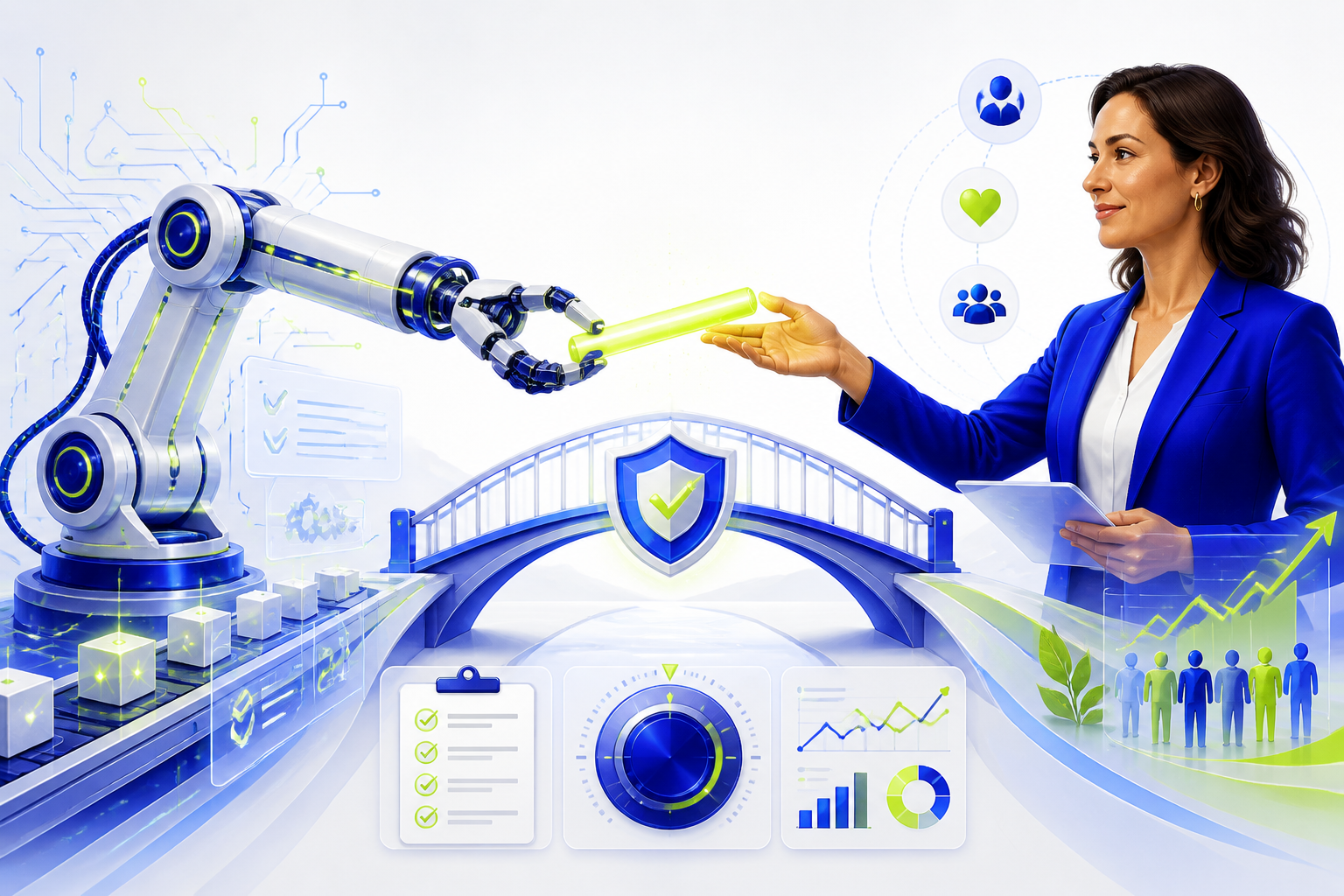
In practice, the most stable model is a hybrid one. The AI accepts the request, determines the topic, clarifies the details, searches for an answer in the knowledge base and solves a typical problem. If a question goes beyond the scope of the instructions, the system transmits it to the employee not in the form of a raw dialogue, but with a story, a brief summary, and already collected data.
For example, the client writes: "My payment is not going through, everything is frozen." The AI can specify the payment method, the time of the attempt, the device, the order number, and the presence of an error message. If the problem is typical, give instructions. If the signs indicate a failure, repeated failure, or financial risk, the referral goes to a specialist. As a result, the employee does not start with the question "what happened?", but immediately sees the picture.
This scheme is especially valuable at high load. The first line is no longer a queue where all requests are equally waiting for a person. Simple queries are closed faster, while complex queries receive a more trained operator. For the client, this does not look like a "bot kicked off", but like a neat route: first, quickly collect information, then connect the right specialist.
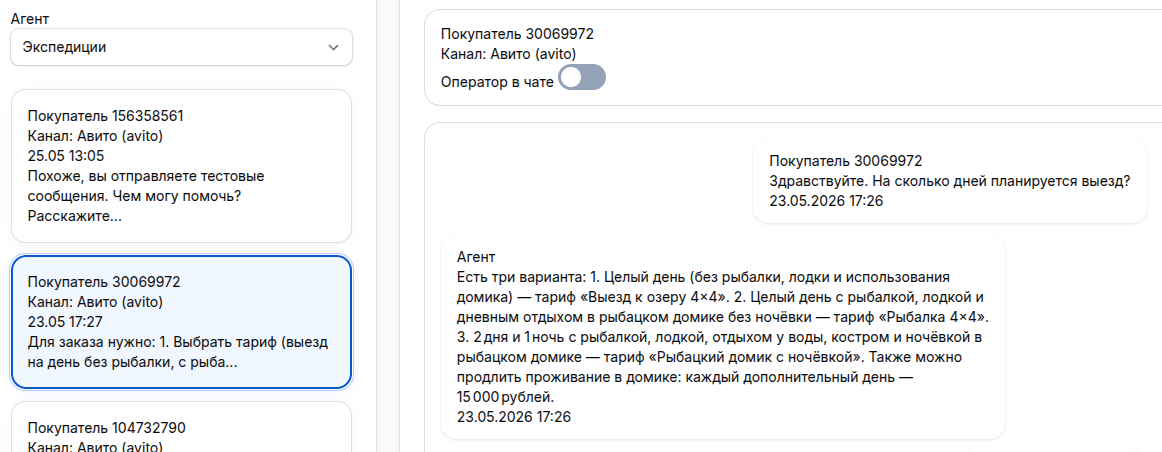
In Softrestchat, you can create a first-line AI operator trained on the company's instructions and FAQ. He answers standard questions around the clock, collects information for treatment, and escalates unknown or complex cases to an employee with a complete history of the dialogue. The supervisor can view the correspondence in the shared office and adjust the agent's knowledge. Such a platform should be perceived as strengthening the team, and not as a promise of a complete replacement of specialists.
When is it necessary to transfer an appeal to a person?
Even a well-tuned AI doesn't have to solve all the requests in a row. Mandatory transfer rules are needed for safe operation. They protect the client, the company, and the automation project itself from situations where one unsuccessful remark can negate the benefits of hundreds of successful sample responses.
The first condition is a direct request from the client. If a person asks for an operator, the system should not keep him indefinitely in an automatic scenario. You can refine the topic and collect data, but failure to transmit almost always worsens the impression.
The second condition is repeated failure. If the AI gave instructions, but the client returned with the same question, it is better not to continue the cycle of the same advice. Repeated contact is a signal that the task is more difficult than it seemed, or the answer was not accurate enough.
The fourth condition is low confidence. If the system does not find an answer in the knowledge base, sees contradictory signs, or cannot classify the request, it is safer to transfer the dialogue to the person. Good automation differs not because AI always responds, but because it knows how to stop in time.
What is required for secure automation
Secure automation does not begin with the choice of technology, but with the order of knowledge. If the instructions are outdated, the FAQ contradicts the regulations, and employees respond "from memory," AI will only accelerate the spread of chaos. Therefore, the first step should be an up-to-date knowledge base: proven answers, understandable scenarios, restrictions and rules of escalation.
The second element is access rights. It is necessary to determine in advance what the AI can do on its own, what it can only prepare, and what is prohibited without the participation of an employee. For example, they can report the status of the application, but not change the financial conditions; they can collect data for a refund, but not promise compensation; they can offer instructions, but not confirm a legally significant decision.
The third element is logging, that is, keeping a history of actions and responses. The supervisor should see exactly what the AI said, on the basis of which knowledge the answer was formed, when the transfer to the person took place, and how the dialogue ended. Without this, it is impossible to manage quality and resolve disputes.
The fourth element is quality control. At the start, you should regularly review a selection of dialogues: successful responses, escalations, complaints, repeated requests. It is useful to turn impersonal examples of AI errors into improvements to the knowledge base and transmission rules. For example, if the system responds too confidently to a question about a return in an unusual situation, you do not need to "scold the AI", but change the instructions and limit the scenario.
The fifth element is data protection and backup route. Client data should be processed according to the company's rules, and in case of a technical failure of automation, the request should not be lost. The client should always have a path to a person or an alternative support channel.
How the role of the support team is changing
After the introduction of AI, it is not the value of the team that changes, but the nature of its work. Previously, a significant part of the time was spent on repetitive responses, copying instructions, and initial information collection, but in the hybrid model, these actions are partially taken over by the automated first line.
Employees are starting to focus more on complex solutions: sorting out exceptions, dealing with complaints, retaining customers, coordinating related departments, and finding the causes of recurring problems. This requires higher qualifications, but it makes the job less mechanical and more managerial.
There is also a new feature — knowledge improvement. The support team sees where customers formulate questions that are unclear, where instructions cause confusion, and where AI too often passes the dialogue on to a human. These observations translate into knowledge base updates, new scenarios, and product changes. Support becomes not only a "response service", but also a source of data on friction in the customer experience.
It is important for the manager to discuss this with the team in advance. If the introduction of AI is presented as a hidden preparation for downsizing, employees will resist and see the system as a threat. If the project is described as a way to remove routine, reduce congestion, and improve the quality of complex solutions, the chances of successful implementation are higher.
Practice shows that a strong team does not disappear after automation. She is getting closer to the role of the center of expertise: she controls scenarios, trains AI through knowledge, analyzes non-standard cases and helps businesses understand why customers apply again and again.
How to launch a pilot without personnel promises
It is better to start support automation with a pilot, rather than with a loud statement about the transformation of the department. The pilot should test the hypothesis on a limited category of requests: for example, status responses, frequent connection questions, diagnostic data collection, or document navigation. The more precisely the site is selected, the easier it is to measure the result and the safer it is to correct errors.
At the first stage, AI can be run not on all requests, but on part of the flow. This reduces the risk and allows you to compare groups: where the usual support worked, and where the automated first line was connected. It is important to look not only at the speed of the response, but also at the quality: whether the issue has been resolved, whether the number of repeated contacts has increased, whether there have been more complaints.
It is better to avoid personnel promises at the pilot stage. It is not necessary to declare in advance that the project will reduce staff by a specific percentage or reduce costs by a fixed amount. Such conclusions depend on the actual structure of the requests, the quality of the knowledge base, seasonality, workload, and maturity of the processes. The pilot's task is to get the data, not to confirm a pre—selected slogan.
A pilot's healthy result may sound like this: "AI confidently closes some of the typical issues, reduces the load on the first line and prepares better transmission of complex cases." This is enough to make further decisions without illusions and pressure.
Metrics that should be used to evaluate the result
It is dangerous to evaluate AI in support only by the speed of the first response. A quick wrong answer is worse than a slow but accurate one. What matters to the client is not how instantly the system reacted, but whether his problem was solved without an unnecessary round of correspondence.
The key metric is the decision from the first request. It shows whether the client was able to get a result without repeated contact on the same topic. Next to it, you need to look at repeated requests: if, after the introduction of AI, people return more often with the same question, it means that automation creates the appearance of a solution.
The next indicator is the percentage of erroneous responses. An error may be an incorrect instruction, a promise beyond authority, an incorrect classification, a missed escalation, or a response without taking into account an important constraint. Such cases should be analyzed separately and translated into knowledge base improvements.
Escalations are also important. Too low a proportion of transfers to humans may not mean efficiency, but risky overconfidence of the system. Too high — that the AI does not classify requests well or the knowledge base is insufficient. The normal level depends on the selected task category and should be evaluated over time.
Finally, you need to measure customer satisfaction, team workload, and employee time for one difficult case. If AI relieves the typical workload, specialists should have more time for applications where a person is really needed. This is where the value of the hybrid model comes in: not just to respond faster, but to distribute the team's attention more wisely.
The answer to the main question is: is it possible to replace a human with AI
Today, AI can automate individual job functions of a support employee: receiving requests, classifying, answering FAQ, searching the knowledge base, primary diagnostics, data collection, resume preparation, and routing to the right specialist. In some companies, this is already enough to significantly unload the first line and reduce queues during peak hours.
But a complete replacement of a person is usually impractical. Support still requires tasks that require authority, responsibility, negotiation, dealing with exceptions, and careful communication in emotionally difficult situations. AI can support these processes, but it should not become the only decision-making point where an error costs the customer and the company dearly.
automate the predictable, accelerate the transfer of the complex, and keep people where responsibility is needed.
For a manager, the practical next step is to audit one hundred requests. Take a real sample of dialogues, categorize them, and evaluate frequency, risk, variability, and emotional complexity. After that, it will become clear which requests can be safely given to the first-line AI, which should be left to employees, and which should be conducted in a hybrid mode.
 Автор
Антон Амосов
Автор
Антон Амосов