AI Development: from fundamentals to business solutions and implementation



In short: who will benefit from the article and what will you get
AI development is no longer just a topic for research labs today. Artificial intelligence helps companies process applications faster, predict demand, look for errors in documents, support customers, manage warehouses, and create new digital products. But there is a path between the idea of "we need AI" and a working solution: data, architecture, team, security, process implementation, and measurable metrics.
This article is useful for managers, business owners, product directors, technical managers, and specialists who plan to develop AI solutions or want to understand how AI development works from scratch. The material covers practical issues: what methods to use, how to choose a contractor, how to calculate payback, which tools are suitable for different tasks, and how to implement AI agents without chaos in the processes.
The key thought:a clear business goal
AI is not a substitute for business strategy. It enhances those processes that are already described, measured, and have clear value to the customer or company.
AI Development: fundamentals, purpose and first developments
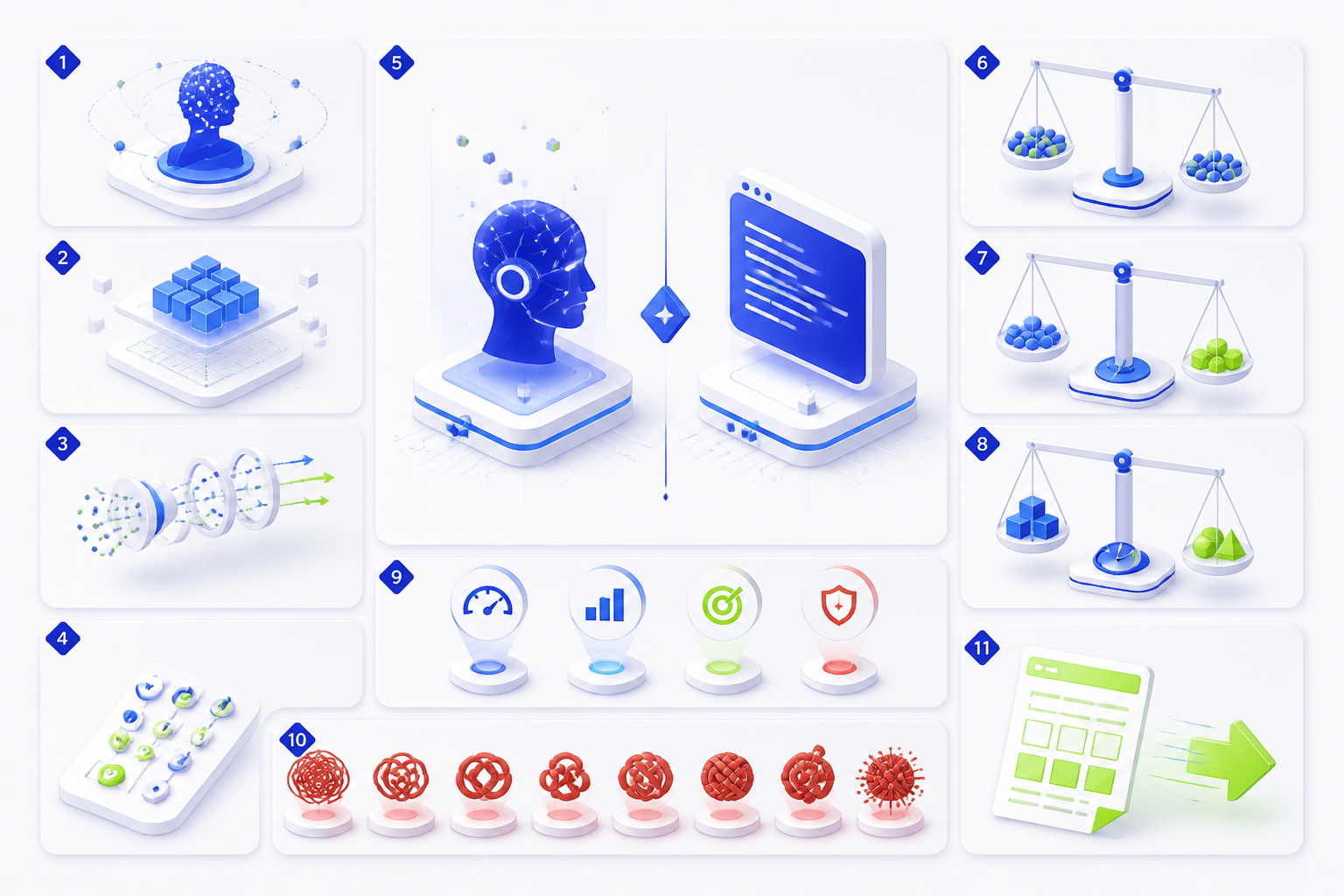
AI development is the creation of software systems that are capable of performing tasks that usually require human intelligence: understanding text, recognizing images, finding patterns, making decisions, conducting a dialogue, or predicting events. Such systems are based on data, mathematical methods, and a software architecture that allows the model to be applied in a real process.
The goal of AI development is almost always practical: reduce costs, speed up work, improve the accuracy of decisions, improve customer experience, or open a new source of revenue. For example, a bank can use AI to assess risk, a manufacturing company can use it for predictive maintenance of equipment, and an online store can use it for personal recommendations.
The first developments of AI appeared in the middle of the 20th century. Back then, researchers tried to describe thinking through rules and logical conclusions. Early expert systems worked on the principle of "if the condition is met, apply the rule." Such systems helped with diagnosis, planning, and finding solutions, but they did not cope well with uncertainty and a large amount of data.
machine learningdeep learning
AI development methods: from classical machine learning to large language models
AI development methods are chosen not by popularity, but by task. If you need to predict customer churn, classical machine learning is enough. If it is necessary to recognize defects in images, neural networks are often used. If you need to analyze emails, compose responses, and work with corporate knowledge, large language models are suitable — systems trained to understand and generate text.
Classical machine learning
Deep learning
Reinforcement learning
Large language models
| Method | When to apply | Example of a business task |
|---|---|---|
| Classical machine learning | Tabular data, forecasts, classification | Customer outflow forecast, application risk assessment |
| Neural networks | Images, sound, complex patterns | Finding defects on the production line |
| Large language models | Texts, dialogues, corporate knowledge | An assistant for the support or sales department |
| Reinforcement learning | Choosing actions in a changing environment | Optimization of routes or schedules |
Tools and platforms: when to choose TensorFlow, PyTorch and other solutions
framework
TensorFlow
PyTorch
scikit-learn
| The tool | When to choose | Strengths | Limitations |
|---|---|---|---|
| TensorFlow | Industrial implementation, mobile and scalable solutions | Deployment, ecosystem support, stability | Might be more difficult for quick research |
| PyTorch | Experiments, modern neural networks, text and image processing | Flexibility, ease of development, active community | Requires discipline in the transition from experience to industrial operation |
| scikit-learn | Tabular data and classical models | Simplicity, speed, explainability | Not suitable for complex neural networks |
| Cloud platforms | When computing, data storage, and managed infrastructure are needed | Quick start, scaling, ready services | Supplier dependence and fixed costs |
cloud
AI development for business: goals, indicators and economic efficiency
Developing AI for business should start with answering the question: what measurable problem are we solving? "We want to introduce AI" is a weak goal. "Reduce the processing time of the application from 20 minutes to 5 minutes", "reduce waste losses by 12%", "increase the accuracy of the demand forecast to 85%" — these are already working guidelines.
ROI = (financial effect − costs) / costs × 100%
Calculation example. The company processes 30,000 requests per month. One operator spends an average of 6 minutes on a request, the cost of an hour of work with taxes and overhead costs is 700 rubles. The AI assistant takes over the primary classification and response preparation, reducing manual time by 35%. The savings amount to about 1,050 hours per month, or 735,000 rubles. If development and implementation cost 3.5 million rubles, and support cost 250,000 rubles per month, then payback can occur in about 7-8 months, taking into account the gradual launch.
Typical payback periods for AI solutions depend on the scale. Automation of document processing can pay off in 4-9 months, demand forecasting in 6-12 months, and a complex computer vision system in production in 12-24 months. The better the process is described and the more repeatable the operations, the higher the chance of a quick return.
It is important to take into account not only the direct savings of the wage fund. AI can have an indirect effect: fewer errors, faster responses to customers, higher conversion, lower penalties, less equipment downtime. In mature projects, these effects are recorded separately, otherwise the value of the solution will remain invisible.
Developing AI solutions: a step-by-step path from idea to support
Developing AI solutions requires discipline. You can't just "plug in the model" and expect a sustainable result. A good project goes through several stages: task definition, data audit, prototype, verification on real processes, implementation, monitoring and improvement.
- Define a business goal.
- Check the data.
- Choose a method.
- Create a prototype.
- Conduct a pilot.
- Implement it in the work environment.
- Set up surveillance.
- Organize support.
A special place is occupied by the MLOps approach to the industrial operation of machine learning models. Transcript: Machine Learning Operations, that is, operational management of machine learning. In Russian, this can be described as a set of practices for training, testing, deploying, monitoring, and updating models. Without this approach, the model quickly becomes outdated: customer behavior changes, new products appear, documents are updated, and seasonality shifts.
CI/CD is another term that is often found in AI projects. CI means continuous integration: frequent automatic verification of code changes. CD stands for continuous delivery or deployment: the managed release of changes to the production environment. This is just as important for models as for regular programs: you need to know which version is running, who updated it, what data was used, and whether you can quickly roll back.
Development of AI agents for business: architecture, implementation and security
Development of AI agents for business
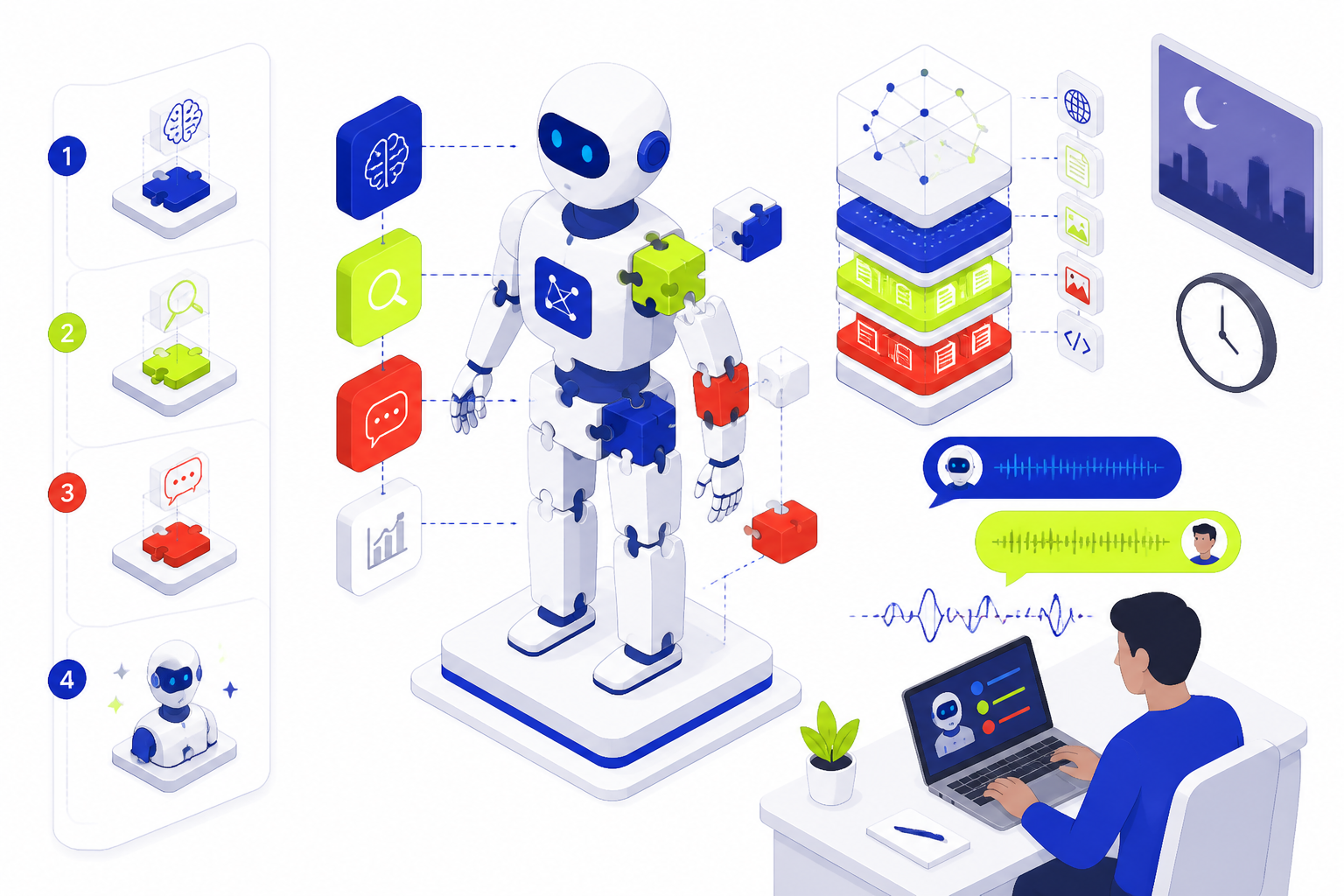
The architecture of an AI agent usually consists of several parts: a language model, a knowledge base, an access rights module, connectors to corporate systems, an action log, a result verification mechanism, and a user interface. If the agent works with clients, tone control, escalation scenarios for the employee, and protection from unwanted requests are added.
An example for the sales department. The agent receives an incoming email, determines the type of request, finds the client in CRM, checks the transaction history, prepares a draft response, suggests the next step to the manager and creates a call task. The manager does not waste time on routine tasks, but retains control over important decisions. This approach reduces the risk of error and gradually increases the team's trust in the system.
Security cannot be left "for later." The agent should see only the data that is allowed to a specific user. All actions should be recorded in the log: who requested it, what the agent did, and what sources he used. For critical operations such as sending a commercial offer, changing the price, or confirming an order, human approval is required.
It is a good practice to run an AI agent in assistant mode rather than as an autonomous performer. First, he suggests actions, then gets the right to perform safe operations, and only after accumulating statistics can he work more widely. This way is safer for businesses and easier for employees to accept.
How to choose an AI development company: checklist and request template
The query "AI development company" often appears when the business already understands the task, but does not know who to entrust the project to. The mistake of many customers is to choose a contractor based on beautiful presentations and loud words. It is more reliable to evaluate experience, methodology, questions at the start, budget transparency and the ability to bring a solution to operation.
A strong contractor does not promise "99% accuracy" before analyzing the data. He asks uncomfortable questions: what data is there, who is the owner of the process, how success is measured, what are the security restrictions, who will accept the result, and what is considered a model error. The more specifics there are at the start, the fewer surprises there will be after the pilot.
Contractor selection Checklist
- There are confirmed cases in a related industry or with a similar type of data.
- The team is able not only to train models, but also to implement them into operational systems.
- The contractor offers stages: audit, prototype, pilot, industrial launch, support.
- The contract describes the rights to data, code, models, documentation, and work results.
- There is a plan for security, logging, monitoring, and updating the model.
- The cost is divided into clear blocks: analytics, development, infrastructure, implementation, maintenance.
Request for proposal template
In the request, the contractor should specify: a description of the business process, the current problem, the amount of data, restrictions on personal data, targets, desired deadlines, a list of systems for integration, security requirements, the pilot format and acceptance criteria. It is also useful to ask the contractor to describe the team, the risks, the estimate of the budget by stages, and the post-launch support plan.
An example of the acceptance criterion: "On the pilot, the system should reduce the average processing time by 25% with a classification accuracy of at least 85% and a manual verification rate of no more than 30%." This criterion is much better than the general formulation "make a smart assistant."
Using AI in software development
The use of AI in software development has already become a working practice. AI helps you write drafts of code, look for errors, create tests, explain other people's parts of the program, prepare documentation, and speed up the verification of changes. But it's important to understand that AI is a developer's assistant, not a substitute for engineering responsibility.
In testing, AI helps you create test scenarios, find edge cases, analyze crashes, and explain error logs. Combined with continuous integration, it can reduce feedback time for the team. However, decisions about the release to the work environment should be based on automatic checks, code reviews, and security rules.
AI development is especially effective in mature teams where code standards are described, documentation, tests, and a clear architecture are available. If a project is in chaos, AI often accelerates the production of new bugs rather than the quality. Therefore, first there is order in the process, then automation.
AI Product Development: ideas, launch, and monetization
AI product development differs from internal automation in that you need to think not only about the model, but also about the market. The user is not buying a "neural network", but a pain solution: it is faster to prepare a contract, cheaper to process applications, more accurately plan purchases, make fewer mistakes in calculations, and it is more convenient to train employees.
Promising ideas for commercial AI products often arise at the intersection of industry expertise and repeatable routine. For example: an assistant for lawyers in the primary analysis of contracts, a demand forecasting system for regional networks, an AI assistant for medical document management, quality control of sales calls, automatic marking of applications for the support service.
The launch strategy should be narrow. Instead of an "AI for the entire sales department" product, it's better to start with a specific scenario: "preparing a summary of the call and the next step in CRM." A narrow scenario is easier to sell, measure, and improve. After a proven result, the product can be expanded.
Monetization can be based on a subscription, payment for the number of documents processed, payment for a workplace, or a share of the economic effect. For the corporate market, a mixed model often works: a one-time implementation cost plus monthly support and usage fees.
Working in AI Development: Roles, Skills, and Growth path
AI development work is not a single profession, but a whole group of roles. A data analyst, a machine learning engineer, a software developer, a data engineer, an implementation specialist, a solution architect, a product manager, and a security specialist can participate in the project. The closer the project gets to the business, the more important it is not only mathematics, but also the ability to understand the customer's process.
A beginner should start with the basics: linear algebra, probability and statistics, Python programming, working with data, basic machine learning algorithms. Python is a programming language widely used in data analysis and AI due to its simplicity and large number of libraries. Then it is useful to make several application projects: sales forecast, classification of reviews, search for similar products, and a simple document assistant.
At the average level, a specialist should be able to select metrics, prepare data, train models, check quality, explain the result to the business, and deploy a solution. At the senior level, architecture, reliability, security, cost estimation, team management, and responsibility for results in the work environment are added.
A career path can go from a junior data analyst to a machine learning engineer, then to a leading specialist, an architect of AI solutions, or a team leader. An alternative path is a product one: from an analyst or product owner to the head of the AI department. In both cases, a portfolio, the ability to bring projects to implementation, and an understanding of the economic impact are valued.
Practical case: implementation of an AI agent in the sales department
Let's consider a typical project. A company with B2B sales receives about 8,000 incoming requests per month: letters, forms from the website, messages from messengers. Managers manually determine the type of request, search for a customer in CRM, clarify the history, prepare a response and create a task. The average initial processing time is 18 minutes, some applications are lost, and the supervisor sees the problem only after the fact.
The goal of the project is to reduce the initial processing time to 7 minutes, increase the proportion of applications with a correctly filled out card to 95% and speed up the first response to the client. The project team consists of a business analyst, a data engineer, a machine learning engineer, an integration developer, a security specialist, a project manager, and a sales representative.
The architecture of the solution includes a language model, a product knowledge base, a CRM connection, an access verification module, an action log, and a dashboard. The agent does not send emails independently at the first stage: he prepares a draft, classifies the request, suggests the next step, and creates a task after confirmation by the manager.
The project can be divided into stages. Data and process audit — 2 weeks. The prototype lasts 4 weeks. The pilot period for one sales group is 6 weeks. Completion and industrial launch will take 4-8 weeks. Support and improvement are ongoing. The budget for such a project for an average company can range from 2.5 to 8 million rubles, depending on integrations, security requirements, and data volume. Monthly support can take 10-25% of the development cost in annual terms.
After the pilot, the company received a 42% reduction in initial processing time, an increase in card occupancy to 96%, and a 28% reduction in missed applications. Managers were wary of the agent at first, but trust grew after the system began explaining which sources it had taken the data from and why it had suggested a specific next step.
How much does AI development cost?
The cost of AI development depends not so much on the "trendiness" of the technology, but rather on the maturity of the business task, the quality of the data, and the depth of integration with the company's current processes. One project may be limited to connecting a ready-made language model to CRM, while another will require markup of the dataset, training of its own model, building an MLOps infrastructure and multi-stage testing on real users. Therefore, it is more correct to talk not about a single price, but about ranges and factors that form the budget.
It is important for businesses to evaluate AI development as an investment, rather than as a one-time purchase of a software module. If a solution reduces the processing time of applications by 30-40%, reduces the burden on operators, or increases the accuracy of demand forecasting, its payback can be calculated using specific metrics: saving working hours, increasing conversions, reducing errors, and speeding up decision-making.
The main budget ranges
A small pilot project or MVP is usually cheaper than a full-fledged industrial system. In this format, the team tests the hypothesis: whether AI really solves the problem, whether there is enough data, and whether the economic effect is clear. An MVP can include a prototype chatbot, a request classifier, a module for extracting data from documents, or a simple recommendation algorithm.
- Pilot or MVP:
- Corporate AI Solution:
- A complex custom system:
The figures may vary markedly depending on the industry. For example, an AI assistant for the initial processing of applications in the sales department is usually cheaper than a computer vision system for quality control on a production line, where cameras, infrastructure, image collection, model training and accuracy testing are needed in different lighting conditions.
What influences the price
The first factor is the state of the data. If the data has already been collected, structured, and accessed via the API, the project starts faster. If information is stored in tables, correspondence, document scans, and various accounting systems, a significant portion of the budget will be spent on preparation: cleaning, normalization, markup, and approval of processing rules.
The second factor is the level of integration. An AI that simply answers questions in a separate interface is cheaper than an agent who creates tasks in CRM, updates customer cards, passes requests to managers, and complies with corporate security rules. The closer the solution is to real operational processes, the greater the requirements for reliability, logging, and action control.
The third factor is accuracy and risk requirements. Creative variation is acceptable in marketing, but in medicine, finance, or legal processes, mistakes can be costly. Therefore, additional stages are laid for sensitive areas: validation, audit, test circuits, manual confirmation of critical decisions, and quality monitoring after launch.
What makes up the estimate?
A typical project estimate includes analytics, architecture design, development, model configuration, integration, testing, implementation, and support. The costs of cloud services, external model APIs, data storage, computing power, and licenses can be taken into account separately. Sometimes it is the operating costs that become the key point, especially if the system processes a large stream of requests every day.
A practical approach is to start with a short pre—project survey. In 1-3 weeks, you can describe usage scenarios, evaluate data availability, select a technology stack, and prepare a roadmap. This stage reduces the risk of "blind development" and helps to understand in advance where the project will bring a quick effect, and where it is better not to spend the budget before preparing the data.
A guideline for making a decision:
How to reduce cost without losing quality
A phased launch helps to reduce the budget. First, one clear business scenario is selected with a noticeable effect: lead processing, knowledge base search, support automation, call analysis, or demand forecasting. After checking the result, the solution is scaled to neighboring processes. This way is safer than trying to build a universal AI platform for the entire company at once.
Another way to optimize is to use ready—made models and services where unique training from scratch is not required. In many tasks, it is enough to design the prompta correctly, set up a knowledge base, connect the RAG approach - a method in which the model responds based on corporate documents — and add quality control of responses. A proprietary model is justified when a company has specific data, strict requirements for autonomy, or the need to significantly exceed ready-made solutions in accuracy.
The total cost of AI development becomes clear after the task is decomposed. The more precisely the goal, data, integration, and success criteria are formulated, the less uncertainty there is in the estimate and the higher the chance that the project will turn not into an experiment for the sake of technology, but into a working tool that brings measurable benefits to the company.
FAQ: Frequently asked questions about AI development
How much does it cost to develop an AI solution?
A small prototype can cost hundreds of thousands of rubles, and an industrial solution can cost from several million. The cost is affected by data, integrations, security requirements, model complexity, number of users, and support. It is important to evaluate not only development, but also operation: cloud computing, storage, updates, monitoring and maintenance.
Is it possible to implement AI without your own data?
Sometimes you can start with ready-made models and open data, but for an accurate business result, you almost always need internal company data: documents, applications, sales, appeals, reference books. If there is little data, you can start the project with a pilot and build a collection of high-quality information in parallel.
Will AI replace employees?
In most projects, AI takes over routine operations first, rather than all human work. It helps you process information faster, suggests solutions, and reduces the number of errors. The most stable scenario is a combination of "human plus AI", where the employee makes important decisions, and the system accelerates training.
How to reduce the risk of errors?
It is necessary to introduce human verification for critical actions, log decisions, restrict access to data, regularly measure quality and use control samples. It is useful for language models to require references to sources within the corporate knowledge base and prohibit actions outside the permitted scenario.
Where should I start a company that is only looking at AI?
The best way to start is to audit processes. You need to find a repeatable task with a clear scope, measurable error cost, and available data. Then calculate the expected effect, assemble a small pilot, and expand the solution only after confirming the result.
Result:
 Автор
Антон Амосов
Автор
Антон Амосов


Related articles
Top 10 platforms for building AI agents: what's inside each service
The cost of developing Telegram bots in Russia in 2025

GPT-6 Astra: a breakthrough to AGI or thoughtful marketing?
How to create an AI agent: clear architecture, tools, and typical errors
AI Agent Constructor: what is really possible to assemble without a programmer and where is the code needed?