AI Agents and 152‑FZ: how to ensure legitimate data processing and risk management



AI agents are already working as consultants on websites, staff assistants, application screening tools, and customer support tools. If personal data enters such systems, the company must comply with 152-FZ: determine the purpose of processing, the legal basis, the composition of the data, the retention period, security measures and the procedure for interacting with suppliers.
The main principle is simple: AI does not override the requirements of the law. If the system accepts, analyzes, transmits or stores information about a person, this is the processing of personal data. This means that it needs to be described in documents, limited technically, and controlled organizationally.
What is important to understand before implementing an AI agent
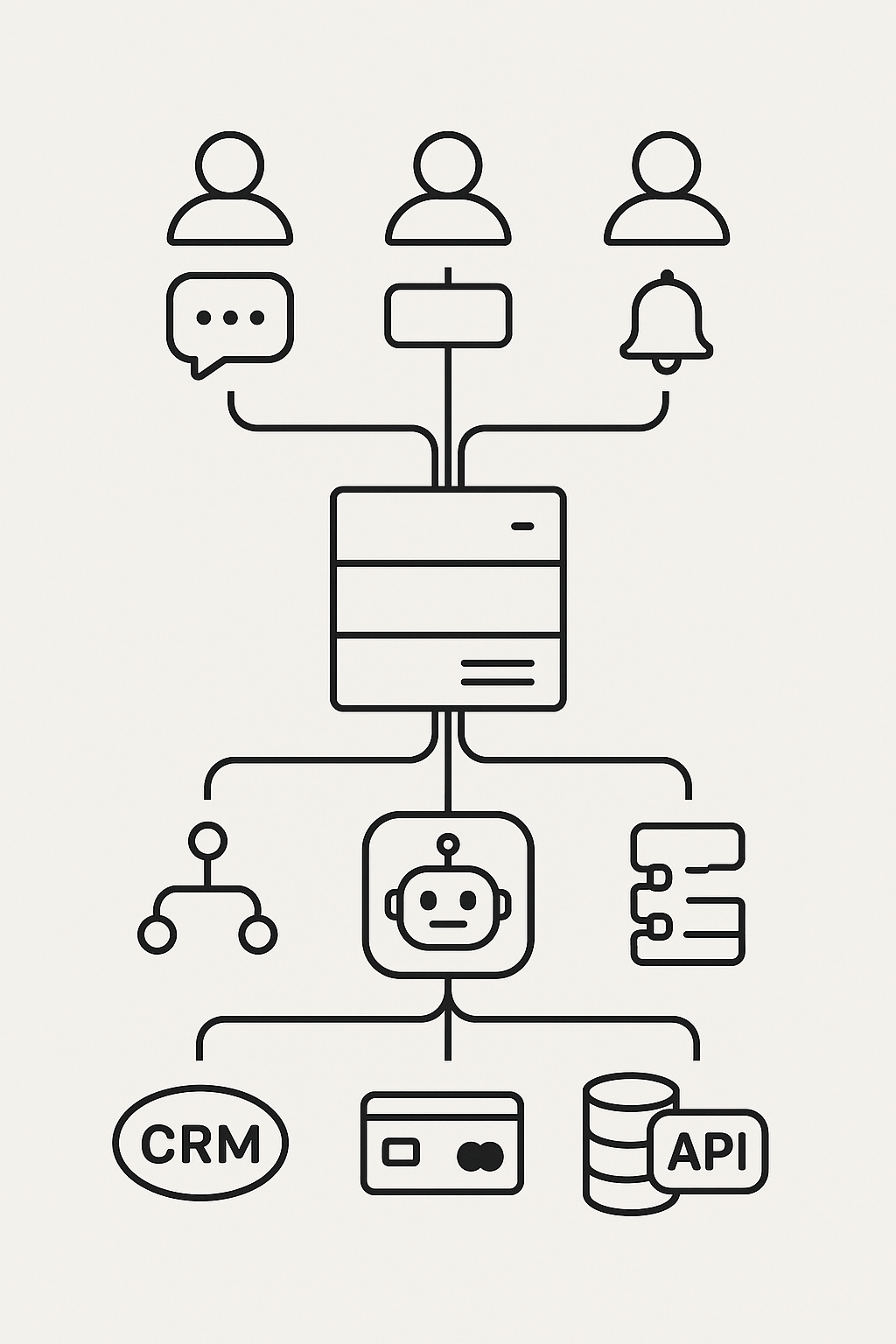
An AI agent is not only a large language model. This is usually a bundle of an input form, a knowledge base, a correspondence log, means of transferring data to other systems, and the rules by which the assistant operates. The risk arises not because of the very fact of using AI, but because of what data is transmitted to it and where it goes next.
Before launching, you need to answer four questions::
- what personal data will be entered into the system: name, phone number, email address, contract number, health information, financial information;
- for what purpose they are needed: consultation, application processing, customer support, preparation of a response to an employee;
- where the data is stored and processed: in Russia, abroad, or in a mixed scheme;
- who has access: company employees, AI service provider, technical support, contractors.
If there are no exact answers to these questions, it is better not to launch the implementation: it is impossible to correctly issue consent, processing policy and contract with the supplier.
The minimum set of requirements under 152-FZ
The company that determines the purpose and composition of personal data processing is usually the operator. She is responsible for the legality of processing even when using an external AI platform or cloud service.
For legitimate use of an AI agent, you need:
- determine the legal basis for processing: consent, contract, legitimate interest within the law, or other basis;
- update the personal data processing policy and notifications for users;
- do not collect unnecessary information that is not needed for the stated purpose.;
- set a retention period for correspondence and applications;
- restrict access to data by roles;
- keep records of actions with data and check the supplier's work;
- ensure localization of the primary record of personal data of Russian citizens in Russian databases, when required by law.;
- to issue an order for the processing of personal data if the supplier is acting on behalf of the company.
Separately, it is necessary to assess whether special categories of data fall into the system: health information, biometric data, political views, religious beliefs. For them, the requirements are stricter, and consent often needs to be more specific.
How to remove unnecessary risks in architecture
A safe scheme is based on minimization. The AI agent needs to transmit only the information without which it will not complete the task. For example, to answer a question about the delivery status, the order number and contact channel are sufficient, but you do not need a complete customer passport.
Practical measures:
- mask data before transferring it to the model: replace phone, email, and contract number with conditional values;
- separate the storage of correspondence and customer card;
- prohibit models from requesting unnecessary data on their own;
- add human verification of the response for controversial or legally significant actions;
- do not use customer correspondence to retrain the model without a separate reason;
- configure data deletion after the storage period expires;
- check which countries the supplier's computing facilities and storage facilities are located in.
The less personal data gets into the AI circuit, the easier it is to comply with the requirements of the law and the lower the consequences of a possible error.
Case study: personal data processing in the chat assistant on the website
Let's say an online service wants to put a chat assistant on the site that answers customer questions, helps select a service, and sends a request to the manager. The correspondence may include a name, phone number, email address, order number, and a description of the problem.
The sequence of actions can be as follows:
- Describe the scenario.
- Determine the composition of the data.
- Prepare a notification for the user.
- Set up restrictions in the assistant itself.
- Split the data.
- Check the supplier.
- To issue a contract and a processing order.
- Set up storage and deletion.
- Perform a check before launching.
This approach allows the use of AI in customer support without turning the chat assistant into an uncontrolled channel for collecting personal data.
A special case: the company uses AI agents according to the "software as a service" model
The "software as a service" model refers to a situation where a company does not install a system at home, but uses an external cloud service from a supplier. In the business environment, this is often referred to as SaaS. For 152-FZ, it is not the name of the model that is important, but the distribution of roles.
If the company decides for itself why to collect customer data, which fields to fill in, and how to use the AI agent's responses, it remains the operator of personal data. The cloud service provider is most often the person who processes the data on behalf of the operator.
Responsibility of the user company:
- choose the legal basis for processing;
- inform clients about the purposes and conditions of processing;
- check the supplier before transferring the data;
- conclude an agreement with the terms of the processing order;
- control what data is sent to the service;
- ensure that localization and cross-border transfer requirements are met;
- respond to requests from personal data subjects.
Responsibility of the service provider:
- to process data only on behalf of the company and within the limits of the contract;
- do not use customer data for your own purposes without a separate reason;
- provide technical protection, access control, and logging of actions;
- report incidents and help with data deletion or upload;
- disclose information about subcontractors and data processing locations.
If a supplier begins to determine the processing goals on its own, for example, using customer correspondence to develop its own product, mailing lists, or model training to its advantage, its role may change. Then separate legal bases and a more complex contractual scheme are needed.
Cross-border transmission and location of large language models
A large language model, often abbreviated as LLM, can be hosted in Russia, in a foreign data center, or run through a supply chain. This is important for the company because the transfer of personal data outside of Russia is considered a cross-border transfer.
If personal data of Russian citizens is first collected through a website or application, it is necessary to take into account the requirement for initial recording, systematization, accumulation, storage, refinement and extraction using databases located in Russia. After fulfilling this requirement, separate transactions with foreign services are possible, but they need to be assessed as a cross-border transfer.
Before using a foreign model or a foreign cloud service, you should:
- set the country of processing and the list of companies that access the data;
- check whether the country is among those providing adequate protection of the rights of personal data subjects.;
- comply with the requirements for submitting a notification of intent to carry out a cross-border transfer, if necessary in a specific situation.;
- fix in the contract the protection measures, the procedure for deletion, and the prohibition of training the model on client data without approval.;
- evaluate whether it is possible to transmit anonymized or abbreviated text to the model instead of the source data.;
- reflect cross-border transfer in the personal data processing policy and in the consents, if they are used.
If the model and storage are located in Russia, there is usually no cross-border transfer, but there are still requirements for the legality of processing, security, and a contract with the supplier. If the model is located abroad, we cannot limit ourselves to the phrase "we use AI": we need to understand the data route and document it.
Documents worth checking
For most projects with AI agents, it's enough to put a few documents and settings in order.:
- personal data processing policy;
- consent and notification forms on the website;
- agreement with the AI service provider and processing order;
- list of processed data and purposes;
- threat model and protection measures if the system is part of the personal data information system contour;
- rules of staff access to correspondence and applications;
- retention periods and disposal procedure;
- the procedure for dealing with an incident and responding to requests from subjects.
There is no need to create documents "for show". Their task is to capture the real process: what data goes to the AI agent, who sees it, where it is stored, and when it is deleted.
A brief conclusion
An AI agent can be legally implemented if it is not treated as a "black box". The company must understand the way personal data is processed, limit its composition, establish relationships with suppliers, and separately verify foreign processing.
The safest strategy is to minimize data, place critical databases in Russia, not transfer unnecessary information to the model, prohibit training on client correspondence without a separate reason, and regularly check that the actual operation of the system matches the documents.
 Автор
Антон Амосов
Автор
Антон Амосов


Related articles
The cost of developing Telegram bots in Russia in 2025

A chatbot in simple words: what is it and what is it for?

GPT-6 Astra: a breakthrough to AGI or thoughtful marketing?

Personal AI Business Assistant: how to choose between Hermes, OpenClaw, a self‑written system and Softrestchat

How to create an AI agent: clear architecture, tools, and typical errors