
AI agent for a construction company: real automation of tenders, estimates, VET and document management


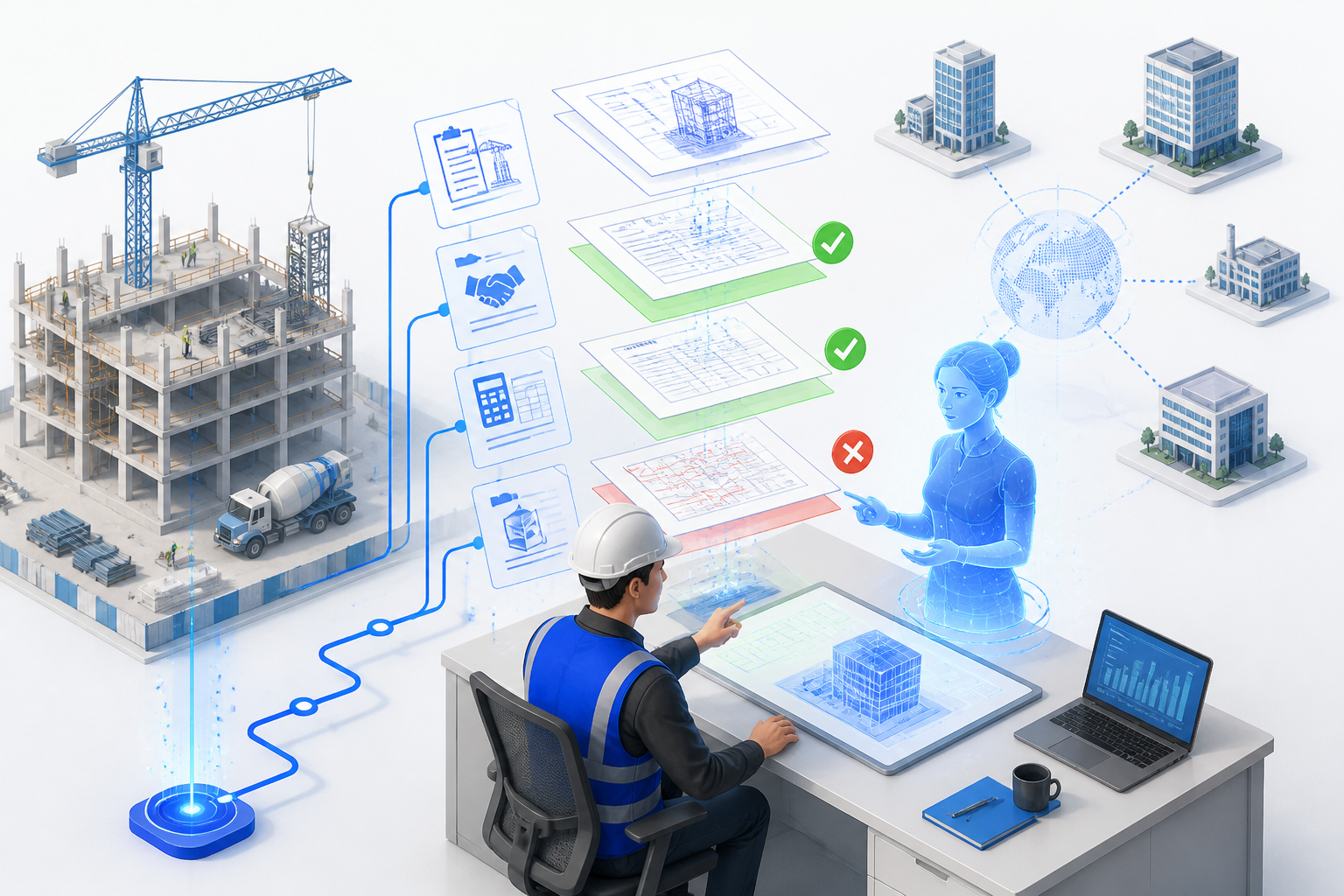
AI agent for a construction companyThe illusion of precision
For a construction company, this is not an academic difference, but a matter of money. The tender department reads hundreds of pages of documentation, lawyers look for risks in contracts, cost estimators compare positions and the regulatory framework, and the VET collects executive documentation for acceptance. An error in one clause of the contract or the absence of a signature in the act of hidden work can cost weeks of time. AI is useful where it reduces the amount of manual verification, shows the source of the output, and leaves the final decision to a specialist.
The main rule of implementation:
AI in constructionSupplier promises
Process: tenders and procurement search
Automation of tenders in construction does not begin with a beautiful "find purchase" button, but with access to data and understanding what exactly the company considers a suitable object. In construction purchases, there is usually no "we are interested" filter. The contractor is interested in the region, type of work, availability of the required SRO, deadlines, advance payment, familiar customer, collateral, fines, experience requirements and real logistics to the facility.
https://int44.zakupki.gov.ru/eis-integration/services/getDocsIPgetDocsByReestrNumberRequestgetDocsByOrgRegionRequestgetNsiRequest
The practical conclusion is simple: "connecting to public procurement" is not a task for a couple of days. Therefore, many construction companies use ready-made services: for example, a Tender Plan with search, analytics and an assessment of the chances of winning based on the purchase history or Contour.Purchases with intelligent search, API module, and integrations with 1C, Bitrix24, and amoCRM. A ready-made service closes the procurement window, but it does not always understand the internal logic of a particular contractor.
This is where the meaning of your own agent comes in. He does not replace the tenderer and does not make a decision on participation. His task is to read the procurement documentation, pull out the requirements for the participant, deadlines, collateral, scope of work, fines, key restrictions and compare them with the company's rules. At the exit, the tender department receives a short "go/no go" summary with arguments and links to documents.
The effect on the primary dropout is particularly noticeable. Where previously the specialist opened dozens of files and searched for risks manually, the agent can highlight in advance: the deadline is unrealistic, the provision is too high, the requirements have experience in a specific type of work, the object is located beyond acceptable logistics, and the customer has already appeared in problematic projects. A person does not read everything in its entirety, but only what has actually passed the pre-filter.
Process: contracts and claims work
the cost of implementing the system
In the international market, the value of the direction is well demonstrated by the deal between Document Crunch and Trimble. Document Crunch specializes in the analysis of construction contracts, and the transaction amount was $246.4 million. Their Project Assist product is claimed to be a tool that helps generate redlines, submissions, and RFI requests for information used in construction projects. The economics are clear: if the average construction dispute in North America exceeds $60 million, then a system that finds contractual risks in advance becomes not a toy, but an insurance business circuit.
In Russian reality, the scenario looks different in form, but very similar in essence. The AI agent can check the draft contract for typical risks: unilateral refusal, acceptance procedure, payment deadlines, responsibility for downtime, warranty deductions, volume changes, conditions for admission to the site, the obligation to maintain enforcement documentation and grounds for withholding money. What is important is not an abstract "legal assessment", but a list of places that the lawyer and the project manager should look at first.
A separate useful scenario is the reconciliation of the contract with the tender documentation. In practice, discrepancies occur regularly: there are some payment terms in the purchase, others in the contract; there is one acceptance procedure in the documentation, additional conditions have been added to the draft contract; one name of work is in the estimate, another is in the contract. The agent can decompose these discrepancies into a table and provide a link to specific points.
Another layer is the commitment calendar. Dates and events can be extracted from the contract: when to notify the customer, when to submit an act, when the deadline for responding to a claim expires, when to send the enforcement documentation, when responsibility for delay begins. This is important for a construction company: claim work is often lost not because the position is weak, but because the notice period is missed or the document is sent without the necessary wording.
Reservation is required:
Process: estimates
Estimates are an area where promises need to be formulated especially carefully. The construction reader quickly distinguishes a working tool from a marketing slogan. If the supplier says that "the AI will check the estimate itself," they need to ask a simple question: which sample was used to measure accuracy, which verification method, and which types of errors the system finds and which it does not find. In most cases, there will be no public response.
The regulatory framework also requires precision. FSNB-2022 was approved by the order of the Ministry of Construction No. 1133/pr and has been applied since 02/25/2023. An important feature: there are no federal single rates in the database, the calculation is carried out using the resource-index method. Additions to the database are released regularly, so the order numbers, effective dates, and composition of the changes must be checked on the day of publication and on the day of calculation. FGIS CA is declared as a source of open data, but the implementation of estimated automation should still take into account the practice of a specific estimated department.
There are tools on the market that help the estimator. Smeta.AI is positioned as an assistant in the compilation, but the system does not perform fully automatic calculation of estimates. GRAND-Estimate develops the functions of automating the selection of prices. The KPSR of Glavgosexpertiza is used to check estimates, but these are mostly deterministic checks according to the rules, and not a "neural network" that independently understands the technology of work.
The honest thesis is this: there are virtually no AI audit systems for estimates with published verifiable accuracy on the Russian market. This does not mean that automation is useless. On the contrary, there are many tasks around estimates where the agent and the usual program code produce an effect without the dangerous promise of "replacing the estimator."
It is realistic to automate the comparison of cost estimates with the regulatory framework, the search for outdated prices, the identification of discrepancies between the estimate, the volume statement and the contract, the preparation of requests to suppliers for market analysis, verification of arithmetic and completeness of filling. It's better to check arithmetic, duplicates, empty fields, and formal inconsistencies with code: it's boring, but reliable and reproducible.
But the selection of prices for the actual technology of work should not be given to the model as the final solution. This is the expert area of the estimator. An error in pricing may come up during the examination, lead to a dispute with the customer, or distort the economics of the project. AI is appropriate here as an assistant: to show similar positions, raise regulatory information, highlight discrepancies, but not to put a final signature.
Process: executive documentation and VET
The regulatory framework for the ID is set by the order of the Ministry of Construction No. 344/pr on the composition and procedure for maintaining executive documentation in the current version, as well as the relevant standards and requirements of the customer. The COP-2 and COP-3 forms remain mandatory for budgetary financing. For a specific project, it is important not only to know the general list of documents, but to link it to the type of work, contract, schedule and internal requirements of the customer.
The PTO AI agent can check the completeness of the package: what documents should be in the current stage, what is missing, where there is no signature, where the dates are in the wrong sequence, where the number of the act of hidden work does not match the registry. "He" can check the acts with the forms, compare the names of the works with the estimate and the contract, search the archive for phrases like "show all the acts of hidden work on this site" or "find the execution schemes for the capture of B".
Verifiability is critically important for an IT engineer. The answer "the document is incomplete" is useless by itself. The working answer should look different: the signature of the representative of the construction control in act No. 18 is missing, the date in the work log is later than the date of the act, one name of the work is indicated in the form, and another in the estimate, the basis is found on such a page or in such a file. It should be possible to check the output in ten seconds.
A good agent does not break the usual VET process, but removes the routine from it. He prepares drafts of cover letters, fills out drafts of magazines according to templates, collects a list of missing documents, reminds of deadlines and helps to quickly answer customer's questions. As a result, the engineer spends less time shifting files and more time monitoring the content.
Where AI fails in construction: drawings
The most dangerous promise on the market is "AI will calculate the volumes according to the drawing." That's what the construction company wants to hear, because measurements, specifications and volume statements take a lot of time. But this is where modern models still often make mistakes. Moreover, mistakes are not always noticeable: the answer looks confident, the table is neat, the numbers are convincing, and the initial perception of the plan is incorrect.
The AECV-Bench study shows an important boundary: models can recognize text in drawings well, up to high-quality OCR, but the understanding of symbols is noticeably lower — about 0.40–0.55 in the estimates given. Counting doors and windows according to the plan remains an unsolved problem. The authors formulate the problem as the lack of real "literacy of reading the drawing" in the models.
Another illustrative plot is DrawingVQA. When analyzing errors, it turns out that the model's reasoning plan may be correct, but visual perception fails: the model "sees" intersections of lines that do not exist, misinterprets conventions, or loses the connection between plan elements. This is critical for the construction process: one incorrectly calculated group of elements turns into an error in the estimate, purchase, or schedule.
The practical conclusion is hard: measuring and calculating volumes according to drawings should not be entrusted to the agent as an independent task. Let's say the pre-markup mode, when the model helps a person to find fragments faster, recognize text symbols, or prepare a rough list of elements. But the final check should be left to the specialist.
This boundary does not make AI useless for construction. On the contrary, it helps to implement it where the effect is real. Documentation, contracts, specifications, letters, minutes of meetings, journals, acts, tender requirements are a textual outline, and the agent works much more reliably in it. A company that understands the difference between text and drawing benefits faster and runs less risk of buying a beautiful but non-working demo.
What are the big players doing?
The global market is already showing that AI in construction is moving not towards one universal button, but towards a set of specialized agents. Procore talks about the "digital employee" and agent packages, as well as the environment for creating your own scripts. Trunk Tools develops AI for construction documents and attracts large investments. Autodesk integrates assistants into its products, including recognizing elements and working with project information.
The claimed effects sound impressive: for example, individual Autodesk customers reported a reduction in estimated work by about 30% and a reduction in measurement time by more than half. But an important caveat is that the accuracy of such scenarios is usually not disclosed in public materials. For a construction company, this means that you need to check a beautiful saving figure on your documents, your types of work, and your control loop.
There is also a less obvious, but very important risk — platform risk. When the process is based on a combination of two external products, changing API access can stop work regardless of the will of the construction company. The story of Trunk Tools being disconnected from the Procore API has shown that dependence on someone else's platform is not a theoretical threat, but an operational risk.
The practical conclusion is that the AI agent architecture should be designed so that a change of supplier does not stop the process. The data must remain in the company's system or in a controlled loop, the integration must be documented, and the agent must work as a separate layer on documents, CRM, 1C, archive, and mail. Then the company buys not dependence on a specific button, but controlled automation of its process.
links to sourcesin a closed loop
Where to start: one process, not "digitalization"
The best first candidate is contracts and claims work. The data already exists in text form, the owner of the process is clear, and the result is easy to verify: whether the agent found risky items, was able to compare the contract with the tender documentation, prepared a calendar of obligations, and showed links to sources. Here you can quickly see whether the tool helps or just beautifully retells the text.
The second strong scenario is the completeness of the executive documentation. It is well measured: how many documents have been checked, how many inconsistencies have been found, how much time the VET engineer spent before and after implementation, and how many errors were detected before being transferred to the customer. For a pilot, one package of IDs for a real object is enough.
The selection of tenders should begin after the company's criteria are clear. If there are no criteria, the agent will bring a lot of formally suitable purchases and create noise. If the criteria are described — the type of work, region, SRO, advance payment, customers, minimum price, deadlines, restrictions on facilities — the agent turns into a useful filter and assistant to the tender department.
It is better to take estimates not as an "AI estimator", but as a set of auxiliary checks: arithmetic, discrepancies between documents, outdated positions, preparation of requests to suppliers, comparison with the contract. Drawings should not be selected by the first process. They have too high a risk of false confidence and too much manual validation.
- Contracts and claims work
- Completeness of executive documentation
- Selection of tenders
- Estimates
- Drawings
How to check an AI agent on your documents
The most honest way to evaluate an AI agent for a construction company is to test it not on a presentation, but on real documents. For the first pilot, five contracts, one package of executive documentation or several sets of tender files are enough. The agent must show what he found, exactly where he found it, and why he considers it important.
In the contract pilot, the result may be a risk map: disputed acceptance conditions, payment deadlines, warranty deductions, volume changes, liability for downtime, discrepancies with the tender documentation, and a calendar of obligations. The VET pilot contains a list of missing documents, inconsistencies in dates and numbers, problems with signatures, discrepancies between acts, estimates and the contract. The tender pilot contains a summary of the purchase with the "consider/not consider" decision and grounds.
 Автор
Антон Амосов
Автор
Антон Амосов


