AI agents: how to automate business processes, reduce TCO and increase ROI


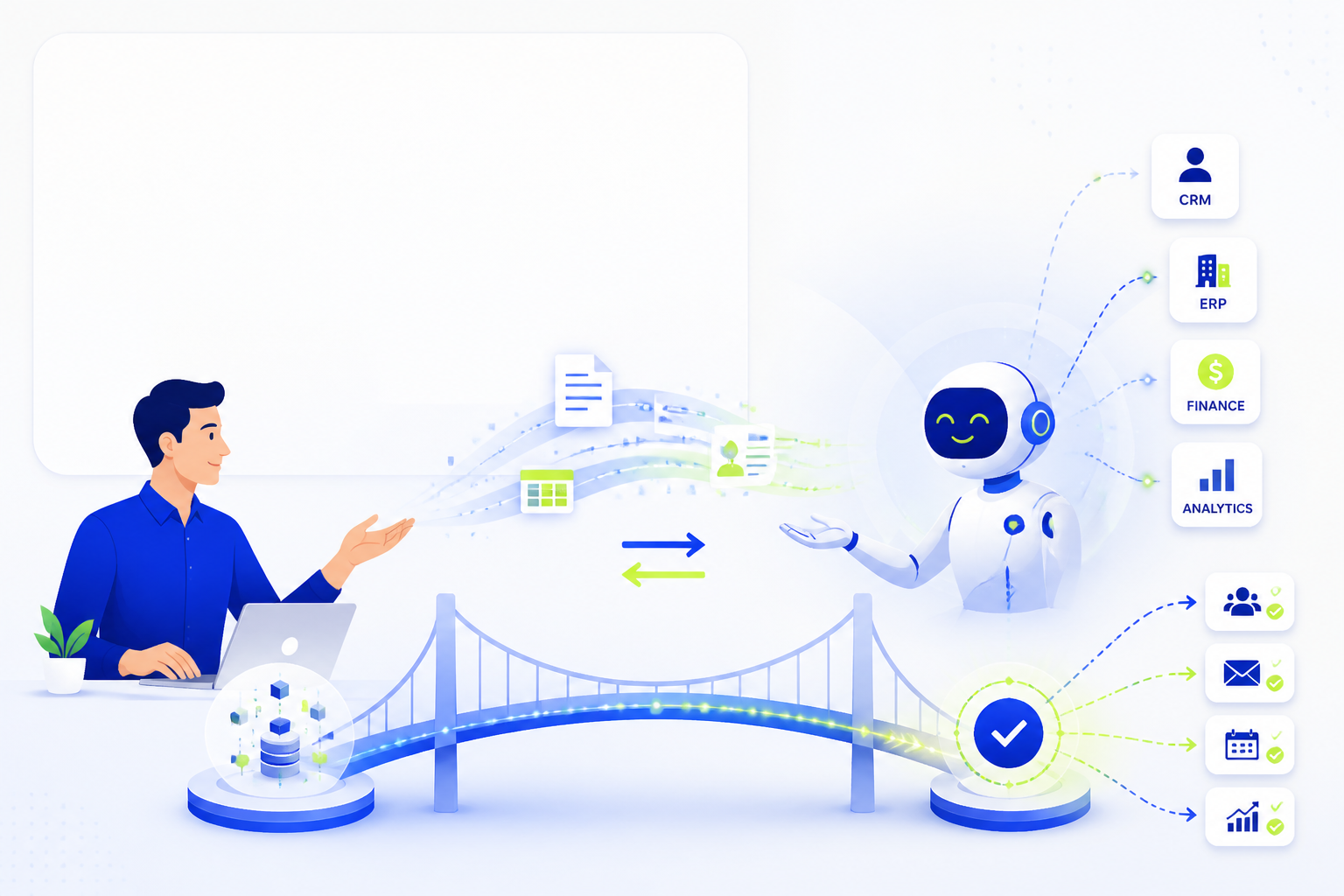
Why does a business need AI agents and when are they more profitable than classical automation?
variabilityconventional RPA automation
The main question of the implementation is not "is it possible to apply AI", but "where AI will give a measurable increase in speed, quality or revenue at an acceptable level of risk".
Definition and types of AI agents
The AI agent
Conversational agentsTask-orchestration agentsAutonomous agents
MLNLPLLMOrchestration
In a mature architecture, an AI agent rarely exists alone. It is connected to CRM, ERP, knowledge base, service desk, mail, telephony, BI-system and document storage. Therefore, automating business processes with AI is not only about choosing a model, but also designing a reliable data loop, access, monitoring, and responsibility.
AI agents, RPA and workflow automation: what to choose
RPAWorkflow-automationAI agents
In practice, a hybrid often gives the best result. For example, an AI agent analyzes a client's email and determines the type of request, a workflow system routes the request, and an RPA bot transfers the data to an outdated system without an API. This approach reduces the cost of integration and allows automation to be implemented gradually.
| Criteria | AI agents | RPA | Workflow-automation |
|---|---|---|---|
| Issue type | Variable, textual, requiring interpretation | Repeatable actions in the interface | Regulated routes and approvals |
| Pilot's time | 3-8 weeks with ready data | 2-6 weeks for a stable process | 2-10 weeks depending on the number of roles |
| Cost of support | Average: quality monitoring and industrial control are needed | Medium or high with frequent interface changes | Low or medium with stable regulations |
| The main risk | Erroneous interpretation or hallucination of the model | Script failure due to UI changes | Excessive bureaucratization of the process |
| When to choose | When to understand text, documents, intentions, and context | When there is no API, but the actions are simple and repeatable | When it is necessary to put things in order in approvals and statuses |
If the process can be described with a single linear instruction and the input data is always the same, you should not complicate the solution with an AI agent. If an employee is constantly making small intellectual choices — reading, comparing, clarifying, choosing the next step — this is where business automation using AI reveals its potential.
Step-by-step implementation plan: evaluation, pilot, scaling
Process evaluation and scoring-matrix
candidates for automationknowledge base
Example of a scoring matrix: if a process gets 5 points for high volume, 4 points for repeatability, 4 points for data availability, 2 points for low risk, and 5 points for economic impact, it becomes a good candidate for the pilot. If the effect is high, but the risk is critical — for example, automatic financial decision—making without control - the process should be started only in the assistant mode with human confirmation.
MVP and pilot
The MVP must solve a narrow but real task. Not to "automate support," but to "classify 70% of incoming requests into 12 categories and offer the operator a draft response." Not to "make AI for sales," but to "reduce the preparation time for the initial letter after the call from 20 minutes to 5 minutes." This focus allows you to measure the result and avoid spreading the project.
The typical duration of a pilot is 4-8 weeks. During this time, the team captures the baseline, connects data sources, sets up an agent, conducts testing on historical cases, launches a limited group of users, and compares before and after metrics. Scaling requires not only good metrics, but also support regulations: who updates the knowledge base, who analyzes errors, who approves changes in the agent's logic.
Practical checklists and templates for launching
To ensure that automation and AI implementation do not depend on the enthusiasm of individual employees, it is useful to prepare a set of working templates in advance. They transform a project from an experiment into a manageable program of change.
Checklist of process selection for the pilot
- Volume:
- Measurability:
- Data availability:
- Risk control:
- The owner of the process:
Pilot's passport template
The pilot's passport must include the purpose, process boundaries, target users, integrations, data sources, a list of prohibited agent actions, success metrics, and stop criteria. For example, for a service center, the goal may be to reduce the average initial processing time by 35%, and the stopping criterion may be to exceed the proportion of incorrect classifications above 8% within two weeks.
For sales, the template will be different: the speed of follow-up preparation, the conversion from lead to meeting, the completeness of CRM filling, and the proportion of emails edited by the manager by less than 20%. For HR— it is the response time to the candidate, the quality of the scoring resume, the observance of the tone of communication and the absence of discriminatory features in the recommendations.
AI agent architecture and technical patterns
fallback
CRM event → query classification → knowledge base search → agent decision → rule verification → API action → logging → quality monitoringThe monitoring layer is designed separately: query logs, the version of the prompt, the sources used, the confidence of the model, the response time, integration errors, user actions after the agent's response. Without monitoring, it is impossible to understand whether an agent is improving the process or just creating the illusion of speed.
Data availability: sources, quality, governance
Check the sources: CRM, ERP, service desk, mail, telephony, knowledge base, contract repository, financial systems. For each source, the owner, update frequency, format, access rights, criticality, availability of personal data, and storage requirements are recorded. Next, the quality is evaluated: completeness, duplicates, contradictions, relevance, the presence of markup and unified reference books.
Data governance
It is not necessary for a pilot to put all corporate data in perfect order. It is enough to prepare a limited but reliable set: 50-200 standard cases, current instructions, reference answers, a directory of categories, a list of exceptions and a set of test scenarios. This minimum allows you to quickly test a hypothesis and not drown in months of preparation.
Efficiency assessment, TCO and ROI
KINGTCOtotal cost of ownership
The basic formula is simple: ROI = (annual benefit − annual cost) / annual cost × 100%. The annual benefits can consist of saving working time, reducing errors, speeding up application processing, increasing conversion, reducing SLA penalties, and increasing customer retention.
| The script | Initial data | Annual benefit | Annual costs | KING |
|---|---|---|---|---|
| Conservative | Save 15 minutes for 20,000 operations per year, the rate is 700 ₽/hour | 3.5 million ₽ | 2.4 million ₽ | 46% |
| Realistic | Save 25 minutes on 25,000 operations, reduce errors by 20% | 8.1 million ₽ | 3.2 million ₽ | 153% |
| Optimistic | Save 35 minutes on 30,000 operations, increase conversion by 5% | 15.8 million ₽ | 4.1 million ₽ | 285% |
hard savingssoft benefits
The payback period for a pilot in successful scenarios is 3-9 months. If the calculation shows a payback period of more than 18 months, it is worth reviewing the scale, choosing a different process, or starting with a cheaper assistant mode instead of full automation.
Risks, safety, and compliance
AI agents work with corporate knowledge, customer requests, and sometimes personal data, so security must be designed from day one. The main risks are data leakage, unauthorized agent action, erroneous recommendation, violation of regulatory requirements, dependence on the supplier and degradation of quality after changes in data.
The minimum set of measures includes a role-based access model, data encryption during storage and transmission, logging of actions, masking of personal data, limitation of agent tools, manual confirmation of critical operations, regular audit of prompta and testing for unwanted responses. For finance, medicine, HR, and legal processes, it is additionally required to document the logic of decision-making and keep traces of verification.
Explainability
A good practice is the risk matrix. For each agent's action, the probability of error, potential damage, mitigation measures, and the control owner are indicated. For example, sending an information letter to a client can be allowed automatically after checking the key, and changing the terms of the contract can only be done as a draft for a lawyer.
Real-world cases and best practices
An AI agent was implemented in the B2B company's service center for the initial classification of requests and the preparation of drafts of responses. Before the project, the operator spent an average of 11 minutes on initial ticket processing. After the pilot, the indicator dropped to 6 minutes, and the proportion of correct classification reached 87%. An important lesson: it was not the model itself that had the greatest effect, but the cleaning of the knowledge base and the unified directory of categories.
In the sales department, the agent helped the managers prepare the follow-up after the calls: summarized the client's needs, suggested the structure of the letter and updated the CRM. The average administrative work time after the meeting was reduced from 18 to 7 minutes. With 40 managers, this provided more than 1,700 hours of free time per quarter. The mistake of the first stage was that the agent wrote too "perfect" letters, similar to an advertising booklet. After setting up tone of voice, the response conversion increased by 6%.
In the financial function, AI was used to reconcile accounts and acts. The agent extracted the details, amounts, and dates and compared them with the orders in the ERP. They did not fully automate the process: documents with discrepancies were sent to the accountant. As a result, 62% of documents underwent initial verification without manual entry, and the number of data transfer errors decreased by 31%.
The general conclusion from successful cases is that you need to start with processes where it is easy to measure the baseline, there is an owner, and you can safely limit the agent's authority. Failed pilots most often start with the abstract goal of "implementing AI," without metrics, data, or an operational owner.
How to choose a product or supplier: RFP, Demo and SLA
Choosing a supplier should not be limited to comparing beautiful demos. In a demo, AI agents often look flawless because they work on prepared examples. In reality, the value is reflected in your data, your exceptions, and your integrations. Therefore, before purchasing, it is necessary to prepare an RFP request for proposal with specific scenarios, metrics and restrictions.
The RFP should describe the business objective, process, volume of operations, data sources, security requirements, list of integrations, expected SLAs, languages, user roles, logging requirements, data storage restrictions, and pilot acceptance criteria. You should also request information about the cost: licenses, implementation, support, training, improvements, query limits, data storage, and scaling costs.
It is useful to ask practical questions on the vendor demo.: how the system works with incomplete data, whether it is possible to see the sources of the response, how human-in-the-loop is configured, how to undo an erroneous action, who has access to logs, how prompta are versioned, what happens when the model is unavailable, whether it is possible to deploy the solution in a closed loop.
The SLA should include service availability, incident response time, escalation procedure, backup requirements, recovery time, model update regulations, responsibility for security, and quality reporting format. If the supplier is not ready to discuss monitoring, auditing, and restrictions on the agent's actions, this is an alarming signal.
How to get started: audit, pilot and turnkey implementation
A rational start is a short process audit for 1-2 weeks. Its result should not be a general report on the benefits of AI, but a map of opportunities.: a list of candidate processes, a scoring matrix, data assessment, preliminary ROI, risks, and a recommendation for the first pilot. Such an audit quickly shows where business automation with AI will bring results, and where data or regulations need to be prepared for now.
auditMVPintegrationescort
AI agents do not abolish managerial discipline. They enhance it. The clearer the process, cleaner the data, and more accurate the metrics, the faster the agent transforms from a fashionable technology into a working growth mechanism: handles routine, reduces errors, speeds up customers, and frees people up for tasks where experience, empathy, and responsibility are still important.
 Автор
Антон Амосов
Автор
Антон Амосов


Related articles
Top 10 platforms for building AI agents: what's inside each service

GPT-6 Astra: a breakthrough to AGI or thoughtful marketing?
How to create an AI agent: clear architecture, tools, and typical errors
AI Agent Constructor: what is really possible to assemble without a programmer and where is the code needed?
Terms of reference for an AI agent: template, structure and examples of formulations